Before the Beginning
Mar 17, 2026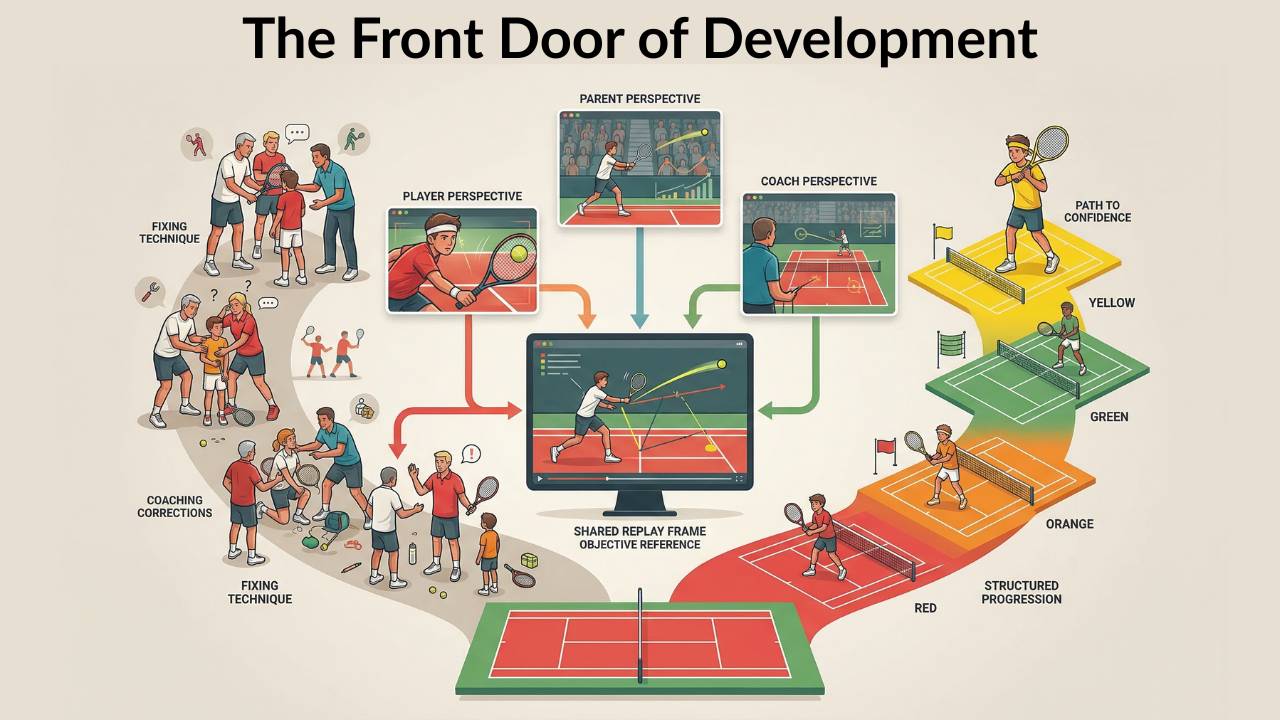
The Front Door of Development — Preface
Most coaches who have worked with elite junior players do not spend a lot of time thinking about Red Ball tennis. They have no reason to. The problems they are solving live at the other end of the pathway, where the margins are small and the pressure is real. If anything, the scaled game looks like someone else's concern, a recreational accommodation for programs that are not yet doing serious work.
That was essentially my position when I arrived at Samuell Grand Tennis Center in Dallas. My most recent experience had been working with two players who were among the best thirteen-year-olds in the country. One of them had won the Little Mo eights and then played up into the tens and won that too. The other had played Madison Keys in the finals of the girls' twelves on clay in a match that, by all accounts, could have gone differently. These players had learned tennis the traditional way, on a full-size court with a yellow ball from the beginning. And the system had worked. There was no obvious lesson from that experience that pointed toward scaled courts and slower balls.
What the experience at Samuell Grand taught me is that the lesson was never obvious. It was structural.
The facility I inherited had courts. It had history. It had the kind of civic prestige that comes from being the first public park to host a Davis Cup tie, which it had done in 1965. What Samuell Grand did not have, when I walked in, was a development pipeline. Players came, stayed for a while, and left. The next group arrived and the cycle started over. Coaches spent most of their time adjusting grips, rebuilding rally tolerance, and correcting competitive habits that had formed somewhere else under someone else's watch. The work was reactive by design, because there was no other option. When a program has no control over where its players come from or how they were introduced to the game, remediation is not a phase. It is the permanent condition.
At some point every program director recognizes that pattern and makes a decision about it. You can keep absorbing the cost of other people's incomplete development decisions, or you can decide to control the beginning of the pathway yourself. Those two directions produce fundamentally different programs and, over time, fundamentally different players.
The decision to build from the beginning forced a serious look at Red, Orange, and Green tennis. In the United States at that time, scaled tennis was still largely understood as a recreational tool, a way to attract younger children and give them an accessible entry point before moving them toward the real game. Most of the implementation reflected that understanding. The courts were smaller and the balls were slower, but the philosophy behind many programs had not really changed. Introduce the basics. Build some strokes. Progress toward the full-court yellow ball when the player was ready. The entry point was treated as a waiting room.
We approached it differently, and the reason was largely practical. If this was going to be the foundation of the program, we needed to understand what it was actually capable of, not what the conventional implementation suggested. So we invested in learning it properly. Kris Soutar, who had been part of Judy Murray's national development work in Scotland, came to Dallas. Mark Tennant, who runs Inspired to Coach and works extensively in international player development, came as well. Their purpose was not to run sessions. Their purpose was to help train our coaching staff to understand what the scaled game was designed to produce and why the design worked the way it did.
What we discovered was not what most coaches expect when they first encounter serious thinking about the scaled game. The smaller court and slower ball do not simply make tennis easier for a young child. They make the structure of the game visible earlier. On a full-size court with a yellow ball, the physics dominate everything. Young players spend most of their time managing where the ball is going rather than deciding what to do with it. The gap between where a ball lands and where it needs to be returned consumes the attention that would otherwise go toward reading the game. Scaled courts collapse that gap. Players begin rallying sooner, recovering space sooner, and recognizing angles and patterns sooner. They are not just surviving the environment. They are beginning to make the kinds of decisions that tennis actually demands, and they are making them years before those decisions would otherwise become available to them.
That realization changed the way the entry point of the program looked. It was not simply where beginners spent time before graduating into the real curriculum. It was the place where players either learned to read the game or learned to survive it, and whichever of those two things happened first tended to set the direction for everything that followed. Development systems rarely announce which path they are choosing. They simply produce players who behave accordingly.
The program at Samuell Grand was built on that understanding. The facility moved from one of the lowest-performing public tennis centers in the country to the 2014 USTA National Facility of the Year for large public tennis centers. That trajectory was not primarily about tennis instruction. It was about what happens when an entry point is designed rather than inherited.
This series is written for the program director who has spent enough time paying the remediation tax to know what it actually costs. Not just in hours, but in what a development program can become when it is permanently anchored at the wrong end of the timeline. The essays that follow examine the entry point of a junior tennis program as a developmental architecture problem, not a beginner accommodation problem. The question running through all of them is simple: when does a program actually begin, and who decides?
The answer to that question determines everything else.
Next: The remediation cycle and the choice between growing your own pipeline or inheriting someone else's incomplete work.
Never Miss a Moment
Join the mailing list to ensure you stay up to date on all things real.
I hate SPAM too. I'll never sell your information.
