Being Exceptional Requires Being the Exception
Oct 04, 2026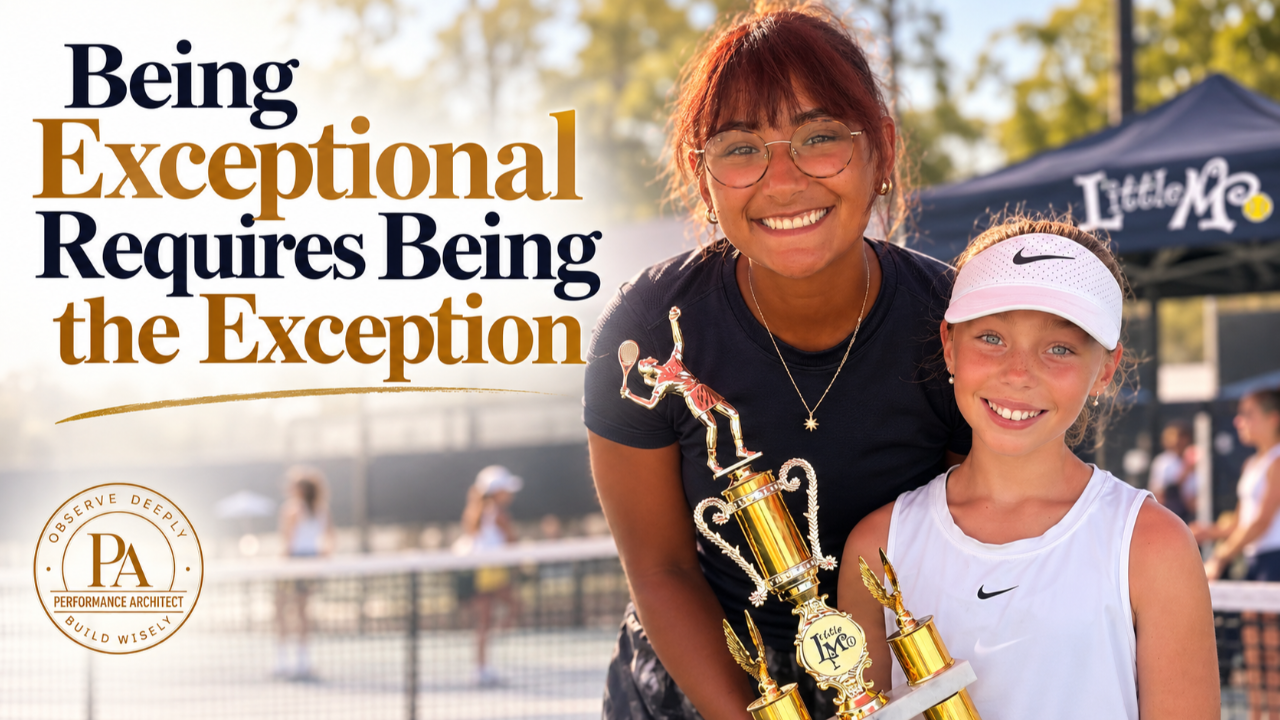
Last weekend, Little Mo Nationals came to Austin Tennis Academy. Before the pre-tournament clinic, the coaches met for a few minutes to get court assignments and a short list of instructions. One of them was almost too simple to say out loud. Learn the names of the players on your court, and you'll be good to go.
My daughter Rhia did.
That shouldn't be remarkable, and I doubt she thought it was. She had plenty else on her plate. Rhia was ATA's official coach for the event, which made her responsible for every ATA player entered in the draw. A clinic court full of kids from other programs could easily have felt like a side task. A national event puts kids from all over the country on unfamiliar courts with adults they've never met. It's exactly the kind of setting where a child turns into a name on a draw sheet. Rhia treated the kids on her court as people worth knowing, and over the next few days I kept catching her doing small things nobody had asked her to do.
Two girls from her clinic court ended up playing each other. Rhia watched. She didn't pick a side or decide that the girl she'd connected with was now hers to root for. She stayed neutral and acknowledged good tennis from both sides of the net. At another point, girls from her clinic were playing two matches on adjacent courts. Rhia found a spot where she could root for all four of them at once without becoming a distraction on either court.
Several parents from different parts of the country asked whether they could contact her after the tournament with questions about helping their daughters. Most had seen her work for only a short time. Parent interest doesn't prove coaching skill, but it does tell you people experienced something they wanted more of.
I've spent more than 35 years in junior tennis, and one habit I've built is paying attention to what doesn't happen as well as what does. Little Mo had brought many of the best eight- through twelve-year-olds in the country to the place where Rhia works every day. Every division is a single birth year, so tens play tens and twelves play twelves. The circuit that leads to Nationals is the only one of its kind in the country built that way. You weren't watching the best ten-year-olds mixed in with older kids. You were watching them against each other. Every court was a lesson in what outstanding kids actually do, as opposed to what adults say they should do. You could see which skills hold up under pressure and which ones break down.
What surprised me was how few coaches were simply watching.
I don't mean coaches parked behind a fence because their player was on court. I mean coaches watching because there was something to learn. A tournament tests the player, and it can calibrate the coach too. If I'm working with a ten-year-old who wants to be one of the best ten-year-olds in the country, I'd better know what the best ten-year-olds in the country look like. And if none of my players qualified, I might have more reason to show up, not less.
That's an essay worth writing someday. It isn't this one. This one is about the coach I couldn't stop noticing.
On the morning of the finals, James, an eleven-year-old ATA player, was playing in the Boys 11 consolation final. He was one of Rhia's players for the event, so she was courtside. At about the same time, the Girls 10 main-draw final was being played on another court. I texted her that I was sorry she might not get to see much of it.
"Meh," she wrote back. She'd already talked with both girls. They had played each other in the final at Regionals, and they were excited to see how this match would be different.
Her next text said she had emailed the coaches and Jack Newman, ATA's CEO, to let them know James was playing his final. "Hopefully we have enough pride for ATA that some of the coaches come show support."
Being at James's match was her job. Trying to fill the fence around it wasn't. I wrote back, "You are too cool for school."
A few minutes later another message arrived. She had asked two 16-and-under girls from ATA College Prep whether anyone in their group was friends with James and could stop by to give him a shout. Then came the line that made me smile.
"We need ATA support!! It's OUR house!!"
That's when I realized I wasn't just watching her watch tennis. I was watching her think about what a place should feel like.
James wasn't playing for a national title. He was in the consolation final, and the older girls didn't need to know him well. None of that seemed to matter to her. He was an ATA kid playing a final at ATA, and she wanted the people around him to make sure he felt it. It's easy for an academy to split into separate arrangements that rarely touch. What Rhia was reaching for ties them together, so older players know younger ones exist and an eleven-year-old in a consolation final can look outside the fence and see his academy looking back.
I don't want to lose that by turning it into a grand theory of coaching. Nothing Rhia did last weekend was dramatic. On the clinic court she learned names, and afterward she kept showing up for those kids, whether they were playing each other or playing side by side. She talked with two girls about a rematch she wouldn't see. Once James's match started, she went looking for more people to be there with him. None of it amounts to much by itself, but together it starts to look like a pattern. Nobody puts any of it on a coaching résumé, and maybe that's part of what fascinates me.
I've written before about *The Credential I Didn't Count*. Rhia grew up inside a developmental environment. She was around players and coaches long before anyone would have called what she was absorbing professional preparation. She coached little kids and saw a tennis program from almost every angle without following the path that makes a résumé look ready.
I'm starting to think I may still have been looking in the wrong place. Maybe another credential I've been undercounting isn't what she knows. It's what she notices.
She notices the player nobody assigned her to watch and the history two girls share across a net. She notices that an eleven-year-old might glance outside the court, and that older players can help a younger one feel he belongs to something. No stroke or certification covers any of that. These are habits of attention, and I'm enormously proud of my daughter for them.
I want to be careful about what I claim. I'm not ready to call her an exceptional coach. She's young and has a lot to learn, the same as every coach worth learning from. What I am saying is simpler. I keep catching my daughter doing things I wish I saw more coaches doing.
We usually recognize exceptional people after the results come in. Someone produces unusual outcomes, and we work backward looking for the reason. We find that they watched when others didn't or went where nobody required them to go. Once the outcome is known, those behaviors look obvious. Before it arrives, they just look different.
I don't know what kind of coach Rhia will become, and in some ways I'm glad I don't. She's apprenticing with me, but she isn't becoming the coach I would have designed. She's becoming herself. What I do know is what I saw last weekend. She learned the names, and then she made sure an eleven-year-old playing a consolation final at his own academy could feel it really was his house.
I'm her father, so I'm allowed to be proud. I'm also someone who has spent most of his adult life thinking about how people develop, and the things that eventually make someone unusual often begin as small choices that look unnecessary to everyone else.
Being exceptional requires being the exception. My daughter is increasingly willing to be one.
Never Miss a Moment
Join the mailing list to ensure you stay up to date on all things real.
I hate SPAM too. I'll never sell your information.
