Bronson Alcott's Problem Was Bronson Alcott
Oct 03, 2026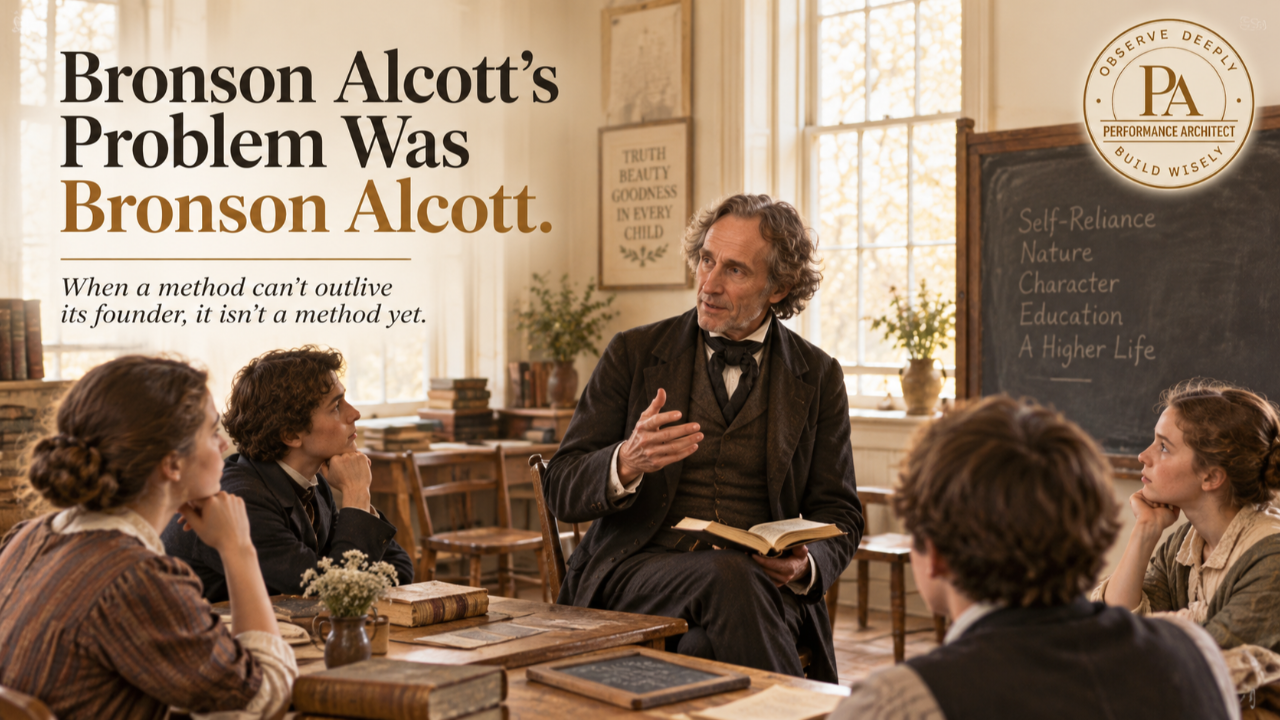
For years I thought I understood why the Temple School failed. Money was thin. Boston in the 1830s wasn't waiting for Bronson Alcott to reinvent childhood. His conversations about religion produced enough scandal to drive families away. Money tightened, and other conflicts followed, until the experiment collapsed. I had spent enough time with the history that none of it felt incomplete.
Then I started reading my own transcripts, and the question that came back wasn't why the Temple School ended. It was whether Alcott had ever built a room capable of surviving him. That's a different problem.
The first four essays in this series were about pointing an instrument at the adults in a developmental room. The next two were about what the instrument could tell me, and what it couldn't. I found I was taking up more space than I thought. I found a format that couldn't do everything I was asking of it. I found a daughter whose preparation didn't look like the résumé I'd have expected, holding the room in ways I couldn't. I found a narrow moment where expertise takes ownership back from the person who just produced something, and then I started asking what any of it actually entitled me to conclude. Somewhere in all of that, Bronson Alcott started looking different to me.
The Temple School depended enormously on Alcott being Alcott. That isn't criticism, and it may have been necessary at the beginning. Somebody has to see the thing before it can be built, and hold a room differently enough that other people recognize there's another way to hold one. Alcott brought an unusual mix of conviction and curiosity and a willingness to treat children as minds worth engaging rather than vessels worth filling. He had to embody the method before anybody could codify it. Founders do that. The problem comes later, when the thing has to stop being indistinguishable from the person who invented it.
I hadn't thought much about that when I began these classroom sessions at Austin Tennis Academy. The idea for that room didn't come from a coaching seminar. It came from years spent studying the Temple School itself, and I wrote the principles because I already knew what I wanted. Players should do most of the thinking and much of the talking. Adults should ask questions, listen, resist filling every silence, and hold off on answers players hadn't had a chance to build themselves. I could describe the room pretty well. Then I discovered I wasn't particularly good at running it, which should have bothered me more than it did. The more I looked at it, the more interesting it got.
Rhiannon could run the room without me. She didn't have the same long tail of explanations I did after a player produced something useful, and she seemed less compelled to turn every good answer into a teaching opportunity. I wrote the principles. She was instantiating them. At first that looked like evidence against me. Eventually I started wondering whether it was evidence for the method.
A method that only works when its inventor is standing in the room is not much of a method yet. The word that matters is yet. There's nothing wrong with a thing beginning as performance, and most new systems probably do. The founder knows where the edges are before the edges have names. He sees exceptions nobody has written down and changes direction because something in the room feels wrong, and if you ask him which rule told him to change it, there may not be one. That kind of knowledge is real. It's also dangerous if it never becomes transferable. An organization starts saying things like you have to watch Duey do it, which sounds like a compliment until you notice what it actually means. It means the system hasn't been extracted from the person, and the founder is still carrying part of the operating system around in his own nervous system. If he leaves, the missing code leaves with him.
I wonder now how much of the Temple School lived there. Not whether Alcott had principles. He clearly did, and people around him understood some of them. One of his assistants, Elizabeth Peabody, published a record of the school while it was still running, so the ideas were already being written down in real time. That proves the ideas could travel. It doesn't prove the room could run without him, and that's the harder question: whether the method ever became separable enough from Alcott's presence that another person could reproduce the experience without impersonating Bronson Alcott. I don't know that the historical record answers that cleanly, and I don't want to turn a genuinely complicated institutional collapse into a single-cause story. Money, scandal, and cultural resistance all mattered, and so did some of Alcott's own decisions. That's not what I'm arguing away. I'm saying I now see something else sitting inside the same story that the funding-and-scandal version never named. Succession, not in the corporate sense of naming the next person in charge, but in the developmental sense of asking whether the thing can pass through another human being without losing what made it the thing in the first place. That's a harder test, and it may be the one founders avoid longest.
There's a particular comfort in believing the work needs you. If nobody can do it quite the way you can, your continued presence becomes evidence of your own importance. You're not merely the person who designed the architecture. You're the load-bearing wall, and that can feel like success. It may actually be unfinished design.
This runs well past tennis and past schools. Restaurants built around one chef. Companies where the founder approves every meaningful decision. Families where one parent carries every piece of invisible knowledge required to make the household work. The person becomes indispensable because the knowledge never becomes infrastructure, and eventually everybody pays for that.
The most surprising thing in these transcripts is that the first evidence I may have built something real isn't my ability to run the room the way I imagined it. It's that somebody else can, and that she brings something to it I didn't put there myself. Rhiannon didn't reproduce me. She grew up around my system and absorbed pieces of it. Then she spent years in other developmental environments and came back with habits I might never have developed on my own. The result isn't a copy, and that may be the point. A method should survive contact with another person. It should be strong enough to keep its principles and loose enough to let somebody else bring judgment to them, which is a much higher bar than writing a curriculum.
It also changes what I think the founder's job eventually becomes. He doesn't prove the method by remaining the best person in the room forever. He proves it by making himself progressively less necessary to the room. I don't know whether Bronson Alcott ever got that chance. The Temple School may have collapsed before the question could really be tested.
I know I have it. And the tape has given me an uncomfortable way to recognize it. The person who wrote the method may not be the person who should keep holding the room.
That isn't failure. It may be the first sign the method is finally becoming one.
Never Miss a Moment
Join the mailing list to ensure you stay up to date on all things real.
I hate SPAM too. I'll never sell your information.
