Discipline Over One's Mind Is the Ultimate Quest
Jun 10, 2026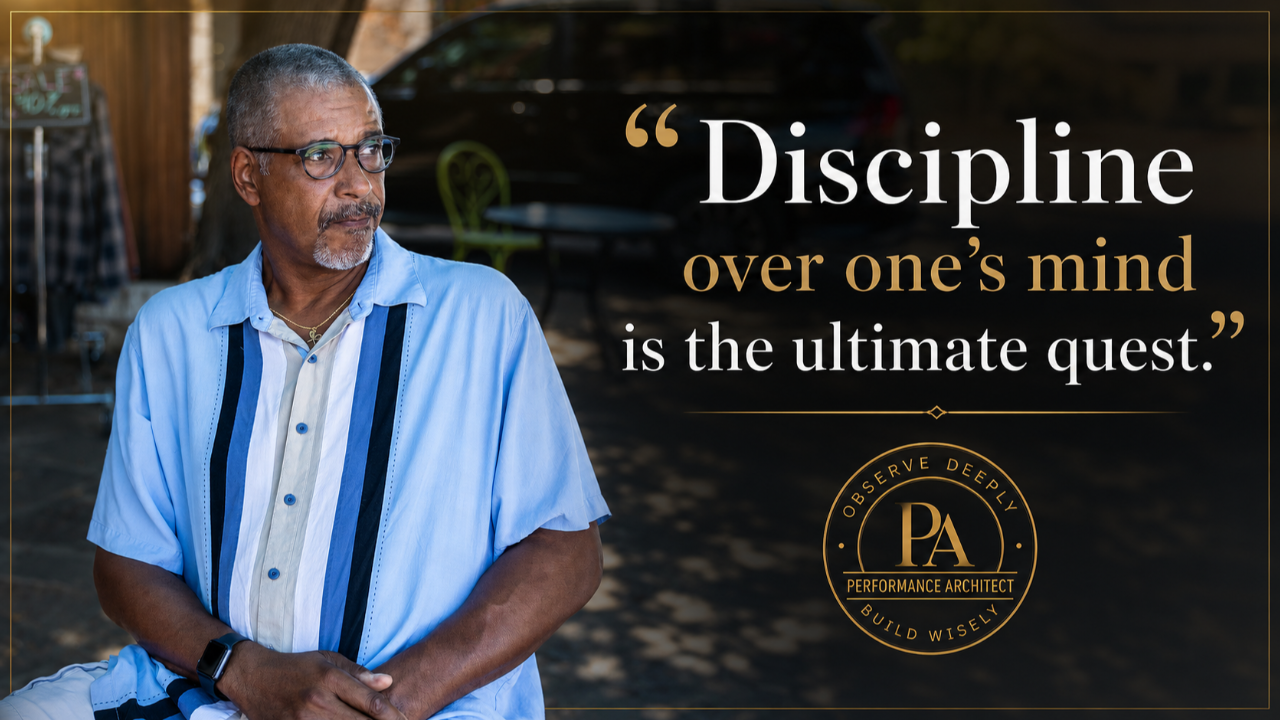
When I think about discipline over my own mind, the first thing that comes to me is Denzel Washington playing Malcolm X. Not an athlete, not some performance-psychology diagram, but an actor inhabiting a man who rebuilt himself from the inside out. I've watched that performance more times than I can count, and what gets me isn't the speeches. It's the stillness underneath them. You're watching a man who has already done the interior work of deciding who he's going to be, and then it hits you that Denzel had to find that same governance in himself to play it at all. Discipline portraying discipline. That double exposure is what stays with me.
For most of my life I assumed the hard work was out there somewhere. The building, the persuading, the hauling around of obligations that don't care whether you slept the night before. That's where I figured the difficulty lived. I got reasonably good at it. But the older I get, the more convinced I am that the real work happens in a much smaller space, somewhere behind my eyes, in the gap between what arrives and how I choose to answer it.
I've taken to calling it drift, the way the mind wanders off from where I actually need it to be, usually without bothering to ask my permission first. I talk about it constantly now, probably too much, and here's the strange part: the more I talk about it, the more I catch myself doing it. That used to bother me. Now I think it's the opposite of a problem. It's the thing that happens when you buy a new car and suddenly that same car is at every light, in every lot, coming the other way on the highway. The cars didn't multiply overnight. You just started seeing what was always there. I'm not drifting more than I used to. I'm finally noticing.
And I suspect, though I can't prove this and only feel it in my bones, that the noticing runs out ahead of the change. The catching shows up first. The drift starts thinning out behind it, quietly, where you're not looking. So when I tell you I keep catching myself, what I'm actually describing is progress wearing the costume of failure.
What I didn't expect was how much of this I'd learn by watching other people. I spend my days reading the state of whoever's in front of me: where their attention slipped off to, the exact moment they checked out, the little tell that surfaces a half-second before they even know it's happening. You do that a few thousand times and it sharpens something you can't switch back off. You can't name a pattern in someone else that often and stay blind to it in yourself. The eye I built for them eventually turned around and looked at me, and it has never fully looked away since.
The old trap was different, and it nearly passed for virtue. I'd drift, catch it, then spend the next twenty minutes prosecuting myself for having drifted in the first place, which is, of course, its own kind of drift, just dressed up as responsibility. Standing over yourself like a disappointed parent doesn't produce ownership. It produces somebody who's gotten very accomplished at feeling bad and not one bit better at coming back.
What actually works is plainer than that, and a little boring. I notice it. I name what happened, no verdict attached. Then I come back to whatever's in front of me. Some days I catch it early enough that almost nothing gets lost. Other days it's already run off with a whole conversation before I clock it, and I come back late, which still counts for something.
Most of my talking these days happens in front of rooms full of young people, and the irony isn't lost on me that I'm usually up there to talk about drift itself. That everybody does it, mine included. That the wandering was never the problem. That the work is in catching the departure early enough to turn yourself around before it runs off with the whole afternoon.
I used to be genuinely bad at the thing I now teach. When I spoke I'd go off on these little walkabouts, tangents that felt wonderful at the departure gate and then left me stranded somewhere with no memory of how I'd gotten there, let alone how to get back. So I started hanging hooks. I'd say it out loud, right in the middle of the talk: "I'll come back to this." That sentence was a stake in the ground, something to navigate home by later. A crutch, plainly, and I knew it was one. It worked because I didn't yet trust myself to find my way without it.
I don't hang the hooks anymore. Somewhere along the line I started catching the departure while it was still happening instead of noticing three exits down the road, and once you can feel yourself leaving, you stop needing to scatter breadcrumbs to find the way back. The crutch just quietly retired itself. What replaced it is the part I never saw coming. Now when I wander, I mostly do it on purpose. The drift turned from something that happened to me into something I reach for.
And in front of those kids, it's the best instrument I own. I don't tell them everyone drifts. I let them watch me do it. I'll slip off on a small tangent mid-sentence, catch it in front of the whole room, and say it right out loud: see, I'm doing it right now. Watch. There it goes, and here's me, finding my way back.
Never Miss a Moment
Join the mailing list to ensure you stay up to date on all things real.
I hate SPAM too. I'll never sell your information.
