Don't Rescue the Silence
Jun 13, 2026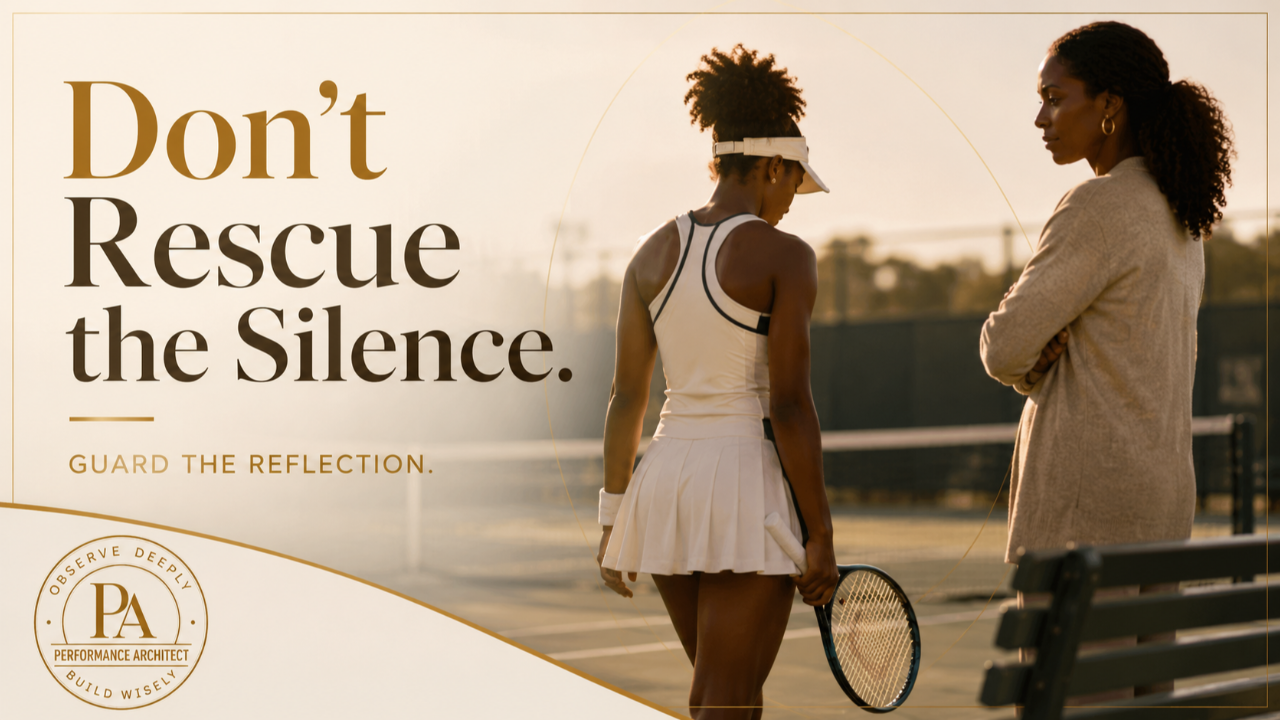
This essay ends with a call to action for the free Parent Pause Guide.
The match just ended. Your kid is walking off the court. You've read the articles, listened to the podcasts, maybe even talked to a coach about this specific moment. You know you're supposed to give them space. You know the first thing out of your mouth matters. You know all of that, and you're still not sure what to do with your hands.
I know this because I'm the one who's been writing about it, and I still got up and walked around the corner during my own kids' matches.
My children played junior tennis. One of them played at a high level before a string of injuries changed the trajectory heading into high school. During those years I spent entire matches mentally redesigning my program from the other side of the fence, sent texts to the tennis center while my kid was mid-match, and walked around the corner more than once when I couldn't handle what I was watching. And when my kids looked up and found an empty chair, what they made of it was that Dad was upset. What followed was drift. Not because anything on court had warranted it. Because I'd become the loudest thing in the environment without saying a word.
That is what most parents get backwards. We think the problem is saying the wrong thing after a match. The actual problem is the belief that saying something is our job. It isn't. The job is guarding the player's first few minutes of reflection, which is different from filling them.
Player agency gets usurped not by cruel parents or bad coaches, but by well-meaning adults who believe the quality of their support is measured by the quality of what they say. Coaches fall into this too. Most coaches feel they're being paid for what they say, not for the silence they protect, not for the space where a player goes looking for the answer inside their own head. The result is that kids learn from a young age that what the adults say must be what matters. After enough of that, they stop searching inward and start waiting for the verdict from outside.
One place this shows up clearly is the difference between an execution error and a decision error. A player hits a forehand line ten times in a row and misses eight. The parent sees it. The parent knows what happened. So the question in the car ride home becomes "Why did you keep going to your forehand line when you were missing it?" There's a question mark on the end, but nobody in the car is confused about whether that's actually a question. It's a verdict with punctuation. And nine times out of ten, the player was trying to do exactly what the coach asked for. They just don't have the skill yet to execute it cleanly. What they needed wasn't a verdict. They needed someone who could sit in the uncertainty with them long enough for them to locate their own read on what happened.
That's where "I don't know" comes in, because "I don't know" is not a dead end. It's the beginning of a search. When a player says it after a match and the adult treats the silence that follows as a cue to jump in, the door closes before anything useful gets through. The instinct is to rescue the player from not knowing, to hand them the answer they couldn't find. But that rescue is exactly what teaches them to stop looking. Don't pollute the reflection. Don't rescue the silence. Those two sentences are more instruction than they sound like, and they're hard in the same way that walking around the corner is hard, because they require the adult to believe something that doesn't come naturally: that the player's search for the answer is more valuable than the adult's possession of it.
I spent a decade living with a trained communications coach and media trainer. One of the things she taught, over and over, was the pause. She'd have people record themselves speaking, tell them to pause deliberately, and then watch the footage back. What every person discovered without exception was that what felt like an uncomfortable eternity of silence was barely visible on playback. The pause that felt like it had gone on so long that people must think something was wrong lasted, in reality, maybe two seconds. You could sit in silence far longer than you think is socially acceptable and nobody in the room would register it as anything unusual. The silence we fear is much larger in our own heads than it ever is in the room. Tennis parents need to know this, because sitting inside that pause after a match is exactly what we're asking them to practice.
One of the parents working with our current cohort told me something during onboarding that I keep coming back to. She said she'd stopped talking to her son after matches entirely, not because she didn't care, but because she'd had no understanding of where she could be in that space without the interaction becoming something her son Avi had to manage on top of everything else. She said thank you during the Zoom call. Not because anyone had told her to love her kid less. Because someone had finally given her a role that made sense.
That's the reframe this piece is trying to offer. Not step back and stay out of it. Not your child doesn't need you. The actual role is specific: guard the reflection. Ask real questions, ones where you genuinely don't know the answer and the player has to go find it. When they say "I don't know," wait. When the silence feels long, let it run a little longer. When they say something that surprises you, follow it rather than redirect it toward what you already believe happened.
Two questions worth practicing: "What were you trying to do?" and "When was it harder to do that?" Ask them in that order. Wait between them. Those two questions, with real silence between them, send the player back inside their own experience, which is where the useful information lives. They are more valuable after most matches than anything else a parent can say.
Coaches aren't off the hook here. I was recently discussing a moment from the NCAA with another coach, a match where a coach came onto the court after every single dead ball with something to say. And I thought about the player who never once got to ask themselves what they thought, who never got to reach for the answer on their own, because the answer was delivered from outside before the inside had a chance to form one. That player may be very good. They are not being developed.
Player agency doesn't get protected automatically. It gets protected by adults who understand that their job in the minutes after a match is different from their job at practice or before a tournament. The match just gave the player feedback. Your job is to make sure they actually receive it before you translate it for them. The translation can come later, and often it doesn't need to come from you at all.
The Parent Pause Guide walks through this in practical terms: what to say, what not to say, and how to sit in the silence that always feels longer than it is. It's free. You can get it by emailing me directly at [email protected]. If you've ever walked around the corner, or said the thing you swore you wouldn't say, or watched a good post-match conversation become an interrogation without knowing quite how it happened, this is the resource I wish I'd had when my own kids were on that court.
Never Miss a Moment
Join the mailing list to ensure you stay up to date on all things real.
I hate SPAM too. I'll never sell your information.
