Drift Isn't the Problem. Not Noticing Is.
Jul 25, 2026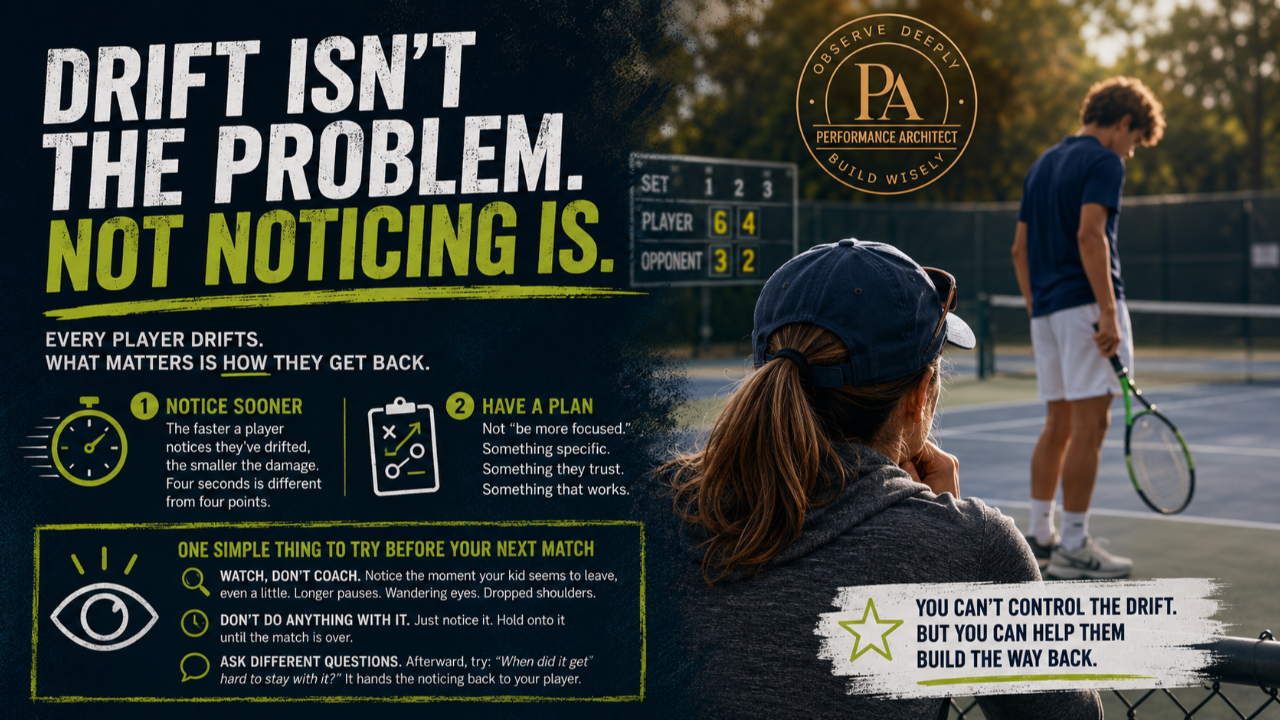
You're watching your kid play a match, and somewhere around the middle of the second set, something changes. The shoulders that were locked in an hour ago start to sag a little between points. The eyes that used to snap back to the baseline after every rally start finding other things to look at, the next court, the parking lot, you. Nothing dramatic happens. No big miss, no obvious blowup. Just a kid who was fully there ten minutes ago and now seems to be playing from somewhere a little further away.
Most parents read that as a mental toughness problem. Something is wrong with the kid's focus, or their conditioning, or their competitive fire, and if you could just find the right pep talk or the right sports psychologist, it would go away for good. That read is understandable. It's also wrong in a way that costs families real time and real money chasing a fix for something that was never actually broken.
Here's the thing coaches who've spent real hours on a court already know and rarely say out loud to parents: every player drifts. Not some players. Not the ones who need more mental toughness. All of them, at every level, in every match. This summer, in a room full of kids I coach, I said it about as plainly as I know how to say it: everybody drifts, and if you tell me you don't, you're lying, and if you think you're the only one who does, you're wrong about that too. It's not a confession. It's what attention does over two or three hours under pressure, with another person a few feet away trying to make you feel worse.
So if drifting isn't the problem, what is? Two things, and they're both fixable in a way "be more focused" never was. The first is how long it takes a player to notice they've drifted. The second is whether they have anything specific to do once they notice. A player who drifts for four seconds and catches it is in a completely different match than a player who drifts for four points and doesn't. Same lapse in attention. Different outcome, because one of them has a way back and the other one is just hoping it passes on its own.
That's the part parents can actually help with, and it has nothing to do with coaching technique.
Here's the one thing to try before your next match. Don't watch for mistakes. Watch for the moment your kid seems to leave, even a little, even for a few seconds. You'll probably catch it: a longer pause than usual before serving, eyes that stop tracking the ball between points, shoulders that drop. Don't do anything with it in the moment. Just notice it, the way you'd notice the weather changing, and hold onto it until the match is over. Afterward, instead of asking what happened out there, try asking when it got hard to stay with it. That question does something a lecture never will. It hands the noticing back to the player instead of doing it for them.
That's a small shift. It won't rebuild anyone's mental game in one weekend. But it's the actual starting point, not the expensive version, not the version that requires a specialist, just the version that starts with watching for the right thing instead of the wrong one.
Never Miss a Moment
Join the mailing list to ensure you stay up to date on all things real.
I hate SPAM too. I'll never sell your information.
