Duey the Queer Duck
Dec 15, 2025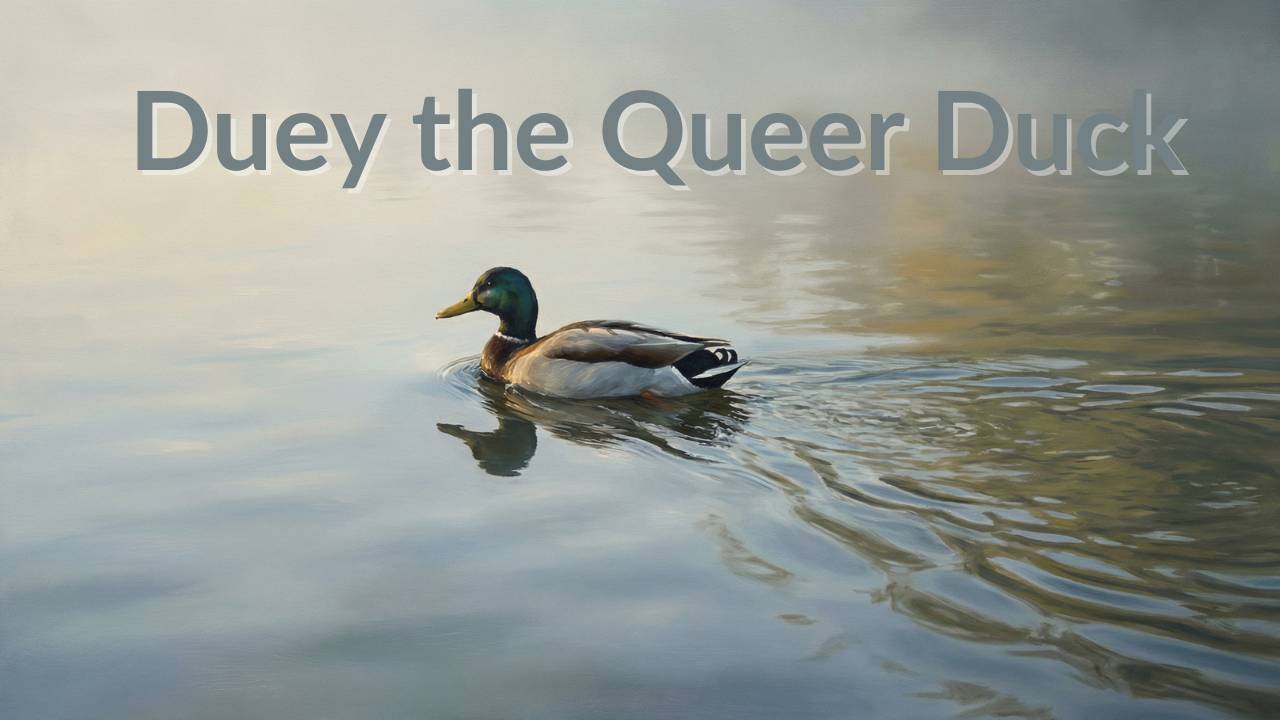
I have been a misfit for so long that it took most of my life to realize it was not a phase.
The word that finally fits is old fashioned and slightly uncomfortable. Queer duck. It does not mean what it means now. It means strange. It means difficult to place. It means belonging without fitting. The kind of creature that moves between environments without ever being fully at home in any of them.
I use the name because I wish I were a Renaissance Man. Using a term no longer commonly spoken feels like it fits. It is a subtle play on words. My dad would appreciate that.
I am Duey. That has been my name since birth. Not a brand. Not a reinvention. A nickname given before I had opinions or plans or defenses. My father loved Donald Duck. That detail matters more than it should. Names are small things that carry more than they appear to.
Donald Duck's nephews were Huey, Dewey, and Louie. I grew up as Duey. Close enough to matter. Far enough to be mine.
Those nephews were not the chaos. They were the observers of it. Donald exploded. They conferred. They watched systems fail and quietly figured out how to survive them. That distinction would take decades to surface in my own life, but it was always there.
For most of my early years, I did not follow the path my temperament suggested. I chose sports. I chose parties. I chose popularity. I chose the path that made sense socially, even if it did not make sense internally.
My first sport was baseball. I had baseball cards in my bicycle spokes, a transistor radio over one handlebar and a glove over the other. There was also football, basketball, track, hockey, and skiing. Sports gave me permission to be intense without being strange. They gave me a language that others understood. They gave me belonging.
What sports did not give me was space to observe. Or rather, they gave me observation without articulation. You can see patterns on a court. You can feel momentum shifts. You can sense psychological collapse before it becomes visible. But you are not rewarded for naming those things. You are rewarded for winning points.
I became very good at translating complexity into instruction. That skill paid the bills. It also slowly narrowed my conversational world.
For more than three decades, my primary interlocutors were teenagers and preteens. Bright kids. Motivated kids. Kids who needed answers, reassurance, structure, and belief. Parents came with questions shaped by anxiety and hope. Administrators came with logistics. Everyone wanted something from me. Very few wanted to explore anything with me.
I learned how to talk about pronation on a serve in my sleep. I could discuss footwork patterns, match tactics, tournament scheduling, and recruiting pathways endlessly. What I could not do was talk about the things that actually animated me without watching eyes glaze over.
Over time, I stopped trying.
That is how an extrovert becomes quiet. Not because the energy is gone. Because the return on investment is too low.
Extroversion is not about crowds. It is about thinking aloud. It is about discovering what you believe by testing it against another mind. When that testing is absent, the mind does not go silent. It loops.
My current life looks solitary from the outside. It often feels solitary from the inside as well. I do not wonder what to do on weekends. The answer is always the same. I sit alone and dive deep into something that has captured my attention. A subject. A series. Sometimes a bottle of wine.
This is not despair. It is not crisis. It is structure.
I intake information from sources I find credible and interesting. I write about ideas that demand deeper discussion. Those writings are read by hundreds of people every day. Sometimes more than a thousand. They sit with the ideas quietly. Or they discuss them in their own circles. Very rarely do they come back to me.
This creates an open loop.
The writing moves outward. The resonance moves sideways. Nothing returns.
That open loop is tolerable for a while. It becomes corrosive over time. Not because of lack of attention, but because of lack of resistance. Ideas sharpen through contact. Without contact, even good thinking begins to circle familiar ground.
I have almost zero tolerance for surface level conversation. That is not a value judgment. It is a nervous system reality. Phatic talk, the kind designed to maintain social cohesion rather than exchange meaning, does not warm me up. It shuts me down.
When given the choice between shallow interaction and silence, I choose silence. That choice looks like reclusion. It is actually triage.
Looking back, this was never new. I once described myself as the perfect dinner party guest who had never been invited to a dinner party. I know enough about many things to find my way into almost any serious conversation. I am genuinely inquisitive. When I sense passion and depth in someone else, I lean in. I ask questions. I keep asking. I enjoy extracting clarity until the other person has nothing left to give.
That does not make for balanced social evenings.
Most gatherings are optimized for circulation, not depth. I destabilize rooms by staying with one thread too long. Hosts sense that instinctively. Even when they like me.
So I learned to sit out.
There is a counterfactual version of my life that still visits me. Had I chosen a different path earlier, I would likely be wealthy. Not because I am smarter than others, but because my kind of eccentricity becomes legible when paired with capital. The difference between eccentric and crazy is often the number of digits before the decimal point in a bank account.
Money retroactively confers sense.
Still, wealth was never really the fork. Institutional legibility was. I optimized for meaningful work in a system that priced visible outcomes. That trade was invisible while I was busy. It only became obvious later, when optionality narrowed.
I do not romanticize this. I do not believe suffering makes ideas better. I do not believe isolation is noble. I believe it is costly.
My middle daughter's old room has become my upstairs office. I already have two downstairs I rarely work from. When I wake up, I simply stroll down into what used to be called Rhiannon's Wing, close the door and only get up when my Apple Watch says I should. And not even always then.
I am a queer duck. Not broken. Not superior. Poorly matched to most default social architectures.
I do not need more people. I need contact that can survive pressure. Reciprocal friction. Dialog where silence is a failure mode and pushback is the currency.
Those encounters are rare. They do not scale. They tend to happen sideways, late, and irregularly.
Until they do, I will continue to write. Not as performance. As signal. As a way of keeping the loop partially alive.
This is not a conclusion. It is a naming. Sometimes naming is enough to stop mistaking structure for pathology.
I am Duey.
The queer duck.
Still swimming. Still watching. Still waiting for water that moves.
Never Miss a Moment
Join the mailing list to ensure you stay up to date on all things real.
I hate SPAM too. I'll never sell your information.
