Fifteen Minutes Not Hitting Balls
Sep 10, 2026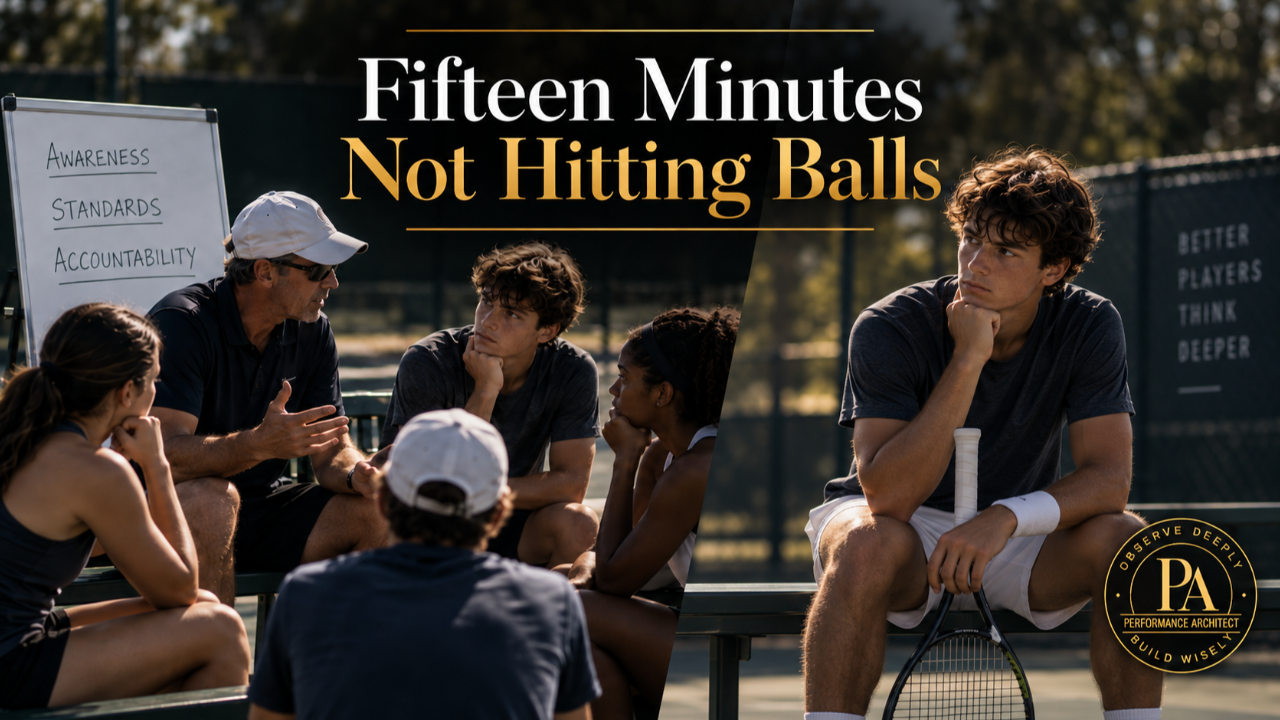
One of our players said something during the first week of classroom sessions that I suspect a lot of tennis players would agree with.
He didn't want to be in there. He wanted to be outside hitting balls.
I understood the argument. If you come to a tennis academy to become a better tennis player, sitting in a room for fifteen minutes can feel suspiciously like time you're not becoming a better tennis player. There are courts right outside the door. There are coaches. There are baskets of balls. Every minute has an obvious alternative use.
Hit another forehand. Work on the serve. Play another point. Get another rep. Those things look like development.
Sitting in a chair talking about awareness doesn't always look like development. That may be part of the problem.
We have become very good in tennis at recognizing the work we can see. A player hits fifty serves and we know something happened. A coach moves a player through a technical progression and we can watch the stroke change. Put eight kids on a court, organize a drill, keep the balls moving and everybody looks busy.
Busy has always photographed well. Reflection doesn't.
There is no satisfying sound when a player recognizes something about himself for the first time. No ball leaves the strings differently because a player finally understands why he keeps losing focus at the same point in practice. You can't count the reps when somebody hears a teammate describe accountability in a way he hadn't considered before.
But if the first two essays in this series have led me anywhere, it is toward a question I don't think I can avoid.
What if some of the work that determines whether tennis training transfers doesn't look much like tennis training?
The classroom sessions at Austin Tennis Academy this year are only fifteen minutes. Mondays and Wednesdays I'm usually in there. Tuesdays and Thursdays Coach Rhiannon takes the lead, although other coaches can rotate through. Rhiannon has a teaching background, and from the beginning she made clear that her room wasn't going to be fifteen minutes of another adult talking at players who had already spent much of the day being talked at.
She wanted conversation. Her approach is essentially Socratic. Put a question on the board. Ask somebody to start. Let the players respond to one another. Agree. Disagree. Give an example. Challenge the example. Try to make the idea fit something that happened on court. She'll guide the conversation, but she doesn't want to own all of it.
That distinction became more important to me than I expected.
One day that week, Rhiannon was out helping with fitness training, and I ended up leading the session she'd already planned. I hadn't seen what she'd put on the board. I found out at the same time the players did. The subject was awareness and accountability, part of the same conversation that eventually produced the question behind the previous essay: can you have accountability without awareness?
At one point the discussion moved to standards.
Should a player hold himself to his own standard or the standard of the group?
There wasn't immediate agreement. One player argued that everybody is at a different place and may be working on different things, so individual standards matter. Another pushed back with a pretty good question: what if someone's personal standard is simply to have fun?
Now we had a problem worth discussing.
I gave them the answer I use for almost everything.
Depends.
Then comes the question that actually matters. Depends on what?
We worked our way toward the possibility that maybe you hold yourself to whichever standard is higher. If your own standard asks more of you than the group does, don't lower it. If the group is asking more than you're asking of yourself, maybe the group should pull you upward.
Then another player went back to the original question about accountability and offered something I hadn't been thinking about at all. He said accountability could mean being someone your teammate can rely on because your teammate knows you'll hold yourself to a certain standard.
That changed the conversation. We had started with something that sounded individual: hold yourself accountable. Now one of the players had turned it into a relationship. My standard affects whether somebody else can trust me.
I remember telling the group it might have been the best classroom discussion we'd had to that point. Not because they had reached the answer I wanted. I wasn't sure there was one. It was good because they were doing the work. That's an important distinction.
Coaches spend enormous amounts of time supplying players with answers. We tell them where to stand, what ball to hit, how high over the net, what the score means, where their toss is drifting, whether they are rushing, what pattern the opponent is using, what their emotional response looks like between points.
Some of that is simply coaching. But in the last essay I wrote that the developmental goal can't be for the coach to remain the player's permanent warning system. Eventually the player has to become better at noticing, interpreting and responding to information without waiting for somebody outside the court to do it for him.
If that's true, then we have to ask where those abilities get practiced. Not where we explain them. Where the player practices them. Maybe one place is a room with no tennis balls.
When Rhiannon asks a question and doesn't immediately answer it herself, the players have to search for something. They have to figure out what they think. Then somebody else offers a different answer and they have to decide whether that changes anything. That's a rep.
A player says awareness means knowing what's happening around you. Somebody else shifts it toward self-awareness. Another talks about knowing your tendencies. Another connects those tendencies to his style of play. Somebody makes a distinction between awareness of an opponent and awareness of yourself.
Those are not forehand reps. They're judgment reps.
The distinction matters because development isn't only the accumulation of correct responses. At some point a player has to learn how to produce a response when the correct one hasn't already been supplied.
A match doesn't present itself as a worksheet. Nobody tells you, "This is the moment when your attention is beginning to drift." The opponent doesn't announce that the pattern from the last four points is about to repeat. There isn't a coach standing next to you saying, "The information that matters right now is this piece, not those other five." Competition is messy. The player has to find signal inside noise.
That is part of what bothered me in the last essay about the phrase "hold yourself accountable." If we've given a player five technical reminders, two tactical intentions and a behavioral goal, then sent him into a two-hour practice after a full day of school, we've given him information. We haven't necessarily helped him decide what deserves his attention.
The classroom can become one place to practice that distinction. Not by teaching players another list. By making them sort: what awareness means and why it matters, whether accountability is personal or affects your teammates, whether your own standard should govern you or the group's, whether integrity can exist if somebody has to keep reminding you.
I don't need every group to arrive at the same answer. In fact, I think the room loses something if they do. The value may be in having to build an answer, hear another one, test both and decide what survives. That starts to sound less like a break from development and more like development of a different kind.
Coaches don't just teach players skills. We create environments. A traditional tennis environment makes certain behaviors easy to recognize, because so much of the thinking has already been done for the player: the basket is there, the drill has a purpose, the coach gives the instructions, the court sets the boundaries, the rotation tells him where to go next.
That isn't necessarily bad. It is often exactly what teaching requires. But the first essay in this series was about what happens when the environment stops prompting the behavior. The second was about what happens when the coach sees something the player hasn't learned to see yet. Both problems point toward the same developmental challenge.
At some point we have to give the player more of the thinking. That doesn't happen simply because we want it to. You can't spend years providing every answer and then become frustrated when the player waits for an answer. You can't make every decision, identify every problem, interpret every experience and then expect independent judgment to appear on tournament Saturday.
If we want players who can think, we probably have to create places where thinking is part of the training. That thinking can happen on court, and it should. It can happen in the debrief after a match, or through a Training Card or Match Card when a player has to put an intention into words. And sometimes it happens during fifteen minutes when the racquet is sitting somewhere else.
I don't want to romanticize the classroom. Fifteen minutes with young athletes after school can be messy. Some groups talk easily. Some stare at you. Some want to make each other laugh. Some would absolutely rather be hitting balls.
The player who said he'd rather be outside wasn't wrong to feel that way. He was describing what tennis development has taught him to recognize as valuable.
Court equals work. Ball equals work. Coach feeding equals work. Conversation is harder to classify.
Maybe part of what we're building this year is a broader definition of the work. If a player becomes better at recognizing drift because he has had to think about what drift feels like, if he learns that accountability isn't simply a coach catching him doing something wrong, if he begins to distinguish between the information available to him and the information that actually deserves action, if he hears a teammate describe a standard in a way he hadn't considered and carries that idea onto a court, all of that matters.
None of those outcomes replace hitting balls. They may help determine what happens to all the things we're teaching while the balls are being hit.
That's the distinction I'm starting to see. The classroom isn't valuable because players need more information. Most of them already get plenty. It may be valuable because they need places to turn information into understanding.
And if the developmental handoff eventually asks the player to notice more, interpret more, choose more and own more, then we can't wait until the coach disappears to find out whether he knows how.
Sometimes fifteen minutes not hitting balls may be exactly where we start finding out.
Never Miss a Moment
Join the mailing list to ensure you stay up to date on all things real.
I hate SPAM too. I'll never sell your information.
