From Concept to Something Players Can Actually Use
Aug 01, 2026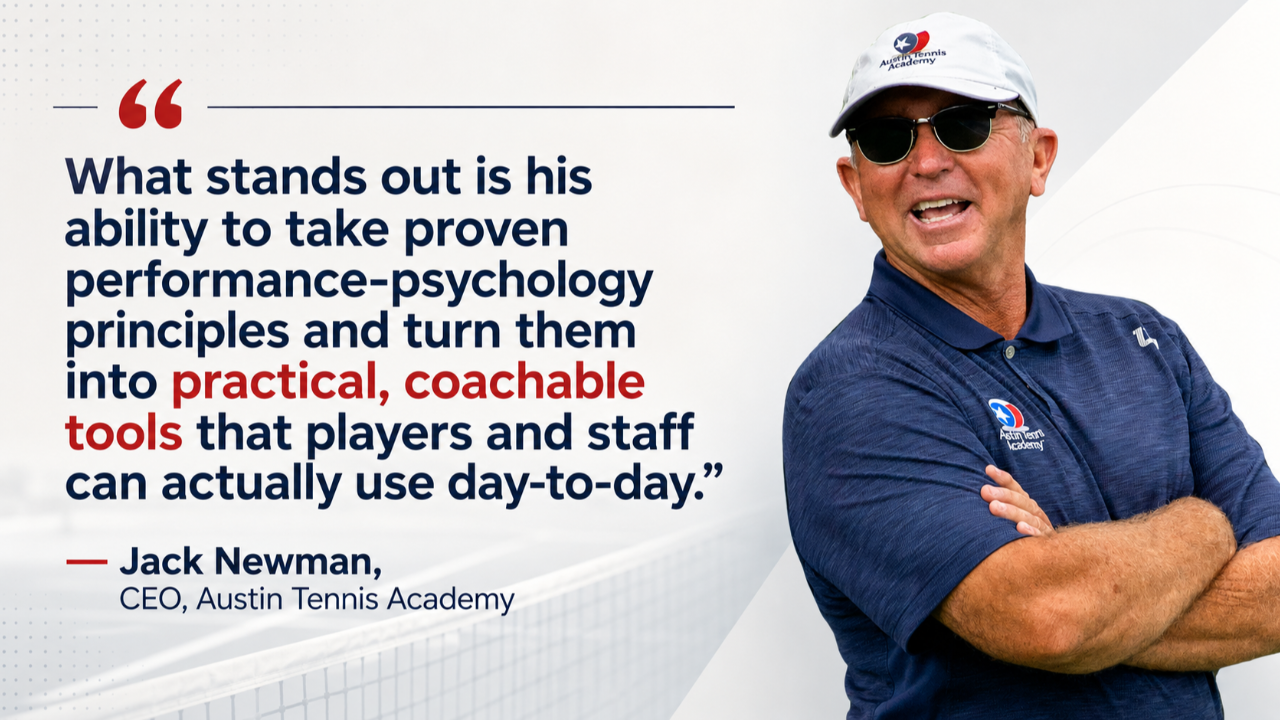
There is no shortage of good thinking in performance psychology. The harder problem is turning that thinking into something a player can use on a Tuesday afternoon, in the middle of practice, after missing three balls in a row, while a coach is moving the group to the next rotation.
That is the part of the work that interests me.
This summer at Austin Tennis Academy, I had the opportunity to develop and implement the IEDE framework along with the Training Card and Match Card systems. The purpose was never to add more information to an already crowded environment. Junior players do not suffer from a lack of instruction. More often, they suffer from too many disconnected instructions, too many adults interpreting their experience for them, and too little structure for deciding what any of it means.
IEDE gives the process a simple rhythm:
Intention. Experience. Debrief. Evolution.
The Training Cards apply that rhythm to practice. The Match Cards apply it to competition. Together, they give players a repeatable structure for deciding what they are trying to do, noticing what actually happened, examining the gap, and carrying something useful into the next experience.
The real test, though, was never whether the framework made sense on paper. The test was whether it could live inside an actual academy.
Could coaches use it without stopping practice every ten minutes? Could players understand it without turning it into another worksheet? Could it become part of the day rather than another program layered on top of the day? Could the ideas survive contact with real courts, real schedules, real personalities, and real competitive pressure?
Coach Jack Newman described that part of the work this way:
“What stands out is his ability to take proven performance-psychology principles and turn them into practical, coachable tools that players and staff can actually use day-to-day.”
That sentence matters to me because it identifies the difference between having an idea and building a system.
An idea can remain impressive while depending entirely on the person who created it. A system has to travel. It has to be usable by someone else, under less-than-perfect conditions, without losing the reasoning that made it valuable in the first place.
This summer, the work moved from concept into academy-wide practice. Players used Training Cards across daily rotations. Match Cards gave them a structure before and after competition. Coaches began working with a shared language around intention, awareness, resets, and what players were carrying forward from one experience to the next.
The cards were never the end product. They were the visible structure.
A card captures one moment. Development is a pattern.
One practice can show what a player noticed that day. One match can reveal what they believed happened under pressure. But the deeper questions only emerge across time. What keeps repeating? What does the player continue to avoid? What is being reinforced unintentionally? Where does training fail to transfer? Where are the player, parent, and coach using different language for the same experience? Is the player becoming more capable of directing the process, or simply becoming more skilled at reporting what adults want to hear?
That is the work behind Beyond the Card.
Beyond the Card is an individualized player-development advisory service built on the same IEDE structure ATA players experienced this summer. It does not replace the primary coach or add another stream of technical instruction. It connects the player’s conversations, Training Cards, Match Cards, competitive experiences, coaching input, and family observations across time.
The purpose is to see what the isolated moments are adding up to.
For some players, that may reveal a gap between ambition and daily behavior. For others, it may show that a technical issue is really a recognition or decision problem. It may expose a pattern that only appears under competition, a parent-player conversation that has become unproductive, or a training environment that is not aligned with the player’s stated goal.
The work is not about supplying more answers. It is about helping the player and the adults around them develop a more accurate shared grammar for the journey.
That phrase, shared grammar, came from a parent I have worked with. It describes the value better than “better communication.” A family does not simply need more words. It needs better distinctions. It needs language capable of separating effort from execution, emotion from interpretation, result from development, support from control, and a difficult day from a developmental pattern.
When those distinctions improve, the conversations improve with them.
The intended outcome is not a player who becomes dependent on another advisor. It is a player who can interpret experience more accurately, respond more deliberately, and progressively assume ownership of the path ahead.
The group process introduces the structure.
The individualized process follows what the structure is revealing.
Never Miss a Moment
Join the mailing list to ensure you stay up to date on all things real.
I hate SPAM too. I'll never sell your information.
