How I Would Introduce an AI-Native Offering Inside an Existing Program
Feb 21, 2026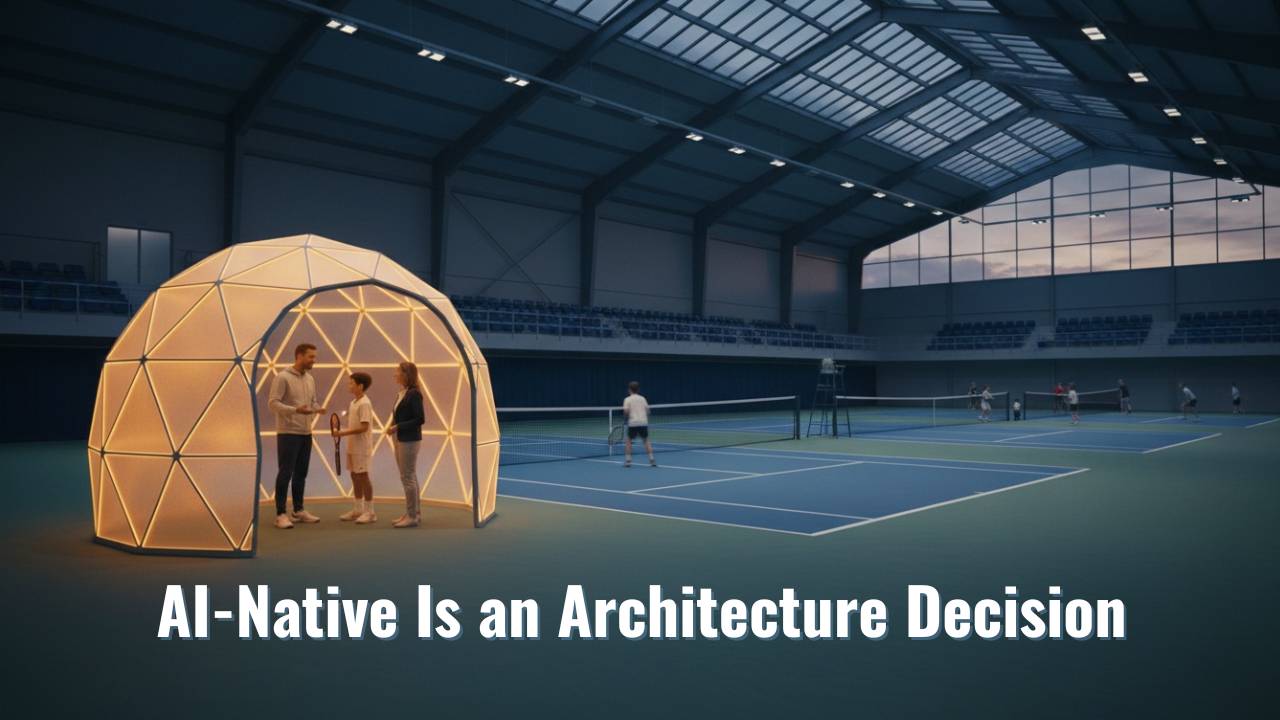
Parents leave tournaments with three different versions of what just happened. Coaches spend half their energy managing interpretation conflicts rather than advancing development. Players learn inconsistently because reflection resets every week when new narratives replace old ones. The match that looked like progress on Tuesday becomes failure by Thursday.
Most programs addressing this problem think they are integrating AI. What they are actually doing is adding features to a structure that cannot metabolize them. A scheduling tool here, a video analysis platform there, maybe a dashboard that tracks statistics. These additions make operations smoother. They save time. They reduce friction. But they do not change how the underlying system thinks, decides, or learns.
The difference between adding AI tools and building something AI-native is not technical. It is structural. One approach makes the machine faster. The other approach changes what the machine can see.
If I were introducing something genuinely AI-native inside an established tennis academy, I would not try to upgrade the entire organism at once. I would create a protected chamber within it. Small. Voluntary. Explicitly experimental. Six to eight families at most. Not because exclusivity matters, but because signal does. Innovation dies when it has to justify itself to everyone simultaneously. Existing systems defend their equilibrium without meaning to. Coaches worry about displacement. Parents wonder about surveillance. Staff members sense evaluation. The immune response activates before the new idea gets a fair test.
So instead of declaring transformation across the board, I would recruit families who understand they are participating in development work, not just purchasing upgraded service. This offering would not promise faster rankings or prettier strokes. It would promise something quieter and potentially more valuable over time. Tighter feedback loops. Faster calibration between intention and execution. Reduced interpretive drift across the three perspectives that shape junior development: the player experiencing the work, the parent observing from the outside, and the coach tracking patterns over time.
In most competitive junior environments, misalignment between these three perspectives is the invisible tax on progress. The player walks off court feeling one way about the match. The parent saw something different from the bleachers. The coach remembers a third version shaped by what they were watching for in that particular moment. By the time everyone talks about it hours later, interpretation has already drifted. Stories have hardened. Defensiveness or confusion has set in. The actual learning opportunity has evaporated.
This dynamic is not unique to sport. Any environment where multiple stakeholders interpret the same event will experience drift unless structure compresses it.
An AI-native structure compresses the time between experience and shared understanding. That compression makes the difference between development that accumulates systematically and development that gets renegotiated every week in the car ride home.
This approach would begin by establishing shared understanding across the perspectives that shape development before attempting to accelerate anything. Not three separate viewpoints that families reconcile on their own. One integrated baseline that makes divergence visible without assigning blame. When misalignment surfaces early in a structure designed to handle it, it stops being a source of friction and becomes useful information instead.
From that foundation, the system tracks how patterns evolve under pressure rather than documenting isolated events. The technology serves as drift detector, not judge. It surfaces recurring distortions between intention, execution, emotion, and interpretation across time. These observations accumulate into visibility that human memory cannot sustain across weeks and months.
The families in this pilot would not experience more data. They would experience faster calibration. Conversations would shift from rehashing what happened to examining why certain patterns persist. The parent-player-coach triangle would start using shared language naturally because the structure creates opportunities for alignment instead of assuming it exists.
If the pilot works, success would not be measured primarily by win-loss records. Those matter, but they lag behind the structural shifts that produce them. Earlier signals appear in how quickly families reset after difficulty, how accurately players assess themselves without prompting, how naturally shared language develops across the triangle of perspectives. When those shifts happen without anyone engineering them consciously, the feedback loop itself has tightened. That is the proof of concept.
Over time, this protected chamber might influence the larger program or it might remain a separate offering for families who need a different rhythm of development. Both outcomes are acceptable. What matters is understanding that AI integration is not a technology question but an architecture question. You can install a faster engine, but if the frame cannot handle the power, you have built an expensive problem instead of a solution.
The programs that recognize this will redesign quietly. The ones that do not will keep adding features and wondering why transformation never arrives.
Never Miss a Moment
Join the mailing list to ensure you stay up to date on all things real.
I hate SPAM too. I'll never sell your information.
