I Already Bought the Equipment. Who Wants to Learn With It?
Aug 02, 2026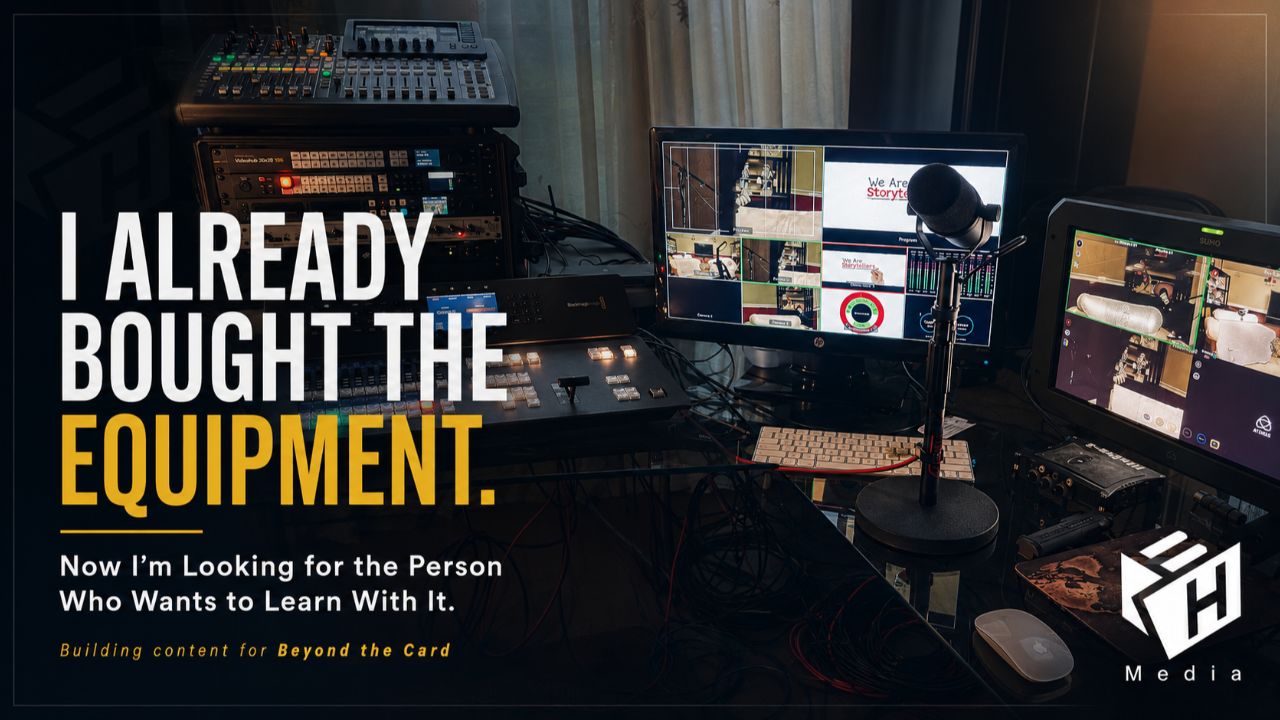
I've usually learned how something works by creating the thing I wanted to understand.
When I wanted to understand management companies, I created Eagle Management. When I wanted to understand tournament operations, I created a series of five tournaments in Charlotte, North Carolina. When I got interested in livestreaming and video production, I followed the same pattern. I created EKH Media and started buying the equipment I thought I'd need to explore what live and recorded production could become.
I didn't buy one camera and see where it led. I invested tens of thousands of dollars, and quite possibly hundreds of thousands over time, in cameras, lenses, switchers, audio systems, production computers, lighting, monitors, communications equipment and cabling, and all the other things curiosity accumulates once it's paired with the ability to place another order.
It worked, in one sense. I learned a great deal about video production because I gave myself access to the tools and then created reasons to use them.
It was also an unnecessarily expensive way to learn.
A smarter approach might have been to find someone who already owned the equipment and persuade them to let me work with it. I could have applied my ideas using someone else's cameras, switchers and audio systems while learning which parts of production actually mattered to me and which pieces of equipment were actually necessary. I might still have built a company eventually, but I wouldn't have needed to purchase an entire production environment before I understood what I was building.
That opportunity didn't exist for me, or I wasn't smart enough to go looking for it.
It exists for someone now.
The Equipment Is Already Here
Today, I have the ability to produce live and recorded content in several different ways. I can build studio environments, run mobile production systems, bring remote guests into conversations, record video podcasts, switch multiple cameras live and produce work from places where a traditional production company would need considerably more time and expense to get established.
Much of that capability currently sits idle.
The cameras are here. So are the switchers, the microphones, the audio interfaces, monitors, lighting, computers, converters and cables. Some of it was purchased for specific projects. Some of it was acquired because I wanted to understand what it could do. The rest has probably been sitting in a case for years, waiting for someone to look at it with fresh eyes and ask why we aren't using it differently.
At the same time, the work I'm building now increasingly needs its own media operation.
Beyond the Card is developing into more than a single service or collection of tools. It grows out of my work in player development, parent education, coach development, performance psychology and the systems I've spent decades building to help people become more intentional about how they learn.
That work needs to be documented and explained through conversations with players, parents, coaches and people working in other performance fields. It also needs demonstrations, podcasts, remote interviews, short-form videos, live productions and stories captured from inside the work itself.
I don't want it handed off to a conventional production company that shows up after the thinking is already done. I want to build the capability internally, close enough to the work that production becomes part of how we understand and extend it.
That means I'm looking for someone to help me build it.
Who This Might Be For
The person I'm looking for is probably near the beginning of their working life.
They may be a recent college graduate who studied broadcasting, communications, film, video production, digital media or something adjacent to those fields. They may have spent several years learning inside a formal program and are now finding that entry-level jobs often mean a long wait before anyone trusts them with the equipment or decisions they signed up for in the first place.
They may also be a recent high school graduate who has already shown an unusual level of maturity, curiosity and initiative. They may have learned by producing school broadcasts, filming sports, editing videos for friends, building a podcast in a bedroom or teaching themselves through whatever information and equipment they could get their hands on.
I don't assume college is the only path into this work, or the best one for every person.
We're entering a period when AI can shorten the distance between a question and a useful explanation. That makes information easier to get. It doesn't make judgment, initiative or discipline any less important, and it may make them more important. The question isn't whether someone had access to instruction. It's what they did with it.
Did they make something nobody assigned them? Did they stay curious after the tutorial ended? Can they organize themselves and be trusted with expensive equipment, real guests and work that matters to somebody besides themselves?
A college degree may tell me something about a candidate. A body of work, even an imperfect one, will usually tell me more.
I'm less interested in where you learned than in whether you learned how to learn.
Maturity Matters More Than Age
Opening this opportunity to a recent high school graduate doesn't mean lowering the standard. It means separating the standard from the credential.
The equipment involved is expensive. Productions have moving parts. Guests need clear communication. Files need to be organized and backed up. Batteries need to be charged before they're needed. Audio has to work. Cables have to be accounted for. A mobile setup has to arrive ready to function, not loaded with whatever somebody remembered to grab on the way out the door.
Creative freedom only works when it's supported by personal discipline.
I'm not looking for someone who simply wants access to interesting equipment. I'm looking for someone who understands that being trusted with the equipment also means accepting responsibility for it. The chance to experiment comes with the expectation that the work gets taken seriously, even when the environment doesn't resemble a traditional corporate workplace.
Maturity, in this setting, means being dependable without becoming rigid. It means being willing to try something new while also understanding why yesterday's files still need to be labeled correctly. It means asking questions, listening carefully and being able to take criticism without treating every correction as a judgment of personal worth.
A mature eighteen-year-old may be ready. An immature twenty-five-year-old may not be. The calendar doesn't decide that. Behavior does.
This Is Not a Traditional Entry-Level Media Position
There will be structure, because production requires structure. There will be schedules, deadlines, file systems, equipment inventories and repeatable procedures. We'll need to know how a remote guest joins a conversation, how the audio gets routed, where the files go when the recording ends and how one production turns into several useful pieces of content.
But the system itself is still being built. The workflows are still evolving. The expectations around preparation, reliability and follow-through will not be.
The person who joins me won't be stepping into a department where every workflow was set ten years ago and nobody remembers why. They'll help determine what those workflows should be. They'll have room to test different camera arrangements, lighting approaches, remote-production platforms, mobile kits, studio configurations and ways of turning longer conversations into shorter pieces without stripping away everything that made the original conversation worth having.
We may build something one way, find out it's unnecessarily complicated, and rebuild it the following week. We may pull a piece of equipment out of storage and realize it solves a problem we hadn't yet named. Or something I once considered essential might turn out to be obsolete, because a better solution now exists on a laptop or inside an AI-supported workflow.
The point isn't to protect the equipment from experimentation. The point is to put it into the hands of someone capable of experimenting responsibly.
This won't be a job where the interesting decisions get made somewhere else and handed down as instructions. I'll have opinions, standards and ideas about what we're trying to accomplish, but I don't want someone whose only contribution is pressing the buttons I point toward.
I want someone who will look at the purpose of a production, look at the tools available and say, "I think there's a better way to do this."
Then I want them to help prove it.
What We Would Be Building
The immediate work will center on creating content for Beyond the Card and the larger body of work surrounding it.
That may include video podcasts with guests joining locally or remotely, conversations with parents and coaches, demonstrations of the systems I've developed, interviews with people whose experience helps illuminate the work, and short-form pieces drawn from longer discussions. It may also include productions from tennis courts, tournament sites, classrooms or other environments where the setting is part of the story rather than something to hide behind a studio backdrop.
It will involve building a repeatable internal media system, too.
How should we record a sixty-minute conversation so it can become a full episode, several shorter videos and written excerpts that stay useful later? What belongs in a mobile production kit if the goal is to arrive ready without hauling in an entire control room?
We'll need to prepare remote guests well enough that the conversation begins with the subject rather than twenty minutes of technical confusion. We'll also need to figure out how AI can speed up transcription, logging, editing, clipping, research and distribution without flattening the voice or removing the judgment that made the material worth producing. The goal isn't simply to create more. It's to create more useful work without adding to an environment that already has too much noise in it.
Those questions aren't distractions from the production work. They're part of the production work.
I'm not merely looking for somebody to operate cameras. I'm looking for someone who wants to help build the relationship between the ideas, the production and the audience receiving them.
What I Bring
I bring the equipment, the projects, the subject matter and access to people and environments capable of producing meaningful work, along with several decades of experience building things before their final form was obvious.
Beyond the Card grows out of that history. It takes ideas from performance psychology and player development and turns them into practical systems players, parents and coaches can use. The media operation around it should do something similar. It should make complex ideas visible without making them simplistic.
I bring a willingness to experiment, but I also bring standards. I care whether something works, whether it communicates what we intended, and whether the choices made during production serve the substance rather than distract from it.
I'll ask why you made a particular choice. I'll also expect you to ask why the content matters, who it's for, and what we want someone to understand after watching it.
That conversation, between production and purpose, is where the real work happens.
What You Should Bring
You don't need to arrive knowing every piece of equipment. I probably own things I've forgotten how to use myself. You do need enough of a technical foundation that we can start by making things, instead of spending months on the difference between a camera, a switcher and an audio interface.
Care about sound. Poor audio can ruin strong work faster than almost anything else. Understand that organization isn't the enemy of creativity. It's one of the things that makes sustained creativity possible. Be able to edit, or prove you can teach yourself the tools it takes to get better at it fast.
Be interested in live and recorded production, not just one or the other. Get comfortable troubleshooting, because equipment has a way of failing at the exact moment someone important is ready to begin.
Most of all, want to make things.
A polished resume will matter less to me than evidence of curiosity. Show me the videos you made when nobody assigned them. Show me the livestream that didn't work and what you changed after, the podcast, the school broadcast, the sports edit, the documentary attempt, the YouTube channel or the unfinished experiment that taught you something.
I'm not looking only for polished outcomes. I'm looking for evidence that you've already begun.
What the Opportunity Offers
This is a chance to work with equipment you may not be able to justify buying at this point in your life, while helping create work with an actual purpose and audience.
You'll have the chance to explore studio, mobile, live and remote production, and help develop workflows instead of merely inheriting them. You'll also learn what happens before the cameras turn on and after the recording ends, when the material has to be organized, shaped, distributed and made useful.
You won't need to wait several years for someone to decide you're finally ready to touch the interesting equipment. Responsibility comes earlier here than it would in most entry-level jobs, and how much independence you get from there depends on what you do with it.
This starts at minimum wage, with the potential for equity after six months. Beyond the paycheck, the trade is standing access to the equipment for your own projects, real productions and real guests from early on, and a genuine hand in building the system rather than a year of fetching cables before anything counts.
There's room here to play, but not carelessly, and room to experiment without treating experimentation as an excuse to avoid finishing anything. There's also room to question how something has always been done, as long as you're willing to help build the alternative.
Play without responsibility rarely produces much. Responsibility without room to play usually reproduces what already exists.
I'm looking for someone who wants both.
How to Raise Your Hand
This is based in person in Southwest Austin and will run twenty to twenty-five hours a week on my projects, with housing potentially available for the right candidate. It starts at minimum wage, with the potential for equity after six months. On top of that, you get fifteen to twenty hours a week of standing access to the equipment for your own personal projects.
Don't start with a formal cover letter. Send me a short introduction, one or two things you've made, and an example of something that didn't work the first time and what you changed afterward. Tell me what part of this interests you and what you'd want to learn first.
Who Wants to Learn With It?
I learned video production by buying the equipment and creating reasons to use it. It taught me what I wanted to know, but it wasn't the most efficient route.
Someone else can take a different path.
The equipment is already here. The work is beginning. Beyond the Card needs an internal media capability, and I need someone who wants to help determine what that capability can become.
You may be finishing college, or you may have finished recently. Maybe you're leaving high school with more practical ability than your age suggests, or you've followed a path that doesn't fit neatly into any of these.
What matters is whether you're curious, mature enough to carry responsibility, and ready to make something.
I already bought the equipment.
Now I'm looking for the person who wants to learn with it.
Never Miss a Moment
Join the mailing list to ensure you stay up to date on all things real.
I hate SPAM too. I'll never sell your information.
