I Didn't Change My Politics Last Night
Nov 04, 2026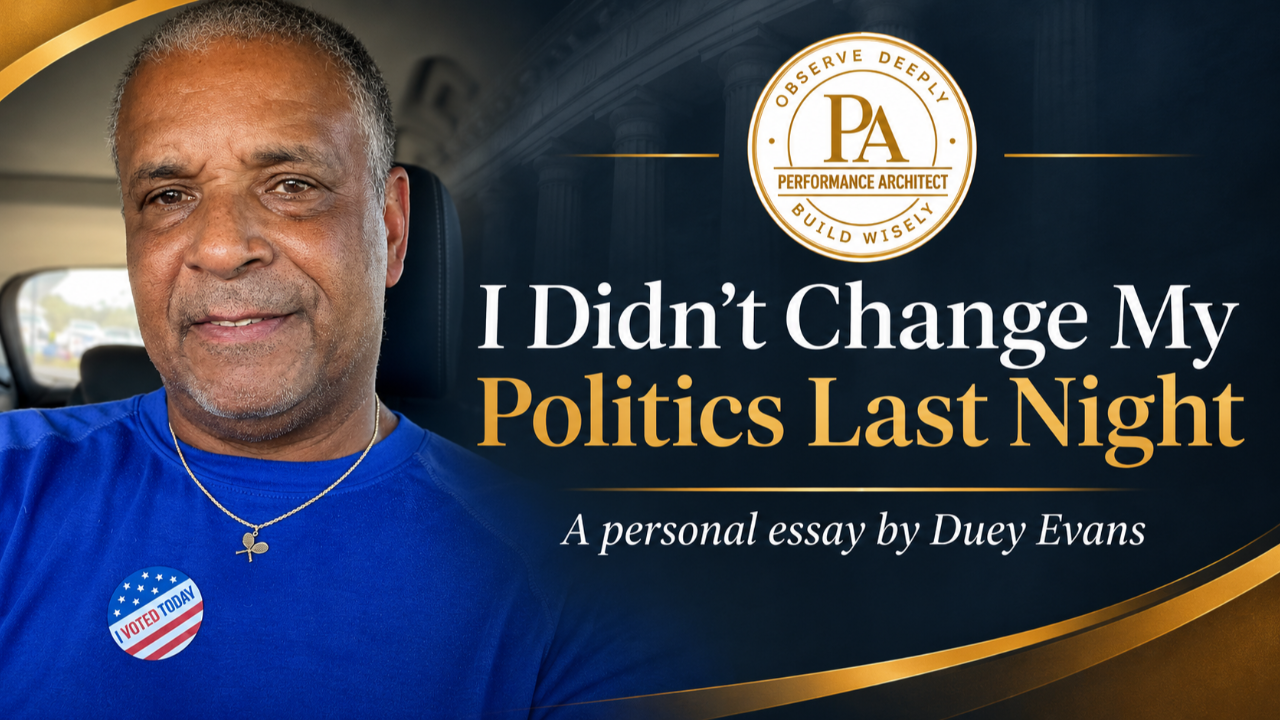
If you're reading this to find out which side I'm on after last night, I'm going to disappoint you. I woke up this morning with the same political convictions I carried into the voting booth during early voting last week. The more interesting part of my election started months ago, when I voted in the primary of a party I don't belong to so I could vote against a man I didn't think should represent me. That decision tells you more about what I value than any label I'd put on myself.
I've considered myself a libertarian since sometime in the 1980s, when I started listening to Gene Burns on AM talk radio in Boston. Burns challenged conventional political thinking in a way that appealed to me. He didn't care much about defending one party against another. He cared about the relationship between individuals and government, and about how much authority we should give to people who claim to know what's best for us. More than 40 years later, I'm still pretty close to where he had me.
I still think there's too much government in our lives. Government often tries to fix problems it helped create, and both major parties have gotten comfortable making it bigger. From where I sit, liberals and so-called conservatives mostly argue over where to spend the money and whose behavior to regulate. Neither seems bothered by a powerful government as long as they're the ones running it.
I don't want government gone. We give it real responsibilities, and some of them are essential. What I've never understood is why so many people who say they value freedom are quick to restrict it when somebody else uses it differently than they would. I'd like government out of our lives wherever reasonably possible, so each of us has the freedom to make our own decisions and the responsibility to live with how they turn out.
Given all that, you'd probably expect me to stay out of party primaries. This year I did the opposite. When I went to vote in the primary, I asked at the polling place whether taking a Democratic ballot would keep me out of a possible Republican runoff, and I was told it would. So I took the Republican ballot, which gave me two chances to vote against Ken Paxton, once in the primary and again in the runoff. He won the nomination anyway. When he lost his Senate race last night, I was glad to see it.
My opposition to Paxton had very little to do with his party and a lot to do with his character. I've watched enough of his public conduct, and enough of the controversies around him, to decide he doesn't meet the moral standard I expect from someone representing my state. Other people can look at the same record and decide differently. For me, it came down to trust. I can disagree with someone about policy and still trust them to deal honestly. I can't extend that to someone whose conduct has already cost him my trust, no matter how often we agree.
Some people will think it's odd for a libertarian to vote in a Republican primary. I don't see a conflict. Political parties are vehicles, not identities, and I wasn't going to give up a say in who represents me because I don't share the platform. I'd go further and argue that libertarians have more reason than most to care about character. Much of the philosophy is about limiting what people in power can do to the rest of us. A smaller government would limit the damage a dishonest official could do, but we don't have a smaller government. We have a big one, and as long as we do, the people running it matter a great deal. Some libertarians would tell me that rules and institutions protect us better than the virtue of any officeholder, and they have a point. I just don't think it's a reason to stop paying attention to who we hand the power to.
Two other results last night mattered to me for a different reason. Keisha Lance Bottoms became the first African American woman elected governor of any state. Byron Donalds became Florida's first African American governor and the first Black Republican ever elected governor. Their politics are far apart, and I'd argue with each of them about plenty. That doesn't take anything away from what they accomplished.
I was born in 1962 and grew up in Concord, Massachusetts, where I was often one of very few Black children in the room. My mother, Peggy, served as Concord's first METCO coordinator, working to open suburban classrooms to Black children from Boston. When I was born, no Black American had ever been elected governor of any state, and none would be until Douglas Wilder won in Virginia in 1989, when I was in my late twenties.
I've spent much of my life in places where people decided who I was before they had a chance to see what I could do. I don't think those experiences define me, but I'm not going to pretend they didn't happen. So it meant something to me to watch voters elect a Black Democratic woman in Georgia and a Black Republican man in Florida on the same night. I'm not claiming we've moved past race, or that every voter chose those candidates for reasons unrelated to who they are. I take it as evidence that more doors are open than when I was growing up, even if plenty remain closed. It also matters to me that one walked through as a Democrat and the other as a Republican. Progress doesn't have to belong to one party, and neither does opportunity.
I don't have to agree with either governor-elect to appreciate what their elections mean. I also don't have to disagree with everything Ken Paxton believes to decide he shouldn't hold public office. Those are different judgments, since one is about history and the other is about trust. What they have in common is that I made each of them without letting a party make it for me.
That's the reason I've stayed outside both parties for so long. I don't want a party doing my thinking for me. I want to be free to agree with a Democrat on Tuesday, a Republican on Wednesday, and neither of them on Thursday. Plenty of people who vote with one party every time have thought it through and landed there honestly, and I respect that. What worries me is how often we treat people who disagree with us as enemies instead of fellow citizens, and how easily we excuse things from our own side that we'd never accept from the other.
We also give politicians too much credit when things go well and too much blame when they don't. I've spent more than 35 years coaching junior tennis players, running facilities, and building businesses, most of it aimed at helping young people become capable adults. I've done that under Democratic and Republican presidents, and under governors I agreed with and governors I didn't. Some of their decisions affected what I could do. None of them relieved me of the responsibility to get up the next morning and do it. The people who won last night will deserve scrutiny, accountability, and sometimes credit, but they won't get my loyalty just because I agree with them on something, and they won't be the ones doing my work.
I was a libertarian before last night's election, and I'm still one this morning. A candidate I didn't trust lost his race. Two people won governorships in a country that hadn't elected a single Black governor when I was a boy in Concord. Some of the people I hoped would win did and others didn't, and that's a good enough night for me. Now I've got people to see and work to do, and very little of it depends on who won last night.
Never Miss a Moment
Join the mailing list to ensure you stay up to date on all things real.
I hate SPAM too. I'll never sell your information.
