I Thought I Was Building Tennis Programs
Nov 07, 2026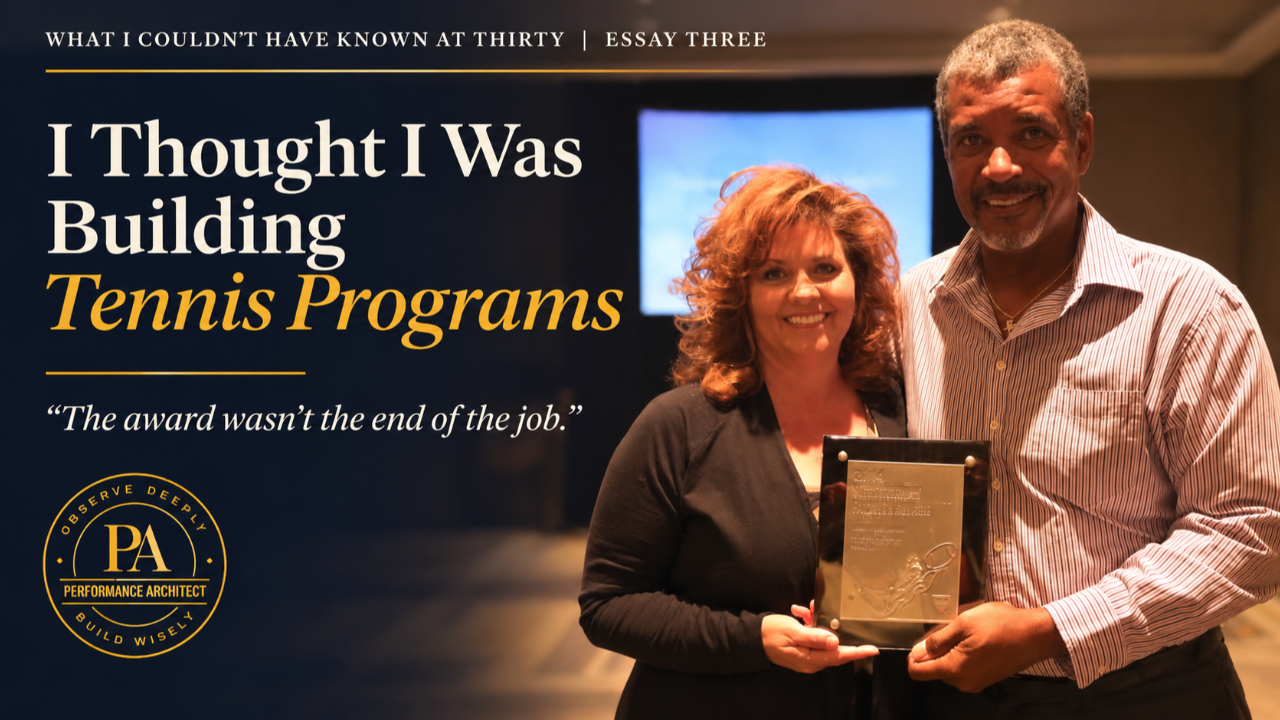
What I Couldn't Have Known at Thirty | Essay Three
When Kim Kurth and I took over Samuell Grand Tennis Center in Dallas in 2010, there were days when nobody came through the door. The phone rang only when someone dialed a wrong number, and the few people who did walk in were usually looking for a restroom. It was the worst-performing public tennis center in the city's system.
In 2014, the USTA named Samuell Grand one of its Outstanding Facility Award winners for large public tennis centers. I knew exactly how we'd gotten there, and I could prove it. We were in the middle of a stretch in which revenue would grow year over year in 56 of 57 months. I'd been in the business of developing players since 1992, the year I turned thirty, and by then I'd learned to trust numbers like that.
Then Kim said something that didn't quite fit the celebration. "Now we have to figure out how to deserve this award every single day going forward."
I heard it as a work ethic. It took me years to hear it as a question. Deserve it for what?
The Scale
About a year into the job, Kim suggested we sit down and grade everything we'd tried on a scale of zero to three. A three got more time, more staff and more attention. A zero got cut. Everything in between got changed or replaced. I loved it. I've never been sentimental about a program that isn't working, and the scale let us make hard calls without arguing about feelings.
It worked. In July 2015, we logged 2,560 visits, up from 1,734 the July before, an increase of almost 48 percent. Revenue that month was $25,440, and about 80 percent of it came from lessons.
I could read a report like that in thirty seconds and tell you whether we were winning. What I couldn't have told you was what the people walking through those doors were getting that the report didn't show. The money mostly tracked lessons. It didn't track the adult beginner who'd still be playing eight years later, or the Saturday evening a kid spent on a court for free.
The Man Who Built It First
In the early 1960s, Dallas didn't have a single municipal tennis center. Jack Turpin, then president of the Dallas Tennis Association, set out to change that. He talked the head of the park department into building one at Samuell Grand Park, designed the courts himself, two at a time on different levels, and asked to run the place for its first two years to make sure it worked.
He was clear about why. "I wanted to put tennis racquets into the hands of children who probably would never have a chance to have a tennis racquet," he told Kim and me years later, when we interviewed him about the center's history. "My goal was not to make champions. That sounds strange."
Then he went after the biggest event in the sport. Mexico was due to host the United States in the 1965 Davis Cup Americas Zone final, but its federation was broke. When an official he knew at the national association told him so, Turpin's answer was simple: "You're saying we can buy it." He guaranteed Mexico $20,000, raised it from local supporters and brought the tie to a public park, something the Davis Cup had never done. Arthur Ashe, the first Black American on a U.S. Davis Cup team, won both of his singles matches there, and about 3,500 people a day filled a stadium built around two of Turpin's courts. Dennis Ralston, who played for the U.S. that weekend, later said, "Everybody could come, all different people were there. No one was excluded."
I knew that history, and I told it every chance I got. In a speech about two years into our time there, I said we wanted 30 to 40 percent of our junior instruction to go to children who qualified for free or reduced lunch. Through our Unfurrowed Ground Foundation, named for the phrase my family uses for doing what hasn't been done before, more than 300 kids had already received free instruction on Saturday evenings in a program we called ACE.
I meant every word. But a mission statement and a measuring stick are different tools, and I ran the place day to day with the measuring stick.
The Program the Report Couldn't See
We also partnered with the Dallas Police Athletic League on a program built very differently from the rest of what we ran. Kids got rackets, balls and a place to play, and they invented their own games. If they wanted instruction, they could ask for it on separate courts. Nobody was building a pathway or chasing a ranking. The point was exposure to the game, and a space where adults weren't shaping everything the kids did.
It ran about a year, until the funding ran out.
It brought in no real revenue and wasn't designed to feed our competitive program, so the numbers we usually leaned on gave little reason to keep it going. By Jack Turpin's standard, it may have been the most Samuell Grand thing we did.
That's the tension I didn't see at thirty and only half saw in my late forties. A public tennis center has to pay its bills. Staff need to earn a living, courts need resurfacing, and a facility that goes broke serves nobody. I don't believe the answer is to ignore the economics in the name of doing good. But a profitable operation and a valuable public institution aren't the same thing. They can overlap, and one doesn't guarantee the other. An organization can value something sincerely and never measure it. What it measures is what gets the time, staff and courts.
What People Came Back For
Years later, someone asked me on camera what I'd loved most about running those tennis centers. I didn't mention the award or the revenue. I talked about watching kids grow up. Some who'd been in elementary school when we arrived were in high school by then. A young man who'd started with us in middle school had just texted me to say he'd been accepted to a very high-level college.
I also talked about Fretz Tennis Center. When we took over the rest of the city's contract there, some of the adults who had started in beginner classes at Samuell Grand turned up playing leagues at Fretz. They followed us from one place to the other. They weren't following a court surface or a city facility. They were following the people and the place they'd come to count on. Fretz itself traced back to Samuell Grand. According to Turpin, it was one of four centers the city went on to build after its park chief saw summer crowds of kids on Turpin's courts.
None of that showed up on the scale. A text message doesn't move monthly revenue. Loyalty might, eventually, but the report could never tell me why people stayed. Yet when I was asked what mattered, those were the things that came out of my mouth.
I won't pretend everyone felt that way about us. Some families found our standards too demanding or our decisions frustrating. One mother believed my rule about late arrivals interfered with her job of raising her children, and that story deserves its own essay. A place can matter deeply to people without mattering to everyone in the same way.
What Kim Was Asking
So back to Kim's line. Deserve the award every day, but deserve it for what?
At thirty, I'd have said for running a good operation: strong instruction, growing numbers, competitive players and a staff that knew its job. I still believe all of that matters. I spent too many years doing that work to pretend it's easy or unimportant.
I'd answer differently now. A program is what an organization offers. An institution is what people become able to do because the organization exists. The award recognized what we'd accomplished, and the monthly reports measured how well the operation was running. The text message, the league players at Fretz and the kids inventing games on courts we'd set aside for them were evidence of what people had become able to do, and I had no column for any of it.
Jack Turpin brought the Davis Cup to a public park because he believed public courts were how kids found the game. Forty-five years later, Kim and I inherited his courts and, for a while, mostly measured whether they paid. I'm not ashamed of the paying part. Without it, none of the rest would have lasted as long as it did.
What I couldn't have known at thirty is how little the numbers I trusted most would tell me about what I was actually building. Kim understood at least part of that before I did. The award wasn't the end of the job. It was a reminder of what the place had been built for in the first place.
Never Miss a Moment
Join the mailing list to ensure you stay up to date on all things real.
I hate SPAM too. I'll never sell your information.
