Part IV: Evolution
Feb 04, 2026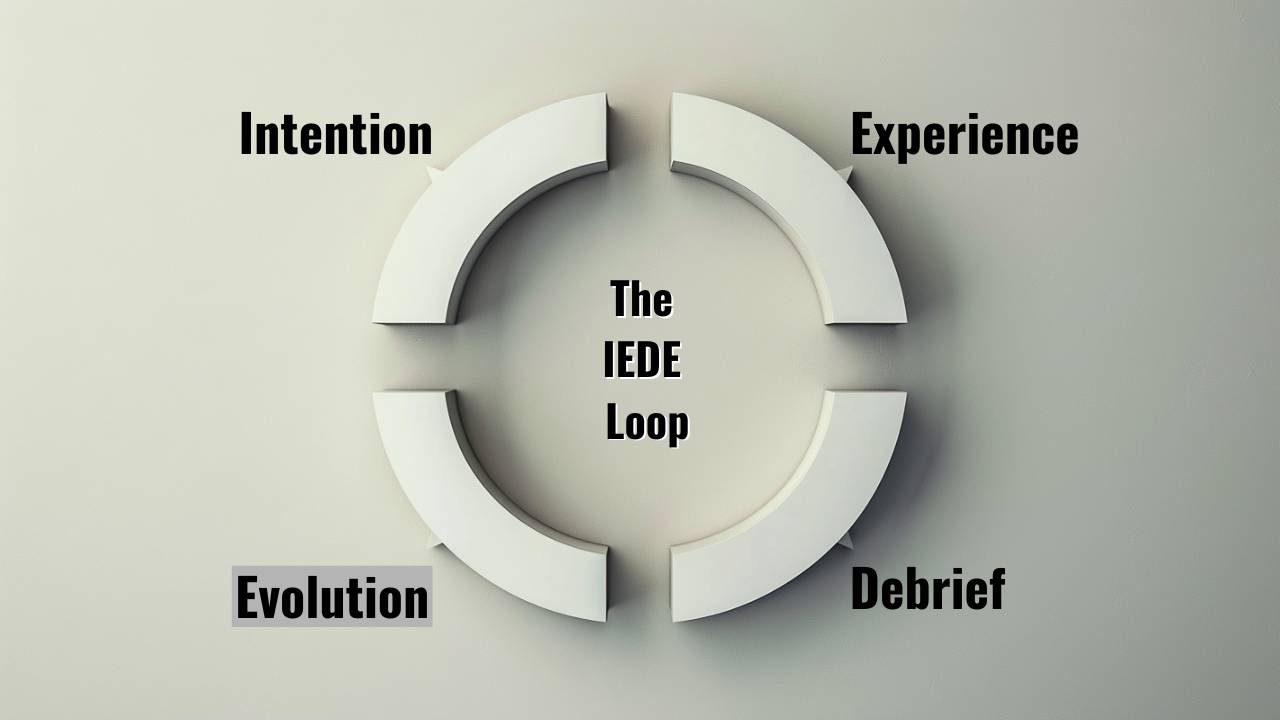
When Understanding Becomes Baseline
The fourth phase of the IEDE loop is where everything that came before either compounds or dissolves. Evolution is the measure of whether the system works. It is the phase where insight extracted during debrief integrates into the player's baseline capabilities. Where patterns become automatic. Where the internal model updates not just once, but permanently.
Most development systems stop at debrief. A player reflects, gains insight, feels clarity. The coach nods. Everyone moves on. The next competition arrives and the player performs exactly as they did before. The insight never reached the nervous system. It never changed behavior. It stayed abstract.
Evolution is what separates learning from knowing. Learning is the acquisition of insight. Evolution is the integration of insight into structure. A player who learns that their tolerance threshold appears when their breath shortens has gained knowledge. A player who now notices their breath shortening in real time and adjusts before crossing the threshold has evolved. The knowledge became capacity. The insight became reflex.
This essay examines Evolution. Not as improvement, but as the process by which debrief produces lasting change in how a player responds under pressure.
What Evolution Is Not
Before defining what evolution does, it is useful to clarify what it does not do.
Evolution is not general improvement. A player who hits harder, moves faster, or wins more matches is not necessarily evolving. They may be stronger. They may be better trained. They may be facing weaker competition. None of that proves their internal model changed.
Evolution is not adaptation. Adaptation is tactical adjustment within a single experience. A player adjusts their patterns mid-match and wins. That is adaptation. Evolution is what happens after many cycles when adaptation becomes faster, more reliable, and requires less conscious effort.
Evolution is not confidence. A player who feels better about themselves after a good result is not evolving. They are responding emotionally to an outcome. Evolution shows up when performance patterns change independently of emotional state.
Evolution is not age or maturity. A player who improves because they are older, stronger, or more experienced is developing naturally. Evolution is what happens when a player's internal responses to pressure change because they learned how to reorganize their own perception.
Real evolution is baseline shift. The player's tolerance threshold moves. Their fortitude depth decreases. Their resilience speed increases. Their adaptability becomes structural rather than situational. These changes are measurable only across time. They are invisible in a single match. They become visible when comparing how the player responds to similar pressure six months apart.
The Difference Between Cycles and Loops
A cycle repeats. A loop compounds. Most players move through cycles. They compete, debrief, adjust, compete again. Each event is separate. Each competition starts fresh. The player accumulates experience but does not accumulate capability. They run in circles.
A loop compounds when each cycle feeds the next. The player competes with an intention. They debrief. They extract insight. The insight changes their internal model. The next intention is set based on the updated model. The next experience tests the updated model. The next debrief refines the model further. Over time, the baseline rises. The player who once broke under moderate pressure now maintains composure under severe pressure. That is not because they tried harder. It is because their internal architecture changed.
Evolution is what turns cycles into loops. Without evolution, IEDE is just structured reflection. With evolution, IEDE becomes a developmental engine.
The Role of Time
Evolution cannot be rushed. It requires repetition. The nervous system does not reorganize after one insight. It reorganizes after many repetitions of a new pattern under varying conditions. The player must test the insight, fail, adjust, test again, succeed, test under harder conditions, adjust again. Each cycle refines. Each cycle deepens. Over time, the new pattern becomes automatic.
This is why most players never evolve. They do not stay with a single developmental target long enough for it to integrate. They set an intention to test tolerance. They debrief once. They notice something useful. Then they move on to a different focus. The insight never becomes structure. It stays surface.
Evolution requires discipline. The player must return to the same component repeatedly. Not because they are stuck, but because integration takes time. A player testing resilience might need twenty competitions before the pattern stabilizes. Twenty cycles of noticing how quickly they recover. Twenty cycles of adjusting the internal process that triggers recovery. Twenty cycles of measuring whether recovery speed is increasing.
That repetition feels boring. It feels like the player is not progressing because they are not testing new things. But evolution is not exploration. Evolution is consolidation. It is the phase where a capability that was fragile becomes reliable.
How to Measure Evolution
Evolution is measured by comparing baselines across time. Not by comparing individual performances. A player who wins more matches may not be evolving. A player who loses the same way every time is definitely not evolving. A player whose tolerance threshold moves, whose fortitude depth decreases, whose resilience speed increases, is evolving even if their ranking stays flat.
The measurement requires longitudinal data. The player must track the same mental toughness components across multiple competitions. Not just once. Repeatedly. Over months. The data reveals patterns that single events cannot show.
For example, a player testing tolerance might track:
- How many games into a match before pressure first appears
- What external conditions trigger the threshold crossing
- Whether the threshold is moving over time
After five competitions, the player notices that pressure used to appear in the third game when they were tied. Now it appears in the sixth game when they are down. The threshold moved. That is evidence of evolution.
A player testing fortitude might track:
- How deep their decision making collapses when they cross their threshold
- Whether the depth of collapse is decreasing over time
- Whether they retain any tactical structure when under extreme stress
After ten competitions, the player notices that they used to lose all pattern execution when they broke. Their shots became wild, their positioning chaotic, their decisions purely reactive. Now when they cross their threshold, they can still maintain basic tactical structure even though their decision making is compromised. The severity of collapse decreased. That is evidence of evolution.
A player testing resilience might track:
- How long it takes to return to baseline after disruption
- Whether recovery time is shortening over time
- Whether recovery is becoming more consistent
After fifteen competitions, the player notices they used to need thirty minutes to recover. Now they recover in five minutes. The speed increased. That is evidence of evolution.
A player testing adaptability might track:
- Whether difficulty is making their baseline stronger or weaker over time
- Whether new pressure situations create learning or damage
- Whether their internal model is becoming more accurate
After twenty competitions, the player notices they used to avoid pressure situations. Now they seek them because pressure reveals useful information. The relationship to difficulty changed. That is evidence of evolution.
These measurements are not about winning. They are about internal state change under similar conditions. That is the signal. That is what proves the loop is working.
What Prevents Evolution
Evolution fails when debrief insights do not reach the nervous system. This happens in predictable ways.
The first failure mode is insight without repetition. The player has a breakthrough during debrief. They understand something they did not understand before. They feel clear. Then they never test it again. The insight stays conceptual. It never becomes behavioral. A single insight without reinforcement dissolves.
The second failure mode is repetition without variation. The player tests the same thing in the same conditions repeatedly. They do not increase pressure. They do not vary context. The pattern stabilizes in a narrow range but does not generalize. When conditions change, the pattern collapses. The player evolved locally but not structurally.
I used to tell parents we have overwritten the software, but the original code is still there. The new pattern was trained in low-variance conditions. Practice. Familiar tournaments. Moderate pressure. The player looked fixed. Parents and coaches believed the problem was solved. But the old pattern was structural, deeply embedded from years of repetition under stress. The new pattern was contextual. It worked in the conditions where it was trained, but had not been tested broadly enough to become structural.
When the big event arrives, different venue, higher stakes, unfamiliar opponent, the stress exceeds what the new pattern was trained to handle. The nervous system reverts to the older, more deeply embedded code. The behavior that disappeared six months ago reappears instantly. Parents say they have not seen that in six months. The surprise reveals the fix was never structural. It was contextual.
This is why evolution requires repetition with variation. You cannot evolve by fixing something in practice and calling it done. You have to test the new pattern under increasing pressure, varying opponents, different venues, higher stakes, unexpected disruptions. Only then does the new pattern become structural enough to override the old one when conditions change.
The third failure mode is accumulation without integration. The player moves through many competitions, many debriefs, many insights. But they never allow one insight to settle before moving to the next. They collect observations the way some people collect books they never read. The nervous system never consolidates. Nothing becomes baseline.
The fourth failure mode is evolution without measurement. The player feels like they are improving. They believe they are evolving. But they have no longitudinal data. They cannot prove their tolerance moved or their resilience increased. They are guessing. Guessing is not the same as knowing. Without measurement, evolution is invisible and therefore unreliable.
All four failures produce the same result. The player competes more and evolves less. They stay at the same baseline year after year. They mistake repetition for growth. They confuse experience with development.
The Connection to Calibration
Calibration is the foundation of the entire mental toughness framework. It is the internal measurement system that determines whether a player's perception matches the actual conditions of the environment. Without calibration, tolerance becomes denial. Fortitude becomes fragility. Resilience becomes repetition of mistakes. Adaptability becomes mislearning.
Evolution depends entirely on calibration. If the player's internal measurements are inaccurate, their debrief is inaccurate, and their evolution is inaccurate. They will integrate the wrong patterns. They will reinforce the wrong responses. They will build capabilities that do not match reality.
This is why evolution cannot happen without clean debrief. Debrief is the phase where calibration gets tested and adjusted. The player's internal model is compared against what actually happened. When the model is wrong, debrief reveals the mismatch. The player adjusts. The next cycle tests the adjustment. Over time, calibration improves. The player's perception becomes more accurate. Their internal measurements become more reliable.
A well calibrated player knows when their tolerance threshold is approaching. They know how deep they fall when they cross it. They know how long recovery takes. They know whether difficulty is strengthening or weakening their baseline. That knowledge is not abstract. It is lived. It is tested repeatedly under real pressure. It is refined through many cycles.
Calibration is what allows evolution to be directional rather than random. Without it, the player drifts. With it, the player climbs.
The Long-Term Function of Evolution
Over years, evolution produces a player who is fundamentally different from the one who started. Not because they are older or stronger. Because their internal architecture changed. Their nervous system responds differently to pressure. Their perception is clearer. Their recovery is faster. Their baseline is higher.
This is where the entire IEDE system reveals its purpose. The goal is not to help a player win one match. The goal is to turn the player into their own developmental engine. A player who can set intentions, generate clean experience, extract accurate insight, and integrate that insight into their baseline without external dependence. A player who carries the loop inside themselves.
That capacity is what makes development permanent. The player who learns to evolve can continue evolving long after formal coaching ends. They do not need someone else to tell them what to work on. They do not need someone else to diagnose their problems. They do not need someone else to interpret their experience. They carry the entire system inside their own awareness.
This is also where the system becomes transferable. A player who evolved in tennis carries the same capacity into other domains. They know how to set intentions in any high-pressure environment. They know how to generate clean observations under stress. They know how to extract insight from experience. They know how to measure whether their baseline is rising or falling. The sport was the training ground. The capacity is permanent.
Evolution as Proof
Evolution is the proof that the system works. Not because it feels good. Not because it sounds right. Because it produces measurable baseline change over time.
A player who goes through the IEDE loop correctly will show:
- Tolerance thresholds that move upward
- Fortitude depths that decrease
- Resilience speeds that increase
- Adaptability that becomes structural
These changes are not subjective. They are not based on feeling or belief. They are based on longitudinal tracking of internal state under similar pressure across time. The data either shows baseline shift or it does not.
If the data shows no change after twenty cycles, the system is not working. Either the intentions are poorly calibrated, the experience is not generating pressure, the debrief is not extracting insight, or the evolution phase is not integrating insight into behavior. Something in the loop is broken.
If the data shows consistent baseline shift, the system is working. The player is evolving. The loop is compounding. The architecture is sound.
This is why evolution is the final phase. It is the measurement phase. It is where theory meets reality. It is where belief must produce evidence or be discarded.
The Connection Back to Intention
Evolution changes what the player tests next. A player whose tolerance threshold moved no longer needs to test tolerance. They need to test fortitude. A player whose resilience stabilized no longer needs to test resilience. They need to test adaptability. The insights from evolution inform the next intention.
This is how the loop closes. Intention sets direction. Experience generates data. Debrief extracts insight. Evolution integrates insight and measures baseline change. The baseline change determines the next intention. The cycle begins again, but the player is standing on higher ground.
Without evolution, the loop is open. The player sets intentions but never knows if those intentions produced lasting change. They debrief but never know if the insight reached their nervous system. They compete but never know if they are developing or just repeating.
With evolution, the loop is closed. The player knows whether they are rising. They know what needs attention next. They know whether the system is working. That knowledge creates confidence. Not emotional confidence. Structural confidence. The player trusts their own development because they can measure it.
What Evolution Reveals About Development Systems
Most development systems fail at evolution. They focus on instruction, correction, and repetition. They assume that if a player is told what to do enough times, they will eventually do it. That assumption is false.
Players do not evolve because they are told what to do. They evolve because they learn how to reorganize their own internal responses under pressure. That reorganization happens through the IEDE loop. It happens through clean intention, pressure-tested experience, accurate debrief, and measured integration over time.
The systems that succeed are the ones that teach the player how to run the loop themselves. The systems that fail are the ones that keep the player dependent on external diagnosis and correction. Dependence prevents evolution. Agency enables it.
This is the answer to the Alcott Dilemma. Bronson Alcott's Temple School could not scale because its intelligence lived entirely in Alcott himself. The quality of development depended on his presence, his perception, his real-time adjustments. When he was not there, the system did not work.
The Common School solved the scaling problem by removing dependence on individual perception. It externalized cognition into curriculum, schedules, and processes. But in doing so, it flattened individuality. Development became standardized. The student became passive.
IEDE solves both problems. It teaches the student how to carry the developmental intelligence inside themselves. The system scales because it trains agency, not dependence. The student becomes the engine of their own development. The individuality is preserved because the student's own perception drives the loop. The teacher or coach facilitates, but does not replace.
This is what evolution makes possible. A player who evolves correctly does not need the system to continue working. They are the system. They carry it forward into every domain where pressure exists. They become permanently capable of self-directed growth.
The Final Measure
Evolution is the phase where development either becomes permanent or dissolves into repetition. A player who accumulates competitions without evolving is not developing. They are aging. A player who evolves is developing regardless of age, ranking, or outcome.
The difference is measurable. Baseline tolerance, fortitude, resilience, and adaptability either change over time or they do not. The data reveals the truth. The player either becomes more capable of navigating pressure or they stay fragile. The nervous system either reorganizes or it repeats.
This is why evolution is not optional. It is not something that happens naturally if the player tries hard enough. It is the result of a disciplined system that connects intention, experience, debrief, and integration into a closed loop. Without all four phases, evolution is random. With all four phases, evolution is inevitable.
The player who runs the loop correctly will rise. Not because they want to. Because the system forces baseline shift. The architecture demands it. The measurement reveals it. The loop compounds it.
That is what IEDE was built to do. Not to make players feel better. Not to help them win more matches. To turn them into engines of their own permanent development.
Evolution is where that transformation completes. It is where insight becomes structure. It is where learning becomes capacity. It is where the loop closes and the player realizes they no longer need the system because they have become the system.
That realization is the goal. That capacity is the outcome. That permanence is the proof.
Never Miss a Moment
Join the mailing list to ensure you stay up to date on all things real.
I hate SPAM too. I'll never sell your information.
