Players Are Building Puzzles Without the Box
Jun 09, 2026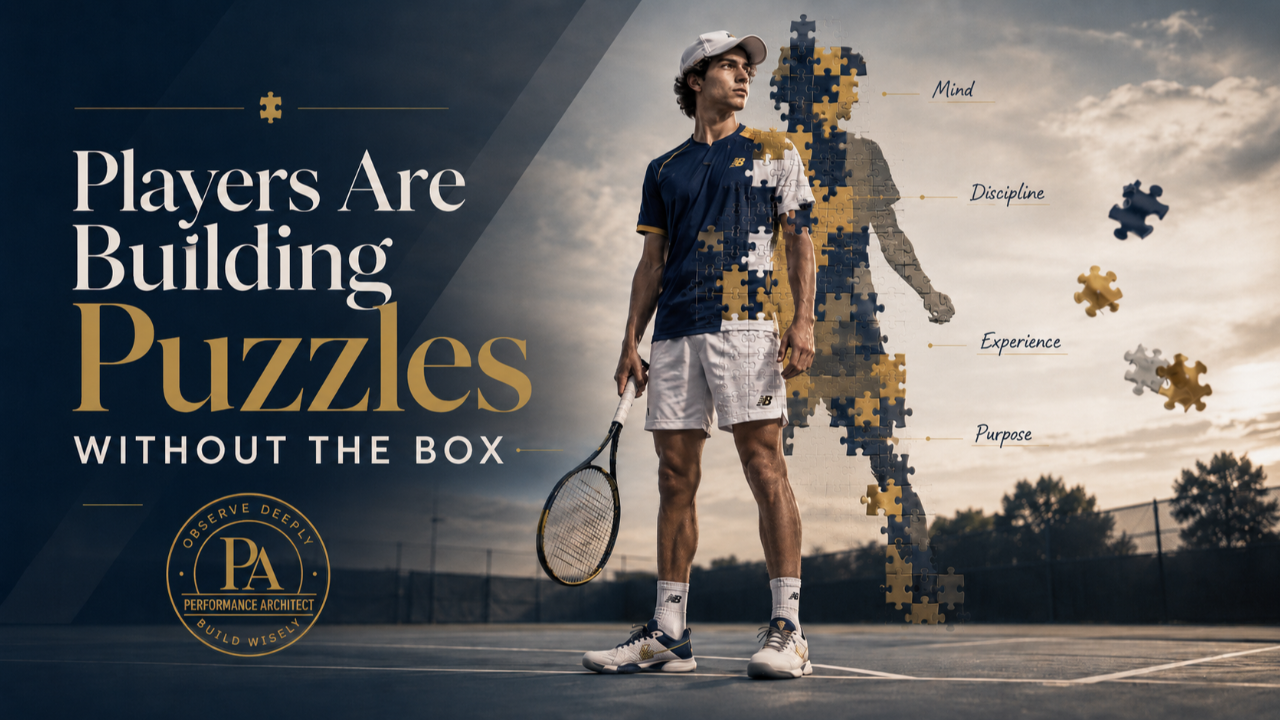
The director stood in front of a group of players and asked them to write down their four best attributes as athletes. Not their best shots. Not their rankings. Their attributes. The parts of themselves they'd carry onto a court.
If you've spent any time around junior tennis, you know what you might expect to hear. Forehands. Serves. Maybe foot speed. What came back was a different kind of list.
One boy said he was a happy person, and that being happy gave him perspective, the sense that a tennis match sits inside a much bigger life. Another said his strength was patience, staying in the point, hitting it back one more time until the other kid handed him something to attack, and fighting with his legs when he was behind. A third named intuition, and explained that it showed up most in doubles, where he could feel where the ball was going before it got there. One named raw speed and the ability to handle pace. One named her height, her endurance from years of cross country, and the fact that she's coachable. One boy listed his tennis IQ, and then, almost as an afterthought, his willingness to ask for help.
The director pointed at what was sitting right there in the room. Everybody's attributes were different. So the way each of them builds a game has to match the person each of them actually is.
That's where I want to start, because what struck me as I listened wasn't only that the kids were different. It was that every one of them was being asked to assemble a tennis identity out of a growing pile of pieces, and almost none of them had ever been shown the picture those pieces are supposed to make.
That's the image I gave the room. We hand these kids pieces all day long. A technical piece from one coach. A tactical piece from another. An emotional piece somebody taught them last week. A correction a parent offers in the car. A habit they picked up watching an older player and deciding that must be what confidence looks like. The table keeps filling up. The one thing nobody hands them is the box cover, the picture on the front that tells you what you're building toward.
Try putting a puzzle together without that picture sometime. It isn't that the pieces are bad. It's that you don't know where any of them go. That's what we do to kids when we teach them to play. We give them good pieces and forget to mention that we never showed them what the finished thing is supposed to look like for them. So a kid can know the drill, repeat the routine, say the right words back to the coach, and still not have a coherent picture of himself. Knowing the pieces and seeing the puzzle aren't the same thing.
And the picture isn't the same from one kid to the next. The patient grinder isn't building the same thing as the boy whose first instinct is to swing big. The kid who reads doubles by feel isn't working from the same operating system as the one who needs a clear tactical script. The work was never to make all of them look alike. It's to help each one get more organized around what's already real in him.
The director made that concrete with a story about a former player, a national-level kid named Brent, whose mother was dying of breast cancer. Brent came to practice every day and then went home and sat with her. Tennis became the good part of his day, because the worst thing that could happen on a court was nothing next to what was happening at home. He went to the Easter Bowl, one of the biggest junior events in the country, ranked somewhere around a hundred, and he beat seed after seed by doing something almost nobody has the nerve to do. He hit two first serves nearly every point. No safe second serve, no extra spin to keep it in. Just go. Afterward the director overheard the father of one of the boys Brent had beaten mutter to another parent, with a few words I'll leave out, something close to "don't they teach a second serve where that kid trains?" The joke is that Brent had hit a pile of second serves all match. He'd just hit them like first serves, and won points doing it, because he had no fear to manage.
Perspective was Brent's box cover. It didn't make him a cleaner ball striker. It told him what the picture was for, and that freed everything else up.
Then the floor came to me, and I had them flip the page over and write down what gets in their way, and I gave them one of mine first, because identity doesn't get built out of only the flattering pieces. Mine is that I can't shut my mind off. I'll chew on a problem instead of trying a simple version and living with what it teaches me. I'm complicated, so the things I touch tend to get complicated. I don't know yet whether that's a strength or a weakness. It's just true, and naming it out loud is where it stops quietly running the show.
The kids went honest fast once they saw an adult go first. One boy said he's so competitive the wanting-to-win can crowd out the part of him that actually loves the game. A girl said she gets furious at herself when she misses a ball she knows she can make, and that on a big point she'll push the ball back instead of going for the shot she can plainly see. Those aren't character flaws. They're pieces too, and they belong on the table next to the good ones. A weakness doesn't have to become a strength. If a golfer ends up in a bunker, the goal isn't to turn bunker play into the best part of his game. The goal is to get out without it wrecking the whole round. The good pieces need to become more available, and the weak ones need to become strong enough that they don't get exploited every time the match asks a real question.
But even the pieces a kid clearly owns don't turn into a picture on their own. I watched a girl work a simple serving drill: five serves in a row, with a coach feeding her the count. She could make four on her own, every time. She missed the fifth one, every time. It wasn't technical. She'd already proven she owned the stroke. Something changed when the count reached five, and I stood there asking questions because the answer wasn't mine to hand her. The serve was a piece. Understanding what changed inside her on the fifth ball was the picture.
I started working with a player a while back, and early on he told me about a match he'd played at an international event the previous summer. As he talked, you could see he was running the film on the inside of his head. He'd been all the way there for it, and the match was still available to him a year later. Then he said he couldn't do that with a tournament he'd played two weeks before. Couldn't find a single moment of it. That gap became the work. Over several weeks of conversation he slowly got it back, until he could run a recent match the same way he'd run the one from a year earlier. That's when we were able to name what had changed. The other voices in his head had quieted enough that his own voice could take hold. Not the coach's voice from the last lesson. Not his dad's. Not whatever his mom said on the drive. His. And once his own voice was present while he played, the match stayed with him afterward.
That's the whole thing, really. A player can't build himself if he can't hear himself.
It doesn't mean the adults disappear. The coach sets the standard. The parent guards the few quiet minutes after a match where reflection either happens or gets trampled. The program provides structure. The match provides honest feedback. But the kid still has to assemble the thing, and that's slower than telling him, and it asks us to ask questions we don't already know the answer to.
A player has to learn which of his pieces are standards, which are tools, which are real strengths, which are weaknesses he has to keep from getting exploited, and which are just noise he picked up along the way. When that sorting starts, the puzzle finally begins to look like something. Not the coach's picture. Not the parent's. Not the academy's. His.
And the question that has to be alive for any of it to happen is the one almost nobody asks a thirteen-year-old directly. Who am I becoming as a competitor? Until that question is awake in the player himself, the rest of us are mostly handing him more pieces and wondering why the picture still hasn't shown up.
Never Miss a Moment
Join the mailing list to ensure you stay up to date on all things real.
I hate SPAM too. I'll never sell your information.
