Sit in the Back
Oct 06, 2026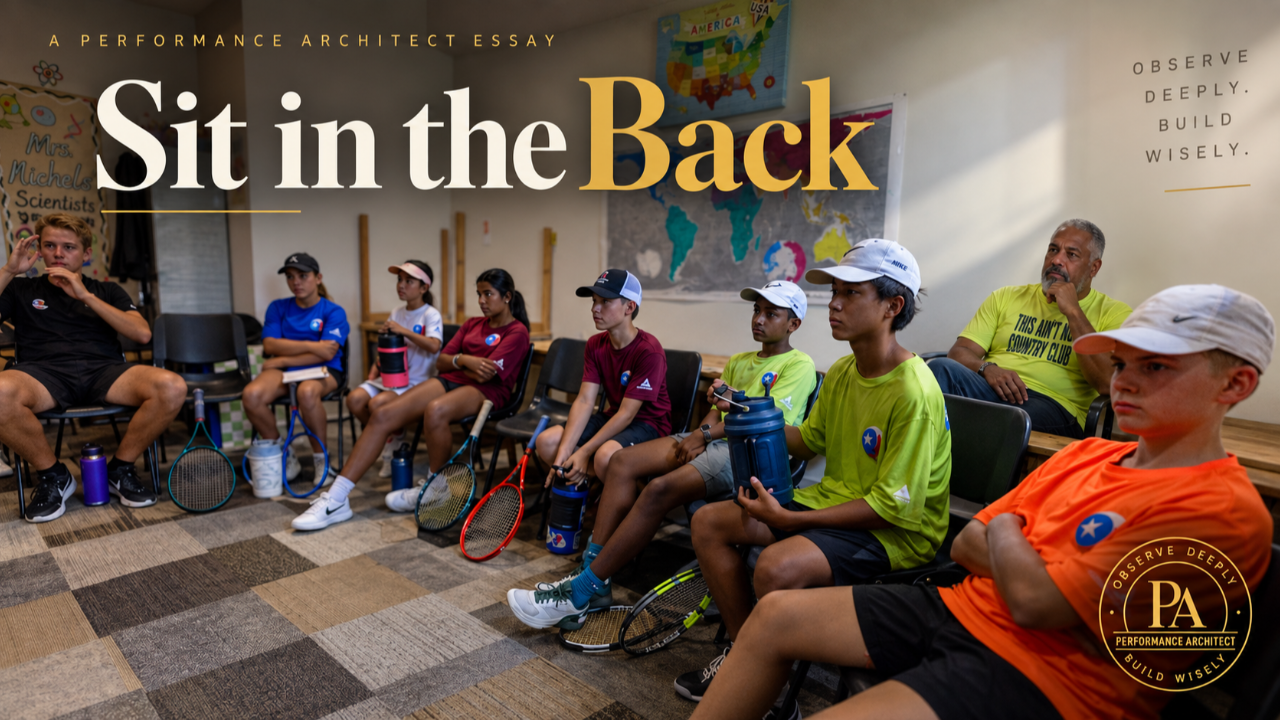
The obvious next move is for me to stop running the room. Not forever, and not because I have nothing left to contribute. Almost the opposite. Seven essays into this, I have enough evidence to know my presence changes the thing I'm trying to study, and enough experience to know I can confuse being useful with being necessary. So for a while, I need to sit in the back, and that sounds simpler than it is.
I built the classroom because I wanted players doing more of the thinking. I wrote the principles, chose the questions, and told the coaches their job wasn't to hand out answers, and then the tape showed me occupying most of the room myself. I counted the words and found a problem. I looked closer and found a structural one. I compared facilitators and found the person with the deepest conventional résumé wasn't automatically the one best equipped to hold the room. Then I narrowed the lens again and found the claim, the moment when a player produces something useful and the adult quietly takes ownership of it back by improving it. I spent two essays after that asking what any of it actually entitled me to say. By the time I got back to Bronson Alcott, the founder problem was hard to miss. A method that still requires its inventor standing at the front is not much of a method yet, which leaves a practical question. What does the founder do once he believes that?
I don't think the answer is disappear. The room still needs architecture. Somebody has to decide what questions are worth asking and help the coaches understand the purpose well enough that they aren't just copying technique. Somebody has to watch what happens, notice where the format fights the goal, and revise the design before the philosophy turns into a set of activities that happen to look similar. That work still feels like mine. Holding the room may not be. There's a difference between withdrawing from the intervention and withdrawing from the system, and I don't think I understood it clearly until now.
For most of my career those two roles were fused. If I designed the practice, I ran it. If I had the idea, I taught it. If something was important enough to introduce, I wanted to be standing there when it landed. Part of that was practical, part was probably ego, and most of it just felt normal. Coaches coach, teachers teach, and founders stand at the front of the thing they founded. But if the goal is transfer, standing at the front forever becomes a strange way to prove it happened. I've spent thirty-five years trying to make players less dependent on their coach. At some point I should apply the same standard to the work itself.
So the next experiment isn't another curriculum. It's absence.
For four consecutive classroom sessions, I want to be in the room and not hold it. I can sit in the back and listen, take notes, and run the recorder. I can watch what happens when somebody else asks the questions and decides how long to let a silence sit. Most importantly, I can resist helping. That last part will probably be the experiment.
I already know what it feels like when a player gives an answer and three connections light up in my head. I know the pull to add the example that makes it clearer, rescue a silence that's gone on too long, or redirect a conversation because I can see where it's wandering. The first seven essays have made those instincts easier to notice. They haven't made them disappear.
Sitting in the back gives me a different job. Instead of asking whether players answered the question I wanted answered, I can ask what the room actually did with the question: who spoke first, who never spoke, and what happened after somebody gave a good answer. Did another player pick it up, or did the facilitator improve it? Did the room tolerate confusion long enough for anything useful to emerge, or did everything still funnel through the person at the front? The tape can answer some of that better than my memory can.
That's where I think the architect belongs, not absent, but one layer back. The architect doesn't have to swing the hammer every time to know whether the building is standing.
That may be the distinction I was missing when I started the Temple School Notebook. I was interested in Bronson Alcott because he'd built a room around conversation, conscience, and the dignity of the learner nearly two centuries before I found myself circling the same questions, and I wanted to know what he'd seen that modern education had misplaced. I still do. But after this series I'm just as interested in what he may not have solved. How does a room stop being his room? What does it take for a method to get strong enough to survive somebody else's judgment, and not just his own? I don't think the answer to either one is standardization.
If Rhiannon ran the room exactly as I would, I'd have learned less from her. Part of what made the transcripts useful is that she brought habits I didn't give her. The method survived contact with another person and changed shape without losing the point, and that feels closer to development than replication does. I think the same is true outside tennis. A manager who has to approve every decision hasn't built autonomy, even if the team performs well. Neither has a parent who solves every problem for a child who rarely gets the chance to fail. The founder version is just harder to see, because indispensability feels so much like proof. Everybody needs me, the room works when I'm there, and nobody knows it the way I do: those can sound like compliments. The tape has taught me they can also be warnings.
I began this series trying to find out whether a classroom was doing what I thought it was doing. I ended up learning I talked more than I believed, and that the format was shaping participation before anybody opened their mouth. I found credentials hiding in places I hadn't thought to look, and ownership changing hands in about two seconds. Even the concepts I built from the evidence turned out to be interpretations rather than facts. None of that produced a formula, and I'm glad it didn't.
The number was never the lesson. It told me where to listen. The tape was never the answer. It gave my certainty something harder to argue with.
And now the next thing I need to test is whether the room still works when the person who designed it stops trying to prove he belongs at the center. So I'm going to sit in the back. I'll still write the questions, watch the tape, and change the architecture when the room shows me something I missed. I just don't need to hold the floor to do any of it.
None of this is finished. Twelve players in a room and a handful of recorded sessions is a start, not a study, and the next batch of tape may complicate some of what these eight essays found. I'd rather say so here than let the series sound more settled than it is.
If you run a room of your own, you already believe something about how much of it you occupy and how necessary you are to it. I believed that for thirty-five years before I counted anything. You might be right. I wasn't.
Maybe that's the final handoff, not from coach to player, but from founder to system.
Never Miss a Moment
Join the mailing list to ensure you stay up to date on all things real.
I hate SPAM too. I'll never sell your information.
