Stabilizing the Loop
Mar 19, 2026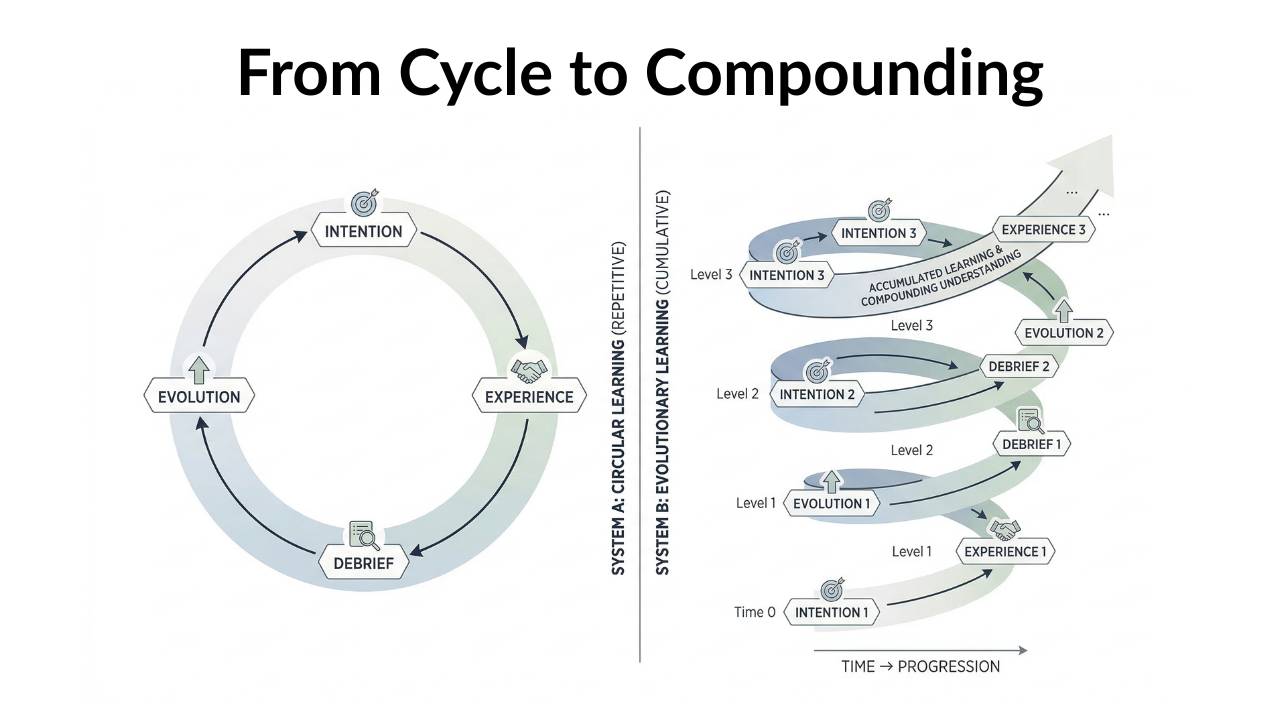
Human to the Power of AI — Essay Nine
Every development environment already contains a learning loop. Most practitioners can name the stages without much prompting: you set an intention, you go through the experience, you examine what happened, and you adjust before the next attempt. The loop is not a new idea. It predates any framework that has tried to formalize it. What differs between environments is not whether the loop exists but whether it actually completes.
That distinction is where most development systems quietly fail, and where this essay picks up the argument that Essays Seven and Eight began.
The loop that drives development in any serious environment runs through four stages. A learner enters a situation with a stated intention. The experience itself follows. Then comes the examination of what happened, the moment where meaning gets made from the event. Finally, the learner adjusts and carries that understanding into the next cycle. Call those stages what you want. The structure is consistent across domains because it reflects something real about how human beings convert experience into judgment. Intention, Experience, Debrief, Evolution. The IEDE framework formalizes that cycle because formalizing it is the only way to protect it.
The first two stages are relatively stable. Intention gets written down or spoken out loud. Experience happens whenever someone acts. The third and fourth stages are a different matter entirely. The debrief is where interpretation enters the loop, and interpretation requires time, attention, and someone capable of asking questions that go past the surface of what occurred. The evolution stage depends entirely on how well the debrief went. When the debrief is shallow, evolution is vague. When the debrief disappears, the loop collapses. The learner experienced something. The environment moved on. Whatever judgment might have formed from that experience never fully formed.
This is not a failure specific to poorly run programs. It is the structural reality of development environments organized primarily around activity. A match gets played, a class concludes, a project is submitted. The event is complete. The visible parts of the environment are satisfied. The examination stage, which is slower, harder to organize, and less legible from the outside, competes with the next event for the same limited time and attention. In most environments, the next event wins. The debrief becomes a conversation in a parking lot, a few words on the way to the car, a note that gets written and never revisited. The environment hosted the exchange. It did not hold it.
The ATA program built around the Match Card makes this concrete without requiring any abstraction. Players arrive at competition with a Match Card already completed: a written statement of intention that reflects what they are trying to accomplish and learn that day. The match itself is the experience. What the Match Card structure revealed, through years of watching where the developmental thread broke, is that the loop was completing the first two stages reliably and collapsing at the third. A player who wrote a specific intention before competing would leave the match carrying only the result. Win or lose, the intention on the card and what actually unfolded on the court rarely got examined together. The next card would get written, but it was informed by outcome rather than understanding. Without a structured debrief that turned the result into something examined, and an evolution phase that fed that examination back into the next card, each match existed largely in isolation. Adding formal debrief and evolution phases to the existing structure was not introducing a new system. It was finishing the loop that was already trying to run.
The debrief stage matters this much because it is where interpretive architecture is created. Not delivered, created. A skilled mentor sitting with a player after a difficult match is not primarily transferring information about what happened. They are demonstrating a way of reading the situation: which details matter, what the player was actually deciding in the moment versus what it looks like from the outside, where the gap between intention and execution opened and why. That demonstration is the architecture. The player who goes through enough of those conversations eventually begins running the same examination process before the conversation even starts. That is the mechanism that Essays One through Five traced across Michael Canavan's development. The debrief is where that mechanism lives.
What has always been true is that the interpretive architecture created inside a debrief disappears almost as fast as it forms. The conversation ends. Both people carry the reasoning with them until the next event, the next pressure, the next shift in attention erodes it. The environment that hosted the exchange holds nothing. Future learners entering similar situations have no access to the reasoning that experienced practitioners developed inside earlier debriefs. They encounter the activity, they attempt their own examination, and they build their own interpretive framework from something close to scratch. The loop runs. The architecture it produces does not persist.
The shift that becomes possible when captured interpretive dialogue is part of the environment's structure is not a new kind of debrief. The examination itself still works the same way. What changes is what happens to the reasoning inside the examination after it concludes. When that reasoning is preserved as dialogue rather than compressed into conclusions, the environment retains not only what decision was made but how experienced practitioners arrived there. The debrief stage stops being an event that resets and starts functioning as a structure that accumulates. Questions that emerged from earlier examinations of similar situations remain accessible to learners encountering those situations for the first time. Distinctions that experienced practitioners developed through years of debriefs are already present in the environment when new practitioners arrive. The loop does not start from zero with each cohort.
The evolution stage changes accordingly. Evolution is the stage where adjusted intention forms, where the learner carries something different into the next cycle because the examination revealed something worth carrying. When debrief is weak, evolution is arbitrary. The learner adjusts based on outcome rather than understanding. When debrief is strong and accumulated, evolution becomes informed. The learner can examine not only what they did differently but how previous practitioners arrived at similar adjustments. The reasoning behind evolution is visible in the environment, not locked inside individuals who may or may not be available to share it.
This is what it looks like when the architecture described in Essays Seven and Eight operates inside a specific mechanism. The environment holds interpretive architecture not as an abstraction but as the accumulated reasoning of every serious examination that happened inside it. Each debrief that is captured adds to what the environment can surface the next time a learner confronts a situation that earlier learners confronted before them. The loop that development environments have always depended on becomes something different when the most fragile stages within it finally have structural support. It stops behaving like a cycle that must be rebuilt and starts behaving like a system that compounds.
The question the next essay takes up follows directly from here. Inside any development environment running this loop, the debrief is not a conversation between two people. It is a conversation involving at least three, because the player, the coach, and the parent almost always leave the same experience with different interpretations of what occurred. How those interpretations interact with the loop, and what changes when a fourth participant can help stabilize the record of what actually happened, is where the arc moves next.
This is Essay Nine of the Human to the Power of AI series.
Never Miss a Moment
Join the mailing list to ensure you stay up to date on all things real.
I hate SPAM too. I'll never sell your information.
