Ten Months Later, INTENNSE Came to Austin
Nov 01, 2026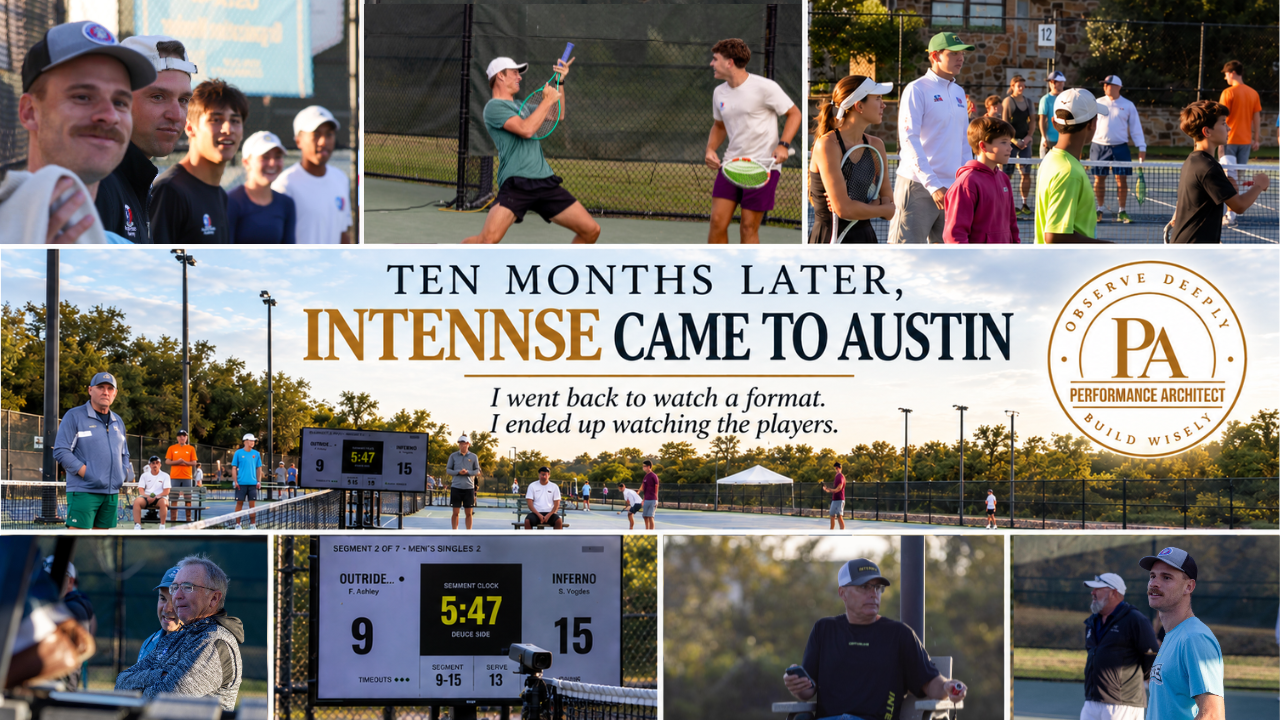
I went back to watch a format. I ended up watching the players.
Last December I drove to Atlanta to watch professional tennis players compete in a format built to change what the sport looks like from the stands.
I'd spent months talking with Charles Allen, INTENNSE's CEO and one of its founders, and with Randy Jenks, its VP of competition. I'd already written about the format and called it the speed chess of tennis. I'd tied it to an idea I'd carried since 1997, when I was coaching Kano Solomon and wondering why tennis never had its Harlem Globetrotters moment. Kids who'd never held a racquet needed to see someone do something extraordinary and decide they wanted to try it.
The exhibition before the Atlanta Cup was my first look at the format in person. I left thinking it deserved close attention.
On Monday, a little more than ten months later, INTENNSE came to Austin Tennis Academy and ran a competition during the College Prep morning practice. I knew it wouldn't be what I'd seen in Atlanta. What I didn't anticipate was how much I'd learn from watching the players meet it for the first time. The format didn't put on a show. It confused people, and that confusion taught me more than I expected.
Same Strokes, Different Decisions
Nothing about the tennis itself was new. Same court, same racquets, same serves and forehands and volleys the players had been grooving for years. What changed was the set of decisions surrounding those strokes. One serve. A fourteen-second serve clock. A running clock that turned time into something you could spend or save. Opportunities to score two points. Substitutions that could change who was on court while the clock kept moving. Some players were assigned to watch the clock, some tried to track who served next, and teammates on the bench learned they had jobs even without a racquet in hand.
Some players caught on fast. Others didn't. In the closing discussion, one player admitted it was hard to know when everything was supposed to happen. He also guessed that after six or seven times through, most of that would go away. I suspect he's right.
But I wouldn't rush past the confusion. It showed how much of what we call tennis intelligence is really familiarity with one environment. Familiarity is its own kind of intelligence, but it's tied to the setting where it was built. Change the environment and you start to see which decisions a player can carry into new conditions and which ones depend on the old ones. A player who knows exactly what to do between points in a regular match now has to decide whether to speed up or slow down. A player raised on two serves has to rethink risk. A kid used to sitting quietly while a teammate plays suddenly has work to do. And a player who loses a point doesn't get much time to complain about it.
That last one got my attention.
No Time to Whine
I've spent a lot of years working with young people on tolerance, fortitude, resilience and adaptability. The hard part has never been naming those qualities. It's building settings where you can actually watch them show up. We tell players to let go of mistakes, hand them routines and ask them to bring their attention back to the next ball. Then we send them into matches with enough dead time between points to hold a full trial in their heads about how unfair the last one was.
INTENNSE takes most of that time away. On Monday the players ran into the same frustrations they'd meet anywhere: missed serves, poor choices, teammates' errors. The difference was that the next decision arrived almost right away.
Afterward, Randy mentioned that one developmental use of the format might be teaching players to turn the page after a point. I told him that was one of the biggest things I'd noticed. You don't have time to whine.
I want to be careful here, though. No time to whine isn't the same thing as resilience. A player who can't voice frustration hasn't necessarily learned to handle it. It may just be sitting under the surface, waiting for the next point to go wrong. What the format offers is a different place to look, one where the next decision arrives before the last one has had time to settle. Does the player actually reset, or does the last point leak into the next choice? Can she stay effective while the feeling is still there?
Pressure is diagnostic. INTENNSE may be a new instrument for applying it.
The Kids Who Weren't Playing
Something was missing Monday that I think matters more than it seems. Ballkeepers.
In Atlanta, the ballkeepers weren't anonymous kids collecting balls. They belonged to teams, wore team uniforms and took part in the competition. On Monday, without that system, players who weren't competing chased balls and kept things moving. It worked for a first look, but it changed the room. Balls piled up in the wrong spots, and players split their attention between supporting teammates and clearing the court. Randy agreed afterward that ballkeepers, organized benches and more formal substitution procedures would make the event feel more competitive and less chaotic.
I agree. But my interest goes past keeping the clock moving.
Part of what drew me to the Globetrotters as a model in 1997 was the bond they built between athletes and kids. They made basketball exciting to people who might never watch an NBA game, and they made kids want to copy what they saw. The ballkeeper idea may go a step further. A child doesn't have to become a professional to be inside a professional competition. She can have a role, a uniform, a responsibility and a real relationship with the players. She belongs to something. And because a ball delivered quickly can catch an opponent who isn't ready, the job asks her to pay attention, anticipate and read the situation. That isn't errand-running. It's participation.
I asked Randy to explain the program to the younger players before practice ended, because I didn't want that piece to fall out of the conversation just because it wasn't part of the day's demonstration. If INTENNSE eventually builds teams tied to cities, I can see ballkeepers becoming one of the main ways those teams take root in a community. Not because those kids are future ticket buyers, though some will be. Because they'd already be part of it.
What Karue Learned, and What I Missed
I also got some time with Karue Sell, who played a professional INTENNSE season. What he told me challenged one of my early assumptions.
When I first started thinking about this format, I pictured it rewarding spectacular athleticism. The improvised, expressive tennis that drew me to Gaël Monfils and Nick Kyrgios, and that had me working on no-look overheads with Kano almost thirty years ago. I wrote that INTENNSE might be the first format to make expressive play structurally viable. Karue described something else.
His team came out playing too aggressively. They chased winners and tried to force the action. Over time they learned that solid tennis, smart clock management and small runs of points paid off more often. Sometimes the right move was to slow down. Other times it was recognizing that a teammate was playing better and leaving him on court, or simply keeping a rough stretch from turning into a disaster.
I'd been looking for a format that might reward different kinds of athletic expression. I hadn't fully considered that it might also reward different kinds of restraint. A format built to create more excitement doesn't necessarily reward the players who try more exciting shots. It may reward the ones who best understand how time, risk, momentum and team performance fit together. That doesn't take anything away from what INTENNSE is doing. It makes the architecture more interesting than I gave it credit for.
What the Juniors Might Get
Randy and I talked afterward about what the format could become for juniors. The longer we talked, the more I suspected the junior version might be worth something on its own terms, not just as a pathway into the professional game.
That's worth sitting with. We usually judge new sports products by spectators, sponsors and television audiences. Those are fair questions for anyone building a pro league, but they aren't the only ones. The format might make practice more engaging. It might give players reps at managing time, deciding under pressure and supporting teammates, while offering a different kind of competition to kids worn down by the traditional tournament grind. Randy suggested that even using it once a month as a team activity could be worthwhile.
That sounds modest next to building a league. From a development standpoint, it isn't. Plenty of kids spend enormous hours practicing tennis and very little time experiencing it in ways that are truly different. Four local academies could run an INTENNSE competition in a single day. Teams could be drafted for balance. Players could compete in several Bolts, the format's ten-minute periods, with enough time between them to reflect on what just happened.
If the adults were deliberate about what they watched, they might learn things about those players that tournament results don't show. Not just who won, but who adapted to the clock, read when a teammate was better placed to help, and changed a losing plan before anyone told them to. Those are developmental questions, and they're the ones I care about.
Seeing It Twice
Part of why I drove to Atlanta was that I didn't want to judge INTENNSE from phone calls, promotional material and video. I wanted to stand inside the environment. Monday backed up that decision. Several people at the academy were seeing the format for the first time, and their early confusion made sense. Randy pointed out that the second experience tends to be less chaotic, because people start to understand what's happening.
That distinction matters when you're judging anything new. The first experience tells you something about accessibility. Later ones may tell you more about what the format can actually do. Monday wasn't a full copy of the professional product, and it wasn't meant to be. Missing ballkeepers, loose bench organization and unfamiliar rules all shaped what we saw. That doesn't make it less useful. It gives everyone a place to start.
Jack Newman has now seen the format run on his courts. The players have been through it once. Some of the equipment will remain available for future use, and there was talk about more events and what a more formal junior competition might look like. Those are possibilities, not conclusions.
What I want to see is the same players coming back a second or third time, with organized ballkeepers, clearer team roles and a little more comfort with the rules. Does the confusion fade and the intensity climb? Do players start making decisions we didn't see on Monday? And do the youngest kids find something that matters in being part of the event without being the ones holding racquets?
I don't know yet. That's why I want to see it again.
Ten Months Later
When I first wrote about INTENNSE, what excited me was the possibility that someone had started rethinking tennis from the foundation instead of renovating the house we inherited. Ten months later I'm still interested, but my questions have moved.
I'm less curious about whether INTENNSE can make tennis look more exciting. I already think it can. I'm more curious about what a changed environment shows us about the people inside it. What it teaches and rewards, what it exposes, and who it makes room for that competitive tennis has usually left on the sideline.
Monday didn't answer those questions. It gave me better ones. After sixty years around this game, I'll call that a pretty good morning.
Never Miss a Moment
Join the mailing list to ensure you stay up to date on all things real.
I hate SPAM too. I'll never sell your information.
