The $50,000 Miscommunication
Jan 06, 2026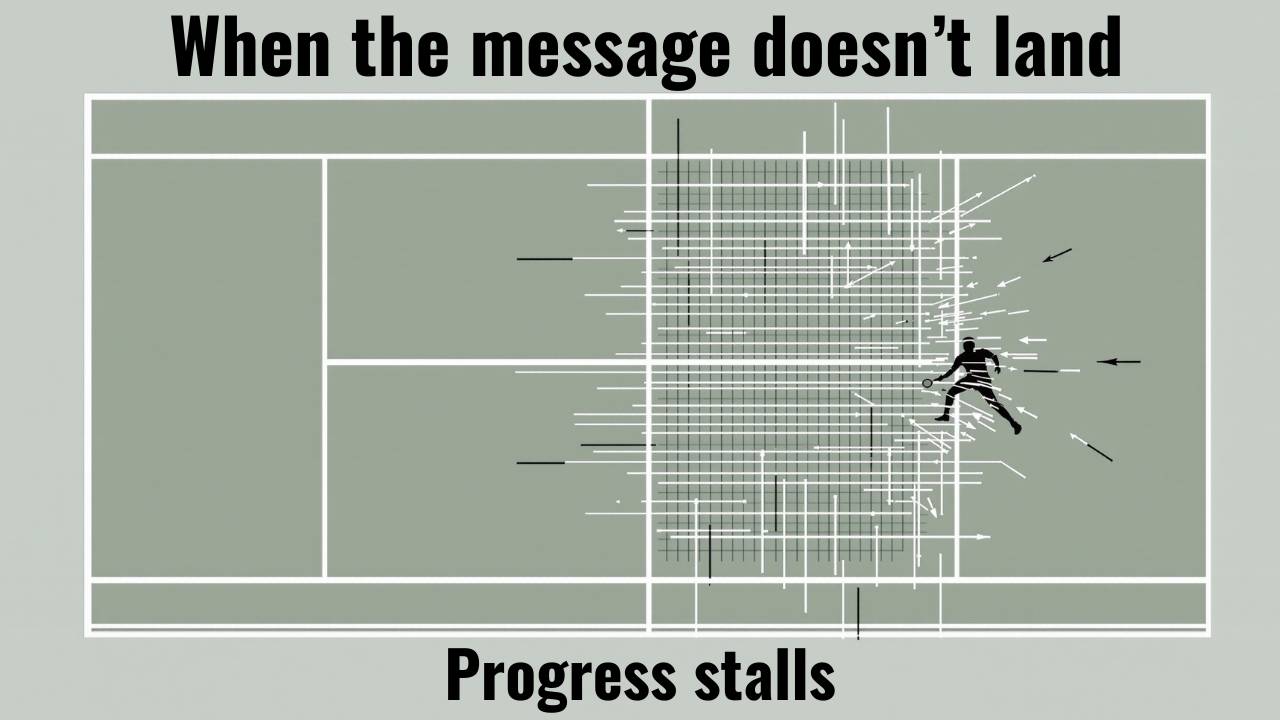
Sarah's daughter Maya had everything working at twelve. Regional rankings climbing. Coaches impressed. College pathway looking solid. The family was spending about $3,000 monthly between private lessons, group training, tournaments, and travel. Standard investment for a player tracking toward a D1 scholarship.
By fourteen, Maya had stopped improving. Actually worse than that. She was regressing in matches despite looking better in practice. Her strokes were cleaner than ever. Her fitness had improved. But her tournament results were sliding backward.
Sarah did what most parents do. She increased the investment. More private lessons with the head pro. Mental toughness coaching. Sports psychology sessions. Tournament schedule expanded to get more match play experience. Hotel weekends became routine. Monthly spend climbed past $5,000. Results kept declining.
The coach blamed Maya's commitment. Said she wasn't focused enough in big moments. Recommended more mental training. Sarah blamed herself for not pushing hard enough. Started tracking everything more closely. Creating accountability systems. Maya started saying she hated tennis. Family dinners became tense. Nobody could identify what had broken or how to fix it.
This pattern shows up everywhere in youth tennis. Different families. Different coaches. Different players. Same expensive confusion.
The Invisible Barrier
Here's what was actually happening with Maya. Her coach was pattern-focused. He saw tennis as a system of tactical relationships and strategic adjustments. When he gave instructions, he described patterns. "When she hits short cross-court, you need to recognize the angle is opening up behind her." "Watch how her weight shifts before she goes down the line." "The pattern you want is wrong-footing her off the first ball so the court opens up on ball two."
Maya's brain doesn't process pattern recognition efficiently under pressure. She's evidence-focused. She needs concrete, sequential information about what to do with her body right now. "Step into the court when the ball lands short." "Move forward and right to cut off the angle." "Hit behind her on the second ball." Same tactical situation. Different language.
This isn't who Maya is. It's how her brain prioritizes information when time collapses and stakes rise.
In practice, this mismatch was invisible. Maya could ask questions. The coach could adjust his explanation until something clicked. Repetition covered the communication gap. But under match pressure, when Maya needed to process information in real time, the pattern-based language her coach had been using all year became static. Her brain couldn't translate it fast enough. She froze. Made mechanical errors. Looked like she was choking when she was actually drowning in information her brain couldn't use.
The mental toughness coaching made it worse. The sports psychology added pressure to "be mentally stronger" when the problem wasn't mental weakness. It was communication translation failure. Same technical instruction delivered in evidence-based language instead of pattern-based language would have worked immediately. But nobody recognized that's what was broken.
Three years. Roughly $180,000 in accumulated spending. Damaged relationship with tennis. Strained family dynamics. All treating symptoms while the infection spread.
Why This Pattern Stays Invisible
Communication translation failures are structurally invisible to everyone inside them. The coach thinks he's being clear because the words make sense to him. Maya thinks she's working hard because she's following instructions. Sarah thinks she's being supportive because she's providing resources. All three are operating in good faith. All three are right about their own experience. All three are failing.
This is why the standard solutions don't work. More coaching from the same coach just delivers more of the communication style that isn't landing. Switching coaches randomly might accidentally solve it, but usually just replaces one mismatch with a different mismatch. Mental toughness training addresses an outcome, not a cause. Sports psychology helps players cope with confusion, but doesn't eliminate the confusion.
Most families waste two to three years before they even recognize this is what's happening. Some never recognize it. They conclude their kid "didn't have what it takes" or "lost their love for the game" when what actually happened was systematic communication breakdown that looked like everything except what it was.
The Pattern Appears Everywhere
I've watched this exact sequence play out for thirty-five years across hundreds of families. The details change. The pattern doesn't.
Ten-year-old shows promise. Family invests appropriately. Player improves rapidly under initial coaching. Somewhere between twelve and fourteen, progress stalls. Sometimes regresses. Family increases investment. Results don't improve proportionally. Confusion becomes anxiety. Anxiety becomes blame. Nobody can identify what's actually broken.
Sometimes it's coach-player mismatch. Sometimes it's parent-player mismatch where well-meaning feedback delivered in the wrong communication style creates noise instead of clarity. Sometimes it's coach-parent mismatch where the coach and parent aren't aligned on what the player actually needs, creating conflicting messages the player has to navigate. Sometimes it's all three in different combinations. The expensive part isn't the mismatch itself. Communication mismatches are normal and fixable. The expensive part is operating without systematic diagnosis while the problem compounds.
Every month that passes with the wrong intervention makes the underlying issue harder to see. The player develops compensations that obscure the root cause. The family adjusts to dysfunction in ways that make the dysfunction feel normal. The coach doubles down on approaches that aren't working because they can't see why they aren't working.
What Actually Fixes It
This isn't a coaching problem. It's an infrastructure problem. The coaching is often perfectly good. The expertise exists. The technical instruction is sound. What's missing is the translation layer that makes the coaching accessible to this specific player's brain.
I've seen the same player who "couldn't focus" under one communication style become systematically excellent under a different communication style within eight weeks. Not because they suddenly developed mental toughness. Because someone finally delivered information in a format their brain could process under pressure.
I've seen parents who thought they were being helpful discover they were creating confusion by using language patterns that triggered anxiety in their kid's processing style. Shift the language. Keep the support. Anxiety drops. Performance stabilizes.
I've seen coaches who were frustrated by a player's "resistance" discover the player wasn't resisting. The player's brain literally couldn't translate pattern-based instruction into executable action fast enough in competition. Switch to evidence-based instruction for that player. Keep pattern-based instruction for players who process that way. Same coach. Same expertise. Both players improve.
The fix isn't mysterious. But it requires systematic diagnosis before intervention. You have to see the mismatch before you can repair it. Most families skip diagnosis and jump straight to more coaching. It's the difference between the broad spectrum chemotherapy of old and the burgeoning highly focused treatments of today. You may kill what ails the player, but you also may kill their desire in the process.
The Three-Conversation Framework
I can identify communication mismatches in three conversations. One with the coach. One with the player. One with the parent. Forty-five to sixty minutes each. Not interviews. Systematic observation of how each person processes information, delivers information, receives information under stress.
The coach conversation reveals their communication style, what they're seeing, what's not landing, where they feel stuck. The player conversation reveals their processing style, where clarity happens, where confusion lives, what creates confidence versus what creates panic. The parent conversation reveals what they're observing, where their anxiety lives, what language patterns they're using, whether those patterns are helping or hurting.
Three perspectives on the same system. Synthesis across all three reveals the invisible mismatches. Not opinion. Not guess. Systematic diagnosis using frameworks developed over three decades watching exactly this pattern destroy potential that didn't need to be destroyed.
What you get is a detailed report identifying specific communication mismatches, concrete adaptation strategies, and an implementation timeline. Not more advice. Architecture. Infrastructure repair that makes existing coaching effective again.
This Isn't For Everyone
This assessment makes sense for families spending $30,000 or more annually on player development who recognize progress has stalled despite increased investment. It makes sense when the player is between eleven and sixteen, which is when communication mismatches cause the most expensive damage. It makes sense when you want systematic understanding instead of another opinion about what might be wrong.
It doesn't make sense if you're still hoping the next tournament cycle will clarify things, or that one more coaching adjustment will unlock progress. The three-conversation framework doesn't validate what you're already doing. It reveals what isn't working and why. That clarity requires action. If you're not ready to implement changes that might disrupt existing coaching relationships, training patterns, or family routines, the diagnosis will create pressure without purpose. This assessment is for families who are past hoping and ready for recognition.
It doesn't make sense if you're looking for quick fixes or someone to tell you what you want to hear. It doesn't make sense if you need consensus from multiple stakeholders before you can act on findings. It doesn't make sense if your investment level makes the ROI unclear.
The three-week process from first conversation to delivery of findings and implementation plan represents a fraction of what most families waste annually on interventions that don't address root causes. Investment details vary based on scope and whether families want one-time assessment or ongoing systematic support. If preventing another season of misdirection matters, this assessment delivers among the highest-ROI investments most families make in their player's development.
What Happens After Diagnosis
The most common response after receiving the assessment findings is relief. Not because every problem gets solved immediately. But because the confusion lifts. Families stop blaming themselves, their player, or their coach for failures that were structural rather than personal. The path forward becomes clear even when the path requires difficult adjustments.
Parents discover their player wasn't lazy or uncommitted. The player's brain simply couldn't process the coaching language efficiently under pressure. Coaches discover their instruction wasn't landing not because it was wrong but because it was delivered in a format the player couldn't translate fast enough during competition. Players discover the anxiety they felt wasn't weakness but rational response to receiving information their brain couldn't use.
Systematic diagnosis removes the guessing. It shows what's actually happening instead of what it looks like is happening. It provides concrete steps that address root causes instead of symptoms. It makes existing investment work instead of requiring families to spend more on top of what's already not working.
If You Recognize This Pattern
Three conversations. Clear diagnosis. Implementation plan. If your player showed early promise but progress has plateaued. If increased investment isn't producing proportional improvement. If you're spending $30K or more annually without clear understanding of what's actually broken.
I take eight to ten consultations per quarter. If you recognize these patterns and are ready for systematic diagnosis instead of another season of expensive confusion, schedule your three-perspective assessment now.
This isn't more coaching. It's infrastructure repair. And infrastructure repair is what makes everything else you're already investing in actually work.
[Schedule Your Assessment]
If this work aligns with where your organization is heading, I’m open to serious conversations about partnership and collaboration.
Performance Architect | Founder, Communiplasticity Solutions
📧 [email protected]
📞 469.955.DUEY (3839)
🌐 theperformancearchitect.com
Never Miss a Moment
Join the mailing list to ensure you stay up to date on all things real.
I hate SPAM too. I'll never sell your information.
