The $50 Million That Changes Youth Development
Jan 24, 2026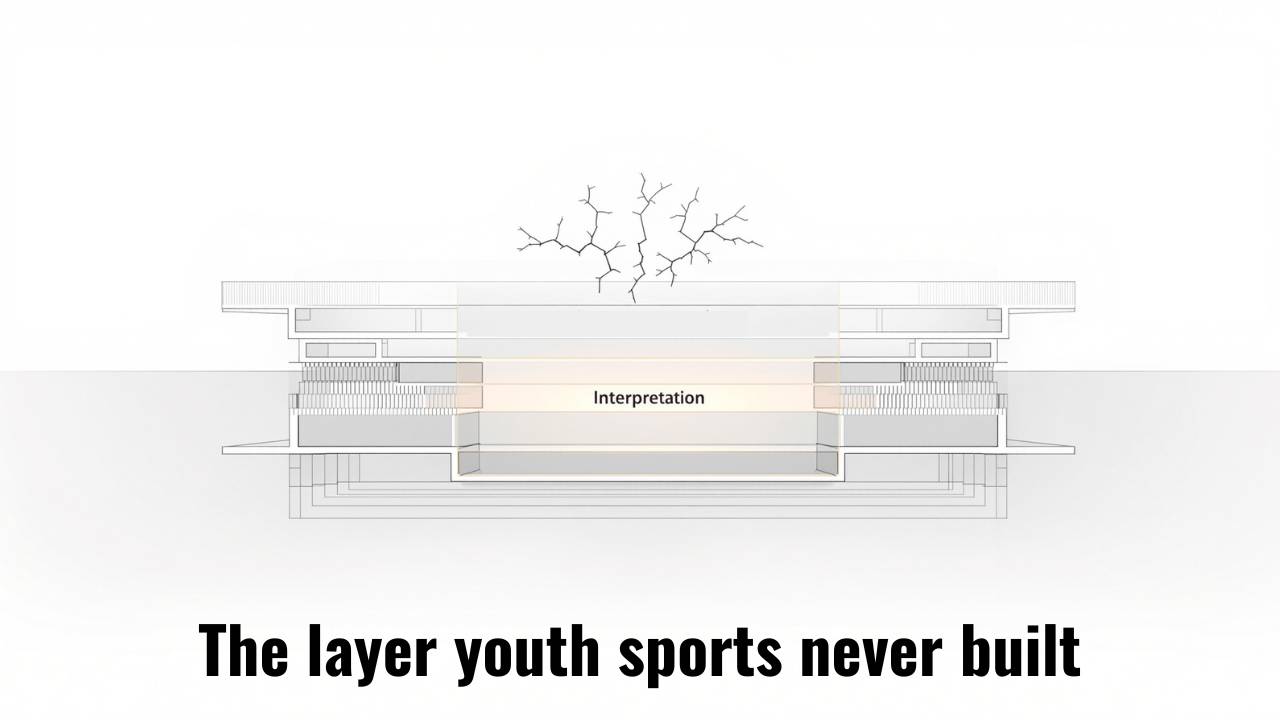
Fifty million dollars sounds like an audacious ask until you realize what gets spent chasing the wrong things. Two mid-first-round draft picks cost that much. National governing bodies spend comparable amounts on marketing and branding initiatives. Spread across the global ecosystem feeding professional leagues, college programs, and lifelong participation, fifty million barely registers as a line item.
The number matters precisely because of how small it actually is relative to the surface area of the problem.
Youth development fails predictably, and money has nothing to do with it. The industry optimized itself around motion instead of understanding, compliance instead of judgment, outcomes instead of experience. Families feel the fractures long before institutions acknowledge them. The system keeps churning. The damage accumulates at home where nobody measures it.
This essay argues for a single, patient, seed investment that changes the trajectory of youth sports by installing what was never built in the first place. Not another program. Not another platform. A missing operating layer that aligns athletes, parents, and coaches around what actually happens during development. One that reduces the unnecessary conflict killing families before talent gets a chance to mature.
The Real Cost Gets Absorbed Where Nobody Looks
The visible costs are easy. Training fees, travel budgets, equipment upgrades, private coaching sessions. Add it up and you get large numbers that families either afford or they don't.
The invisible costs never get tallied because they happen inside relationships. Most families run a high-stakes project with no shared language, no clear authority structure, and no reliable feedback loops. Parents piece together information from coaches, rankings, social media conversations, and other parents operating under their own confusion. Athletes experience pressure in their bodies months before they develop words for what they're feeling. Coaches work inside incentive structures rewarding short-term wins over long-term understanding because nobody taught them how to do anything else.
When systems refuse to explain themselves, families absorb all the uncertainty. That uncertainty surfaces as anxiety, miscommunication, and conflict that feels personal but stems from structural failure. Conversations miss each other because people optimize for different definitions of success without realizing it. Expectations drift sideways and downward. Decisions become emotional reactions instead of informed choices because the information required for informed choice never existed in usable form.
Marriages strain under the weight of disagreements about things neither parent understands clearly. Parent-child relationships fracture when kids internalize adult fear and mistake it for their own motivation. Athletes quit not because they lack talent but because they cannot survive the emotional weather created by everyone trying to help them.
None of this happens because families are weak or uncommitted. It happens because the system was built without an interpretation layer.
What Never Got Built But Should Have Existed Decades Ago
Most complex fields solved this problem before anyone alive today was born. Medicine built teaching hospitals where novices could develop judgment alongside experienced practitioners before lives hung in the balance. Aviation built simulators that let pilots experience catastrophic failure without dying. The military built war colleges where officers could study decision-making under uncertainty before soldiers paid for their mistakes.
Each created environments where complexity became intelligible through structured experience and guided reflection. Places where judgment formed before stakes became irreversible. Where the difference between good and bad choices could be named and studied instead of just felt in the aftermath.
Youth sports never built its equivalent. Instead we built tournaments, rankings, and pathways that assumed understanding would somehow emerge from repetition alone. It rarely does. Repetition without reflection produces compliance, not insight. Performance without interpretation produces fragility, not resilience. The entire industry operates on the assumption that people will figure it out by doing it wrong enough times until something clicks.
The missing institution has nothing to do with another academy or another online platform. What never got built was a place where experience gets translated into understanding in real time. Where families and athletes develop a shared map of what's happening and why it matters.
The Architecture Solves a Different Problem Than Most People Think
The core mechanism is simpler than it sounds. Create instrumented environments where performance, perception, and decision-making can be observed, discussed, and aligned. Pair physical experience with structured reflection instead of treating them as separate activities. Give families and athletes access to the same evidence at the same time so conversations start from common ground instead of competing interpretations.
Here's what that looks like in practice. A player thinks they lost because they choked under pressure. The data shows their decision timing stayed consistent but shot selection deteriorated in specific tactical situations. The coach recognizes a pattern they've seen before. The parent hears the explanation in plain language without technical jargon. The athlete leaves with one clear thing to train and three things to stop worrying about. Everyone saw the same evidence. The conversation took eight minutes instead of three weeks of misaligned anxiety.
This approach refuses to tell families what to do. It gives them the ability to see clearly, which turns out to matter more. When athletes understand what they're actually working on, effort becomes intentional instead of performative. When parents understand what progress looks like in real time instead of retrospectively, pressure decreases because anxiety stems from not knowing, not from knowing bad news. When coaches can point to shared evidence instead of relying on intuition alone, trust stabilizes because everyone can verify claims against observable reality.
The architecture works in tennis because tennis provides measurable outcomes, controlled environments, and immediate feedback loops. Team sports add complexity through collective dynamics and distributed decision-making, which makes a shared interpretation layer even more valuable. The principle transfers across contexts. Anywhere human development unfolds nonlinearly under emotional pressure, structured translation between experience and understanding changes outcomes.
Why Outcomes Change for Families and Why That Matters More Than Performance Metrics
One of the least discussed costs of youth sports shows up in family stress, counseling sessions, and the slow erosion of trust at home. The industry damages relationships that were supposed to support development in the first place.
Parents argue because they optimize for different interpretations of success without realizing those interpretations diverge. One parent sees rankings as validation of investment. The other sees rankings as distraction from skill development. Both think they're arguing about tennis or soccer or gymnastics when they're actually arguing about competing theories of what childhood should produce. Kids shut down emotionally because they cannot reconcile adult expectations with their lived experience of struggling to master difficult things while managing social dynamics and academic pressure. Coaches withdraw from meaningful communication because explaining complexity inside a noisy system full of people who lack shared vocabulary becomes exhausting fast.
The result is rupture. Not the kind that leads to immediate dramatic collapse, but the kind that erodes connection slowly until families realize they stopped being able to talk to each other years ago.
By creating shared orientation, this system changes the emotional mathematics inside families. Stress does not disappear because stress is inherent to meaningful development. But intelligible stress is survivable in ways that mysterious stress is not. When experience gets named accurately instead of interpreted through competing frameworks, communication improves. When communication improves, trust stabilizes. When trust stabilizes, families stay intact long enough for growth to compound over the timelines actually required for humans to develop into capable adults.
The promise here is not harmony. The promise is coherence. Coherence reduces panic. Panic is what destroys families while the industry pretends not to notice.
Why Fifty Million Is the Right Number Instead of More or Less
This is not a moonshot budget requiring venture-scale returns. It's a protection budget designed to preserve integrity during the learning phase. Fifty million dollars funds a small number of deeply considered prototype environments across multiple sports. It supports longitudinal study rather than forcing premature scale. It buys independence from rankings bodies, national federations, and short-term monetization pressure that corrupts every other attempt at reform.
Less money forces compromises that undermine the core thesis. You cannot build instrumented environments that produce reliable data with inadequate equipment. You cannot run longitudinal studies when funding might disappear next year. You cannot maintain independence from incumbent institutions if you need their endorsement to survive.
More money invites bureaucracy and mission drift. Large capital stacks attract administrators who optimize for managing capital rather than learning what works. Fifty million is the minimum required to preserve epistemic integrity while discovering what actually changes outcomes at the systems level.
What Fifty Million Actually Builds
Over twenty-four to thirty-six months, three to five prototype environments across different sports contexts. One mobile instrumented unit that can move between facilities, plus two permanent sites where longitudinal observation becomes possible. The mobile unit proves portability. The fixed sites enable depth.
A small interdisciplinary team combining expertise in human development, measurement systems, and communication design. Not an organization chart. A working group accountable for learning what transfers and what doesn't.
Longitudinal cohort tracking with shared evidence standards that survive personnel changes and funding cycles. The infrastructure persists beyond any individual program or personality.
Governance structure preventing institutional capture. Independent oversight that cannot be bought by rankings organizations, national federations, or commercial interests that benefit from the current confusion. This protection matters more than the equipment budget.
Why This Beats Traditional Philanthropy and Venture Capital Logic
Philanthropy funds programs. Venture capital funds growth. This funds the missing capacity: interpretation.
This investment funds understanding. Understanding compounds quietly across domains. It improves outcomes even when talent ceilings stay fixed. It transfers between contexts in ways that programs cannot. And it leaves behind something durable regardless of whether any specific intervention succeeds at scale. A way of seeing that persists after funding ends, infrastructure depreciates, and organizations dissolve.
Even in failure, the return is knowledge that prevents future harm by showing what doesn't work before more families get damaged trying it. That alone is rare enough to justify the experiment.
The Investor Question Beneath the Question
Every serious investor who built something meaningful eventually confronts the same private reckoning. Did I simply win, or did I improve something that actually mattered beyond the returns it generated.
For the cost of two mid-first-round draft picks who might never play rotation minutes, it becomes possible to reduce family rupture, athlete burnout, and systemic waste across an entire development ecosystem. To fund understanding instead of noise. To replace guesswork with shared orientation in a domain that shapes millions of young people during the years that determine how they'll approach challenge for the rest of their lives.
This work will exist eventually because the current system damages enough families that institutional inertia cannot hold indefinitely. The only open question is who chooses to underwrite the experiment before the results become obvious enough that the opportunity to shape foundational infrastructure disappears.
Fifty million dollars does not buy certainty. It buys the chance to finally build what should have existed all along.
Never Miss a Moment
Join the mailing list to ensure you stay up to date on all things real.
I hate SPAM too. I'll never sell your information.
