The Academy of the Future May Not Be a Place
Sep 01, 2026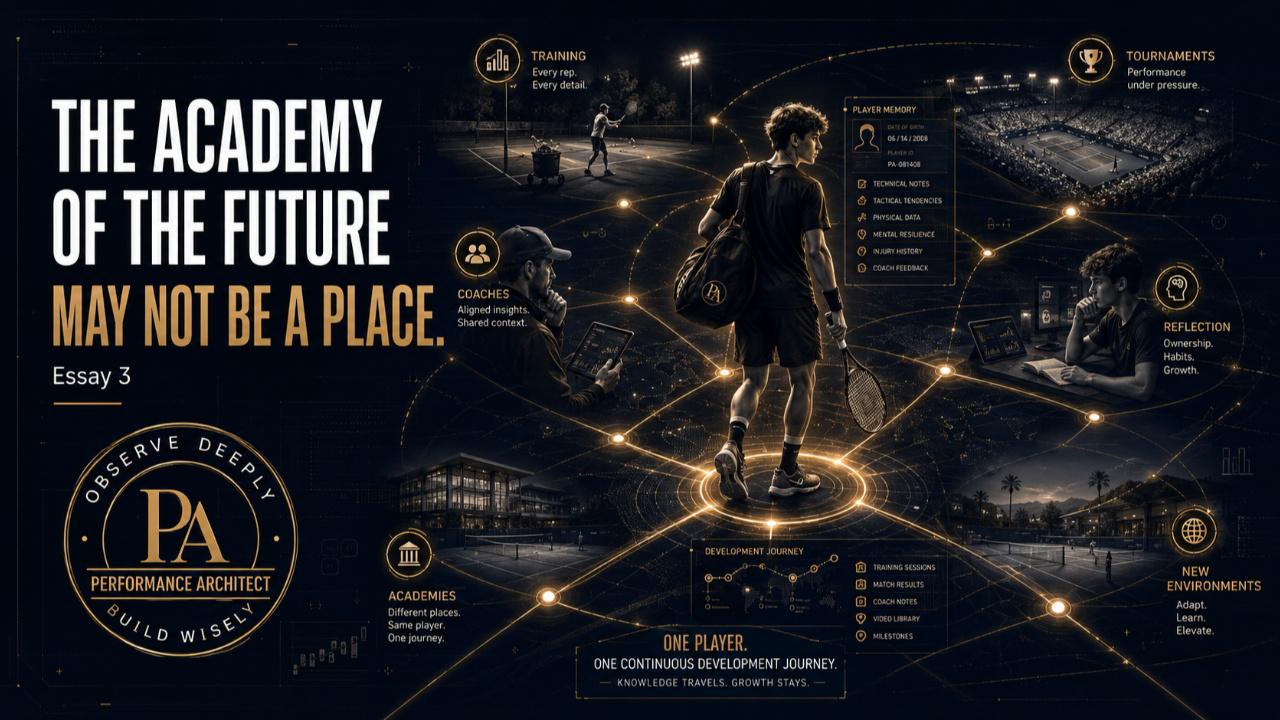
A player changes coaches. It happens all the time, for all the ordinary reasons: a family moves, a program changes hands, a kid outgrows a fit that used to work, money gets tight, or something just goes quiet between a coach and a player and everyone senses it's time. We treat it as routine, and mostly it is. A new coach, a fresh start, a clean sheet.
Look closely at what the new coach actually receives, though, and "clean sheet" starts to sound less like a fresh start and more like an act of forgetting.
The new coach inherits a ranking and a rating. She inherits a handful of videos, usually the flattering ones. She inherits a parent's version of events, which is sincere and partial and shaped by a hundred car rides. If she's lucky she gets a short phone call with the previous coach, ten or fifteen minutes of the highlights before both of them get back to their days. And she inherits whatever the player herself can put into words, which at fourteen is never the whole picture, because kids are living their development, not keeping a running history of it. That's what changes hands: not the player's development, just a rumor of it.
Everything the previous coach actually knew mostly stays behind. The three weeks spent fixing one thing. The reason they stopped working on the serve in March. The pattern that showed up under pressure and then vanished. The intervention that finally clicked and the four that didn't. Some of it was in a notebook that's now in a drawer. Most of it was never written down at all. It lived in one person's head, and when that person stepped away, it went with them.
Development Got Tied to a Place Because That's Where the People Were
For as long as I've been doing this, we've treated the academy as the place where developmental knowledge lives. There's a good reason for that, and it isn't sentimental. The knowledge lived at the academy because the people lived at the academy. The coach who knew the player was there. The court where the work happened was there. The notebook, if there was one, sat in a bag in a locker down the hall. Memory was local because everything that made the memory was local.
That worked well enough as long as nobody moved. But kids move. Coaches move too, and programs reorganize, seasons turn over, a lead coach takes a job in another state, and every one of those transitions quietly destroys context that took years to build. We've accepted that loss as the natural cost of doing business, the way you accept that a printout fades. It's just how it's always worked. The reason I keep circling it is that it doesn't have to work that way anymore, and once you can see that, the academy starts to look like something other than the center of the universe.
What If the Record Traveled With Her
Picture the same coaching change, but with a different thing changing hands.
Imagine a fourteen-year-old who has six years of real developmental history behind her, and imagine that history is portable. Not just her scores and her rating, which travel fine already, but the layer underneath. What she was trying to learn at each stage. What her coaches saw. What she said she experienced. The interventions somebody chose and what happened at the next three tournaments after each one. The problem everyone thought was about her forehand and turned out to be about her feet. The thing that looked solved in April and came back in September.
Now the new coach doesn't start from a rumor. She starts from a record. On the first morning she can see this player has been told to be more patient by three different coaches, that it worked twice and fell apart both times under the same specific pressure, and that nobody has yet asked whether patience was even the right instruction. That coach is starting somewhere much smarter than the last one did, and she's starting there on day one instead of in year two.
That's the whole idea, and it's worth being precise about what it is and isn't. It isn't automation. Nothing in that record decides anything. A machine can retrieve the pattern; only the human team can decide what the pattern means, or whether the record itself was built on a wrong assumption that needs throwing out. The point isn't a system that develops the player. It's continuity, so the humans who develop her aren't forced to keep relearning her from scratch.
Say that player travels to a tournament where a coach who isn't her primary coach watches her compete, sees something, and writes it down where it won't evaporate by Tuesday. She debriefs the match in her own words. The intervention that follows gets recorded, and so does whether it held up over the next month. Then she changes cities a year later, and all of that goes with her. The new city inherits a player, not a stranger with a good backhand and a mystery attached.
The Roles Get Clearer, Not Blurrier
The first worry people raise when I describe this is it turns coaching into data entry, or lets everybody meddle in everybody else's work. I'd argue the opposite. A shared record forces you to get clear about who does what, because the moment several people can see the same player, you have to decide what each of them is for.
The primary coach still leads the developmental plan. The second set of eyes at a tournament contributes an observation, not a verdict, and knows the difference. The player owns her own account of what she's experiencing, which is the one perspective no adult can supply for her. The parent has a real and bounded role, and part of what a good system does is help a parent see where that role ends. A fitness or mental-performance specialist sees one slice deeply. The person running the program sees across players and across time. Those are different jobs with different responsibilities, and today they mostly collapse into whoever happens to be standing courtside. A record that holds all of them side by side doesn't erase the roles. It's the first thing that makes them distinct.
Where AI Actually Earns Its Place
This is the point where I'm supposed to get excited about artificial intelligence, and I am, just not about the part everyone talks about. I don't need AI to tell me a forehand is late. I have eyes, and so does every decent coach. What I can't do, what no human can do reliably across dozens of players, is hold six years of one player's developmental history in my head and pull the right piece of it forward at the right moment.
That's the job I'd hand to a machine. Find me every time this pattern has shown up before. Show me how her own description of this problem has changed over the last year. Tell me whether the coaches see in practice what the observers keep seeing in matches. Remind me we've tried this exact fix three times, and what happened after each one. Summarize the last six tournaments so I walk into Monday already knowing what to look for. None of that is prediction. It's memory, made searchable, at a cost and effort that used to make it impractical.
It matters just as much to be clear about what the machine should never do. It should never turn a coach's offhand note into a permanent label the kid can't outrun, or make a real developmental decision on its own, or be built so its suggestions are hard to overrule. Above all it can't be allowed to dress a correlation up as a certainty, which is the specific way these systems tend to go wrong: they present an inference with enough confidence that people start reading it as truth. A record that remembers everything can make good judgment more valuable, because someone still has to decide what all of it means. It can also, if we're careless, make bad judgment more efficient. The difference is entirely in how we build it.
The Future Isn't Only Software
It would be easy to hear all this and picture the future as an app, and that would be the wrong picture. The most important parts of what I'm describing are stubbornly physical and human.
You need somewhere to actually build and test this. A real court with real players, where the capture and the translation and the coaching all happen in the same place at the same time, so the architecture stops being a diagram and becomes something you can run, break, and fix. That's the point of what I've been calling Court 4, a physical proving ground for this kind of system. Its value isn't the court itself. It's that a system like this has to be made real somewhere before anyone should trust it, and a place built for that purpose is how you keep the ideas honest.
You also need somewhere for the coaches' knowledge to live, not just the players'. Every argument a group of builders ever had about how development actually works, every hard-won reason behind a decision, every correction paid for in wasted seasons, most programs let all of it reset when the people who held it move on. The next staff starts over, relearns the same lessons, remakes the same mistakes. I've started calling the fix for that the Founders' Room, a persistent home for a program's institutional memory, an environment whose whole job is to keep the reasoning of the people who built a program from vanishing when the personnel change. A player's memory shouldn't reset every time she switches coaches. Neither should a program's.
I want to be careful here, because it would be easy to make the physical academy sound obsolete, and it isn't. The place still matters. The community of kids and coaches still matters. What changes is that the building is no longer the container that holds the whole relationship. It becomes one important node in something larger than itself.
A Network That Doesn't Flatten Everyone Into the Same Coach
There's a version of this I'd fight against, where one company builds one system, decides there's a single right way to develop a tennis player, and quietly pushes every academy toward the same doctrine. That's not architecture. That's a franchise, and it would strip out exactly the local character that makes good programs good.
The version worth building is closer to a shared language than a shared script. Academies could keep their own methods, their own philosophies, their own arguments about the game, while agreeing on a common grammar for how developmental memory gets recorded and carried. One program builds patient counterpunchers and another builds first-strike players, and a kid can move between them without her history turning to static at the door. This past summer I spent eleven weeks putting the first pieces of this to work at an academy in Austin, moving the cards and the loop from something I could describe into something coaches actually used week after week. That's a long way from a finished network. But it's the difference between a theory and a thing that runs, and that difference is most of the work.
The Question I Keep Landing On
Here's the part that should make all of us slow down. None of what I've just described guarantees better development. A developmental record that follows the player, a memory that survives coaching changes, a system that surfaces patterns across years, all of them are unusually powerful tools, and powerful tools serve whatever they're pointed at. The same architecture that helps a coaching team make a better decision for a fourteen-year-old can help a business make a more profitable one. The same record that remembers what she needs can remember what she'll buy.
I've been circling this since the first essay, when I said the real question isn't who owns the pipeline, it's what the pipeline is taught to care about. Now the pipeline is starting to have a memory, and increasingly powerful ways to act on it. Which means the question stops being interesting and starts being urgent. A system this capable will get very, very good at whatever we reward it for. So we had better decide what that is, on purpose, before the machinery gets pointed at whatever happens to be easiest to sell.
That's where I want to go next.
*This is the third in a four-part series that began with a question Lisa Stone put to the ParentingAces community after sharing a Sports Brief article: what are the implications of this for junior tennis?*
Written with Reggie, Claude, Gemini, Otter, and 64+ trips around the sun.
Never Miss a Moment
Join the mailing list to ensure you stay up to date on all things real.
I hate SPAM too. I'll never sell your information.
