The Architecture of Collaboration
Apr 14, 2026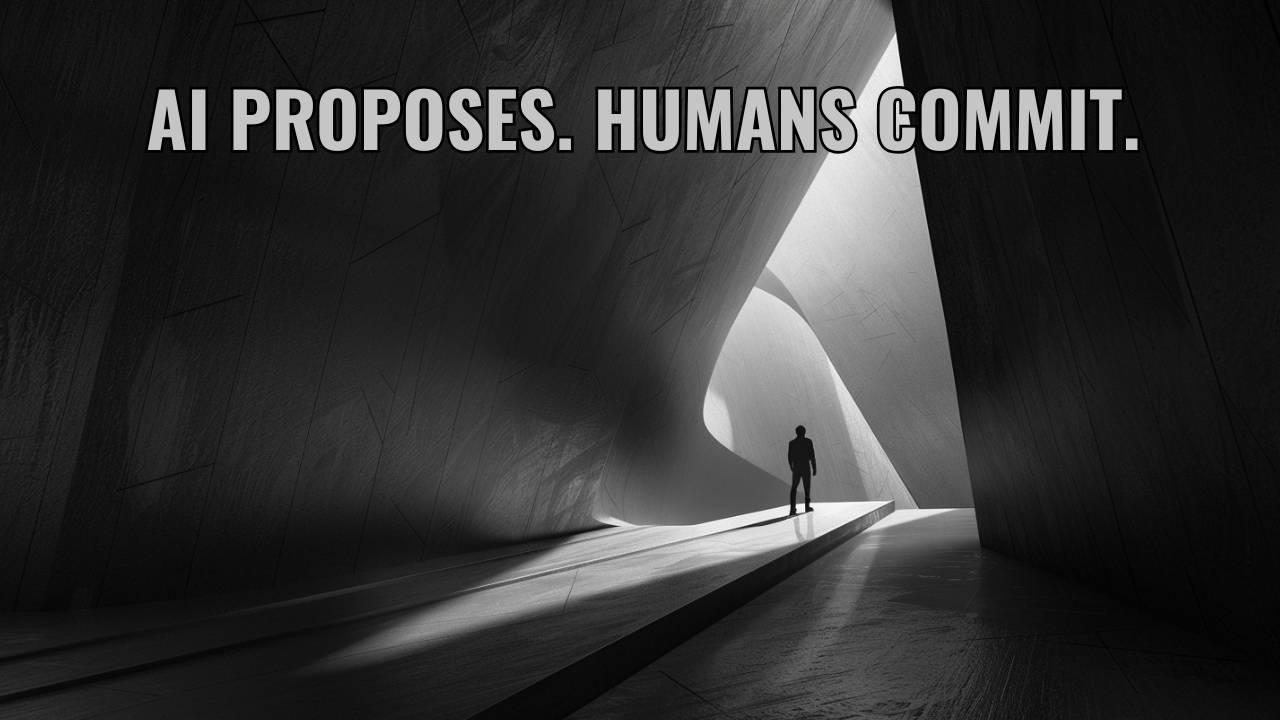
Tuesday — April 14
Human to the Power of AI — Essay 20
When intelligence moves from scarce to continuous, every system built around its scarcity faces a structural problem it cannot optimize its way out of. This is not a prediction about where things are headed. It is the operating condition right now, in every organization that has adopted AI into existing workflows and discovered that speed increased while understanding did not. Nineteen essays in this series established why that happens. What they did not do is describe the architecture that follows from it, because that work belongs here, in the closing essay, where the argument has had time to harden into something that can actually be built.
Most of what is called AI adoption does not engage this problem at all. Organizations identify where tasks can be automated, where decisions can be accelerated, where existing processes can be made cheaper or more precise. These are genuine gains. The systems that achieve them move faster. What they do not do is change where understanding is allowed to form, and that is the question the architecture of collaboration is built to answer.
Understanding is the bottleneck in almost every high-stakes environment. Not speed, not data, not access to information. The bottleneck is the gap between what actually happened and the interpretation of it that reaches the people responsible for the next decision. In most systems that gap is structural rather than accidental. Decisions are made with partial context. Reflection happens after the moment has closed. Multiple perspectives exist but do not converge in time to produce a coherent account of reality. Organizations recognize this problem and attempt to solve it through meetings, reporting structures, and layered decision processes, each of which introduces delay, fragments context, and reduces the fidelity of what actually occurred. The result is that by the time a decision is made, the understanding behind it is already a reconstruction rather than a representation. Most institutions have normalized this condition so thoroughly that they have stopped recognizing it as a design flaw. They experience it as the unavoidable cost of operating at scale.
What AI introduces is the ability to maintain multiple perspectives simultaneously, without the fatigue, political pressure, or cognitive load that causes human systems to collapse ambiguity prematurely. But without structure, this capability produces noise rather than clarity. More interpretations, more data, more outputs — none of it converging into the kind of understanding that allows a committed decision to be made with full visibility of what it is deciding between. The collaboration gap is the absence of a system that can hold multiple perspectives without collapsing them, surface them at the moment they matter, and allow a human to commit with context intact. Closing that gap requires design. It does not emerge from tool adoption, and it cannot be approximated by adding more tools to a structure that was never built to hold what they produce. Architecture thinking begins by asking a different question: not where AI can be inserted, but what a system would look like if continuous intelligence were assumed from the start. That question does not lead to better tools. It leads to a different relationship between perception, interpretation, and decision.
The system that follows from this question has three requirements, and they are sequential rather than parallel. The first is that reality must be captured while it is still intact, not reconstructed from memory or reported after the fact, but held in a form that preserves what actually occurred, including what the participant intended and what they experienced in the moment of action. AI makes this layer possible because it does not depend on recall or interpretation to maintain a continuous account of the system's state. Without this foundation, every downstream decision is built on degraded information, and no amount of interpretive sophistication recovers what the initial capture missed. The second requirement is that the captured reality be interpreted across multiple frames simultaneously rather than collapsed prematurely into a single account. Most systems, human and organizational alike, resolve ambiguity faster than accuracy requires. A single coherent explanation is preferred over the discomfort of holding competing ones. AI changes this because it can maintain conflicting interpretations without the cognitive pressure to choose between them and make the structure of divergence visible to the human participant without forcing resolution. The value of this layer is not the production of a better answer. It is the visibility of alternatives before a commitment is made. The third requirement is where the architecture becomes non-negotiable: only a human decides. Not because AI lacks the analytical capacity, but because a decision is more than an output. It carries accountability, establishes intent, and shapes relationships and future actions in ways that cannot be reduced to optimization across known variables. When this layer is removed or blurred, the system may continue to generate outputs efficiently while gradually losing alignment with the people it was designed to serve. What separates the architecture of collaboration from the broader conversation about AI augmentation is precisely this sequence: AI proposes the frame, surfaces the alternatives, and extends the cognitive reach of the human participant, but the commitment belongs entirely to the human.
What the three requirements produce together, when they are present in sequence, is a system where understanding does not form after the moment has passed. It forms inside it. The participant is not reconstructing an interpretation later and hoping it aligns with what actually occurred. They are working with an accurate representation of the moment, held open long enough to examine it, across enough perspectives that the decision made at the end of it reflects reality rather than the version of reality that survived the delay. This is a different operational condition than the one most systems are designed for, and the difference is not subtle once you know what to look for.
The environments where this matters most are the ones where the cost of the gap is highest. High-performance development, where the difference between what a participant intended and what the system captured determines whether learning occurs at all. Organizational settings, where decisions made without integrated perspective create compounding inefficiencies that no subsequent optimization can fully resolve. Institutional structures operating at scale, where the gap between what the system was designed to do and what it actually does becomes visible only after it has caused enough damage to be undeniable. What AI changes in all of these is not the existence of the problem. It changes whether the problem can be addressed directly or only managed at the edges. For the first time, the gap between experience and interpretation can be closed inside the moment of action rather than outside it, which means the entire downstream logic of delayed reflection, fragmented perspective, and reconstructed decision can be replaced by something that actually holds.
The work of the past year has been building this architecture in environments where the gap is visible and the consequences are traceable. What has come back from that work is not a proof of concept but the discovery of what the constraints actually are: that the timing of the capture matters as much as its quality, that the sequence in which perspectives are introduced determines whether integration is possible at all, and that the decision layer cannot be compressed without compromising the accountability that makes the system trustworthy to the people inside it. Those constraints did not come from the argument. They came from building and watching what held. The architecture is running. The question for anyone reading this is not whether it can be built. It is whether the systems they are responsible for will be designed around it or will continue operating as though the gap is a management problem rather than a structural one.
Year one ended with a statement: the container can be built now. This is what it requires to hold.
Never Miss a Moment
Join the mailing list to ensure you stay up to date on all things real.
I hate SPAM too. I'll never sell your information.
