The Architecture of Five Years
Nov 30, 2025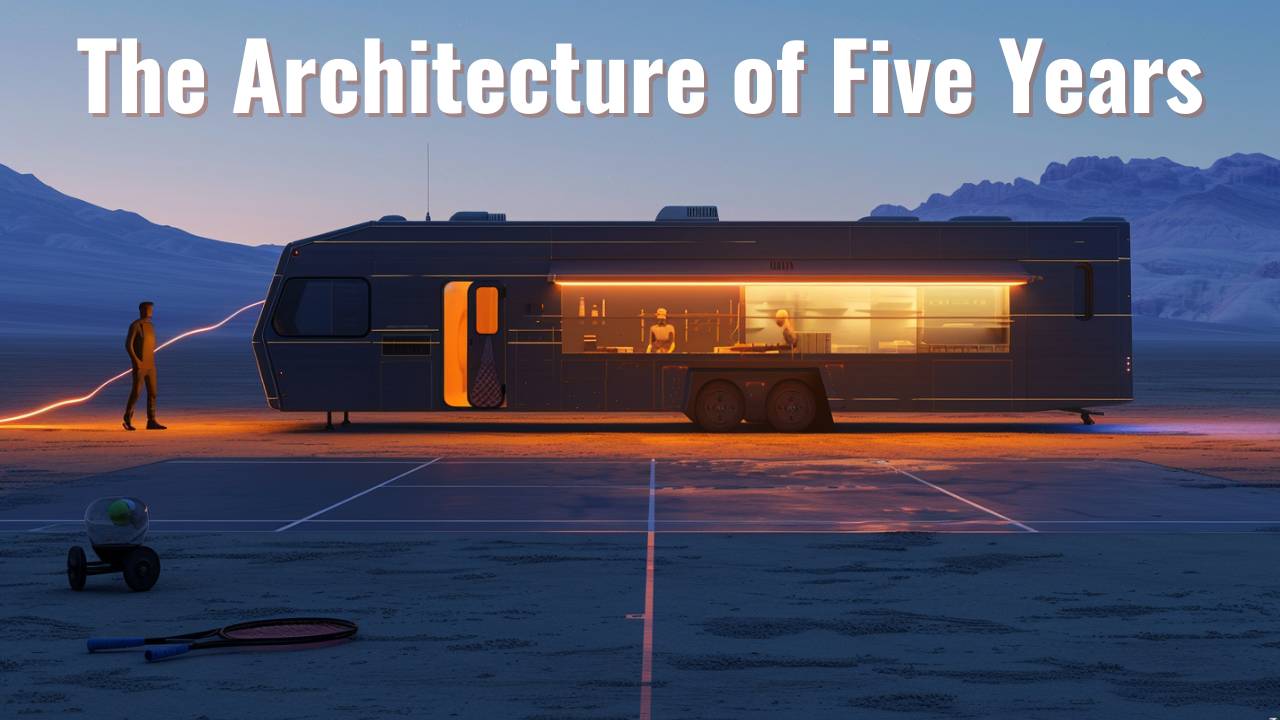
There is a quote by Charles "Tremendous" Jones that has been haunting me lately, and you have probably heard it before. It serves as a reminder that stagnation is often a choice we make by default. It goes like this: "You are the same today that you are going to be five years from now except for two things: the people with whom you associate, and the books you read."
I have spent the last thirty-five years in a profession where I am usually the most intelligent person in the room, but that is not a boast; it is a confession of failure. When you spend three decades explaining complex biomechanics to fourteen-year-olds, something happens to your brain. You start to edit yourself, shrinking your vocabulary and simplifying your thoughts until they fit into the attention span of an adolescent or the anxiety of a tennis parent. You stop sharpening your iron because you are busy carving wood.
I looked at my life recently, specifically examining the last five years and projecting the next five, and I realized a stark imbalance. I have nailed the "Books" part of the equation because I consume information voraciously, walking for hours listening to Peter Diamandis talk about moonshots or Alex Hormozi break down acquisition models. I listen to the a16z podcast dissect the future of technology and have conversations with AI late into the night (and more often beginning in the morning when some night owls are just going to bed) that are deeper and more rigorous than 99% of the conversations I have with human beings. My "Books" are Nobel Prize level, but my "People" and my environment hasn't met the same standard.
I have been living in a desert.
It is a specific kind of silence that defines this isolation. It is the sound of a ball machine firing every three seconds, drowning out the need for an argument or a complex thought. It is the feeling of your brain revving at 5,000 RPM in a room where everyone else is idling at traffic lights, and there is nowhere for that intellectual energy to go.
From the age of fifteen to thirty I was too busy rebelling to notice who I was associating with, often hanging out with the jocks and the party people because it was easy. Don't get me wrong, most of my dearest friendships were developed during that time. However, I was running away from the intellectual weight of my family, a line of heavy hitters from Harvard, Brown, and Boston University. My grandfather was the valedictorian of his high school class who had to work as a chauffeur because of the color of his skin, and my mother was the first METCO coordinator in Concord. My only sibling was Salutatorian of her class at Pepperdine. These people did not do small talk; they did big work.
Somewhere along the line I traded that heritage for a basket of tennis balls and traded the salon for the court. While I have built a hell of a career coaching champions and building systems like The Performance Architect, I feel the atrophy. I miss the nerds and the people who want to talk about the architecture of conscience rather than the grip on a backhand. I miss the people who understand that good is the enemy of great.
The Invisible War
I had settled into thoughts of retirement earlier this year as the logical conclusion to a long grind, but then in March my girlfriend, Kim Barton, was killed in a car accident. That kind of loss does not just break your heart; it breaks your timeline. The concept of "waiting" suddenly seemed ridiculous, and the concept of "retirement" felt like a lie. I started doing what Steve Jobs talked about by connecting the dots backwards, looking at the West Point cadet who memorized MacArthur and the coach who realized the problem wasn't the player's arm but the player's mind.
I realized I have not been building a tennis career; I have been building a perception engine. I have been trying to make the invisible visible because in tennis we obsess over what we can see like the ball and the racquet. But the game is actually decided by the split-second decision window or the spike in cortisol that freezes the feet. I have spent thirty-five years trying to get people to see this invisible war, and I realized I cannot do that if I am just a "coach." I need a new architecture that isn't just about sensors or cameras, but about language. The gap between the coach's intent and the player's action isn't physical; it is a translation error.
Communiplasticity
I am calling the next five years Communiplasticity Solutions. It is a big, nerdy word that I would have been afraid to use in a junior development clinic five years ago. Neuroplasticity is the ability of the brain to rewire itself, where we expect the student or athlete to adapt and "figure it out." Communiplasticity is the inverse; it is the ability of the communicator to rewire the message and the obligation of the teacher to adapt the signal until it fits the receiver's operating system.
It means realizing that "move your feet" is almost never the real instruction. To an engineer, the message is "reduce the friction coefficient," to a fighter it is "close the distance," and to a dancer it is "find the rhythm." If I use the wrong language and the feet do not move, that is not a compliance issue; it is a translation failure. This is how we solve the dropout crisis and stop wasting billions of dollars on youth sports programs that act like daycare centers. To build this I cannot just read books about it; I need to associate with the people who can build it.
The Four Organs
I am done with fragmentation and having a "tennis business" over here and a "media company" over there. I have spent the last few weeks mapping out the Masterfile, which serves as the blueprint for the rest of my life and operates like a single organism.
First is the Heart, which we call Court 4. It is the kinetic lab where we strip away the noise and capture the raw data of performance. We use cameras, sensors, and eyes to see the naked truth. There is no quibbling here, just reality.
Second is the Brain, which is Communiplasticity. This is the cognitive operating system that takes the raw data from the Heart and translates it. It turns "you missed" into "your decision window closed forty milliseconds too early." It makes meaning out of motion.
Third is the Lungs, or the Founders' Room. I am building a sanctuary modeled after the Temple School my ancestor's neighbor Bronson Alcott built in Concord. It is a place for Socratic dialogue where we use light and sound and AI to slow down time and force high-level cognition. This is where I will find my people, the systems thinkers and ethicists, and we will talk about the Concord of Conscience.
Fourth is the Blood, which is the RV. I am putting this entire system on wheels to create a mobile command center and rolling laboratory. Blood moves oxygen to the muscle, and the RV moves the oxygen of the Founders' Room to the muscle of the Court. It ensures the organism doesn't just survive in a lab but thrives in the wild.
The Concord of Conscience
I am writing this because I want to put a stake in the ground. I am sixty-three years old and have an implanted loop recorder in my chest that watches my heart every second of the day. I know better than anyone that time is not guaranteed. I am done playing small, apologizing for being the most intelligent person in the room, and associating with people who are comfortable with "Good."
I am looking for the Great. I am looking for the people who want to understand the invisible moments, the nerds, and the people who would rather be at the Nobel Prize ceremony than Wimbledon. If you are reading this and you are tired of the quibbling and the daycare masquerading as development, come find me. I will be the one in the back of the RV building a Temple of Light. We have work to do.
If this work aligns with where your organization is heading, I’m open to serious conversations about partnership and collaboration.
Performance Architect | Founder, Communiplasticity Solutions
📧 [email protected]
📞 469.955.DUEY (3839)
🌐 theperformancearchitect.com
Never Miss a Moment
Join the mailing list to ensure you stay up to date on all things real.
I hate SPAM too. I'll never sell your information.
