The Asset Nobody Actually Invests In
Jul 07, 2026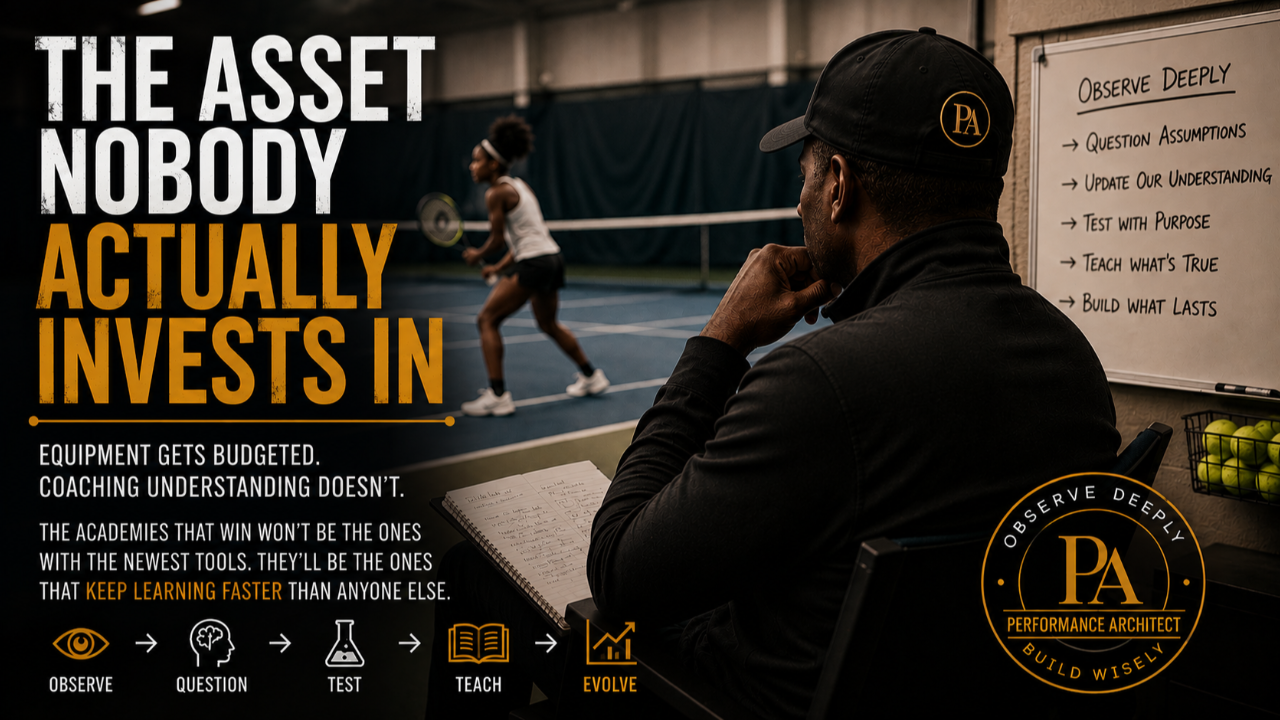
Every academy will tell you its coaches are its greatest asset. Almost none of them spend money like they believe it.
Walk through the capital budget and you'll find new courts, new ball machines, updated fitness equipment, a subscription to whatever software promises better scheduling, and a marketing push for the fall session. Rarely will you find a line item for what the coaching staff knows, or whether what it knows is still true. The same coach who taught a beginner group a decade ago is teaching one today, using roughly the same understanding of how people learn that he had a decade ago, and nobody in the building has asked whether that understanding still holds up.
For most of tennis history that arrangement was defensible. A coach could spend two decades accumulating court time and reasonably expect that accumulation to hold its value, because the underlying science of how people learn movement, manage pressure, and build a competitive identity changed slowly enough that experience and expertise were nearly the same word. That arrangement is ending. Research into motor learning, perception, decision-making, and the psychology of pressure is producing better answers faster than most coaching staffs are absorbing them, and the gap between what a coach believes and what the current evidence supports is widening every year whether anyone in the building notices or not.
Experience is still valuable. Experience defending an outdated model of how people learn is not experience. It's repetition.
I spend a good part of my time in other people's programs, watching lessons, asking questions, trying to understand how a staff thinks rather than what it says in its marketing materials. The pattern that keeps showing up is a coach who reached certainty long before he earned it, inherited a set of drills and phrases from whoever trained him, and then spent the next twenty years defending those phrases instead of testing them. A player gets told to get the racket back early without anyone asking whether the incoming ball gives him enough time to take a big backswing. Another gets taught that the split step happens at one fixed location instead of understanding what the step is for, which is loading the body so it can move in any direction the point demands. None of these phrases are wrong in every situation. The problem is that they get delivered as universal law instead of what they are: a decision that depends on the situation in front of the player.
That is where the conversation about artificial intelligence belongs, and it is not the conversation most people are having.
An artificial intelligence system carries none of the inheritance a human coach carries. It doesn't begin by asking what coaches have always said. It begins by asking what predicts a better outcome, and it has no investment in protecting the answer it started with. If a shorter backswing consistently produces cleaner contact against a specific incoming ball, it will find that. If the cue every coach in the building has repeated for thirty years turns out to be an oversimplification, it won't feel obligated to preserve it. It can compare patterns across a volume of repetitions no coach could consciously track, and it doesn't get tired, distracted, or attached to being right. Whether every current claim about artificial intelligence in performance settings survives scrutiny over the next five years is a separate question from whether the direction is real. It is real.
Notice what that does and does not mean. It does not mean artificial intelligence replaces coaches. It means coaches who stop updating their own thinking are now competing against something that never stops. Those are different claims, and the difference is the entire argument.
A coach who keeps studying new research, keeps questioning the drills he inherited, and keeps refining what he sees when he watches a swing is not competing with the technology. He's using it the way a good physician uses a second opinion, as one more source of information that sharpens judgment rather than replaces it. A coach whose entire value is transmitting what he was taught, unchanged, is in a different position, because a system that updates continuously will eventually transmit better information more reliably than a person can.
This is not really an essay about artificial intelligence. It's an essay about whether an organization is built to keep learning after the people who founded it are no longer the only ones doing the teaching.
The academies that separate themselves over the next twenty years will not be the ones with the newest equipment. They will be the ones that treat a coach's time in another gym, another conference, another program's practice session as work rather than a day off, and expect that coach to come back with something the staff didn't already believe, test it against what the program already does, and teach it to everyone else before the next season starts. Most coaching staffs don't have a mechanism for that to happen. They have a schedule, a set of drills, and a hope that whoever is in the room that day happens to understand enough.
An organization that has built the mechanism gets smarter every year regardless of who's on staff that particular season. An organization that hasn't gets exactly as smart as its most experienced coach, for exactly as long as that coach stays, and starts over the moment he doesn't.
That's the actual competitive advantage, and it has very little to do with whether the person delivering the correction on Court 4 someday turns out to be a machine.
Never Miss a Moment
Join the mailing list to ensure you stay up to date on all things real.
I hate SPAM too. I'll never sell your information.
