THE COGNITIVE BROADCAST: Architecture for the Invisible War
Dec 03, 2025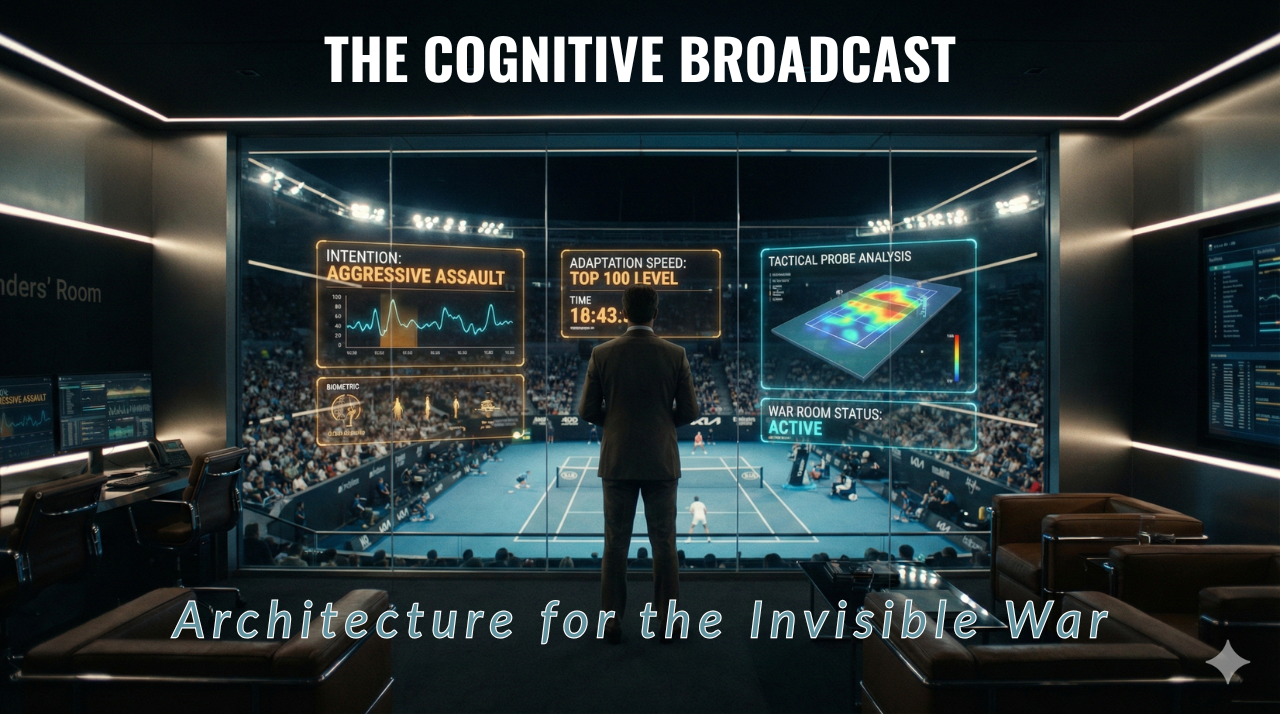
A White Paper by Duey Evans, The Performance Architect
Introduction: The Silent Movie in 4K
We are currently living through a paradox in sports broadcasting. We have never seen the ball so clearly, yet we have never understood the battle so poorly.
We film tennis in 4K resolution. We place microphones on the net post to capture the friction of spin. We deploy Hawk-Eye cameras to track the ball's trajectory within a millimeter. We inundate the screen with spin rates, serve speeds, and win probabilities. We have perfected the art of measuring the physics of the sport.
And yet, we are watching a silent movie.
Decades ago, while attending West Point, I memorized Douglas MacArthur's definition of athletics: "Upon the fields of friendly strife, are sown the seeds that, upon other fields, on other days, will bear the fruits of victory". When you step onto a tennis court, you are not engaging in recreation; you are engaging in warfare.
The true action of tennis does not happen in the swing. As I wrote fifteen years ago, technique is merely a given at the highest levels. Everyone can hit the shots. The real war happens in the six inches between the player's ears—in the "War Room" of their mind where reconnaissance is gathered and assaults are planned.
The current broadcast model treats the viewer as a passive consumer of spectacle. It measures the "cart of balls"—the repetition of technique—rather than the employment of tactics. The next unicorn in sports media will be the platform that finally bridges the gap between the Kinetic Game (what we see) and the Cognitive War (what is actually happening).
This is the blueprint for The Cognitive Broadcast.
Part I: The Flaw of Physics
"Tennis is a simple game played by complicated people."
If you look at the current analytics stack—IBM Watson, AWS Match Insights—you will notice a singular obsession: they measure the object.
They can tell you that a forehand was hit at 86 mph. If it lands one inch wide, they mark it as an "Unforced Error." This is a statistical lie. It lumps a courageous, strategic decision that missed by a millimeter into the same bucket as a lazy, fearful swing. To the algorithm, these are identical events. To the tennis mind, they are opposites.
But the inverse lie is even worse.
Consider the ball that is hit safely over the net but lands four feet short of the service line. To the analytics engine, this is a "successful shot" because it landed in. There is no error recorded. But if we dig deeper, as we do in the Founders' Room, we see the truth: that was the moment the player lost the point.
By leaving the ball short, they surrendered control of the battlefield. They invited the opponent to step inside the baseline and launch an assault. The analytics see a rally in progress; the strategist sees a tactical surrender.
In "Tennis Warfare," I described the difference between hitting balls and "making points." The broadcast focuses on the former. It ignores the "Reconnaissance Mission"—the loopy ball thrown to a backhand not to win the point, but to extract information for a future assault.
By failing to distinguish between a Tactical Probe, a Technical Failure, and a Strategic Surrender, the broadcast flattens the narrative. We must build a system that respects the complexity of the combatants. We need an architecture that visualizes the "War Room."
Part II: The New Architecture (The IEDE Engine)
The core operating system of this broadcast is not a video feed. It is a learning loop.
In my ecosystem, we use the IEDE framework: Intention → Experience → Debrief → Evolution. This is how high performance is built. The Cognitive Broadcast applies this framework to the viewing experience itself.
Here is how the broadcast flows:
1. Intention (The Pre-Game Context)
Before a ball is hit, we establish the Cognitive Profile. We don't just show rankings. We ask: How does this player handle the fog of war? Do they panic when their "smart bombs" (big shots) fail to break the opponent's will? Do they possess the "attrition mentality" of a Nadal, willing to stay out there as long as they are breathing?
2. Experience (The Live Mechanic)
The match is played. This is the raw data.
3. Debrief (The Interactive Layer)
This is the disruption. Instead of a commentator telling the viewer what happened, the viewer is invited to diagnose it.
Scenario A (The "Out" Ball): A player blasts a ball that misses by an inch.
- The Prompt: [ Bad Execution ] vs [ Good Intention ]
- The Insight: The Crowd sees an error; the Experts see an "All-Out Assault" on a weakness.
Scenario B (The "Safe" Ball): A player hits a ball that lands safely in the court, but short.
- The Prompt: [ Safe Shot ] vs [ Tactical Surrender ]
- The Insight: The Crowd thinks the point is still even because the ball is in. The Founders' Room recognizes that the player just gave up the offensive.
4. Evolution (The Reveal)
The broadcast reveals the consensus. The viewer learns: "I thought that short ball was fine because it stayed in. But the Founders' Room marked it as a 'Casualty' because it let the opponent dictate the next shot."
Part III: The Tiered Consensus (Court 4 vs. The Founders' Room)
We must destroy the idea that all opinions are equal. The Cognitive Broadcast re-establishes the hierarchy of competence by segmenting the voting data into two streams.
Stream A: Court 4 (The Crowd)
This represents the "Kinetic Eye."
- What they see: They see the "cart of balls." They judge based on aesthetics and ball speed.
- Their Vote: Usually aligns with the result. If the ball went out, they vote "Execution Error."
Stream B: The Founders' Room (The Cognitive Studio)
This represents the "War Room." This group consists of those who understand the "gritty competitor level."
- What they see: They see the intention. They recognize that sometimes you accept casualties to win the war.
- Their Vote: They might vote "Correct Decision" on a ball that hit the fence, because the tactic was an "All-Out Assault" on a known weakness.
The Product is the Gap
The drama is not "Who won the point?" It is "Why did the Crowd see a mistake when the Experts saw a strategy?" This creates a "Velvet Rope" dynamic. Viewers want to graduate to the Founders' Room.
Part IV: The AI Interlocutor (The Ellis Ferreira Metric)
In "Tennis Warfare," I shared a conversation with Ellis Ferreira (former World #1 Doubles) regarding adaptation speed. He noted that you could beat a Top 100 player five or six times with the same tactic. But against Pete Sampras or Agassi? You could use it once. By the second time, they had adjusted.
Current broadcasts cannot measure this. The Cognitive Broadcast can.
We introduce AI not as a predictor, but as "The Archivist." It measures Adaptation Speed.
The Scenario
Player A uses a drop shot. Player B loses the point. Three games later, Player A tries it again.
The AI Interlocutor
It generates a prompt:
"Analysis: Player B has failed to adjust to the drop shot tactic for the 3rd time. Their Adaptation Speed is currently at 'Top 100 Level.' Against a 'Sampras Level' opponent, the adjustment would have occurred 15 minutes ago."
This digitizes the wisdom of the greats. It quantifies when "the pot has gone off the boil." It reveals who is simply hitting balls and who is actually fighting the war.
Part V: The Business Model (Monetizing Intelligence)
Why will this work? Because the audience is smarter than we treat them.
In the U.S., tennis kids are the smart kids. They are straight-A students heading to top universities. They understand complexity. As I found years ago, even young players are fascinated by concepts of reconnaissance and diversions—it resonates more than sterile talk of "percentages."
The current broadcast bores them because it treats them like robots. The Cognitive Broadcast treats them like strategists.
1. The "Tennis IQ" Asset
We track the viewer's voting record. Over a season, we generate a "Court Sense Rating."
- User A: Aligns with Court 4 (Kinetic).
- User B: Aligns with Founders' Room (Strategic).
This gamifies the intellectual pursuit of the sport.
2. The Subscription Funnel
- Viewer: "I keep missing the reconnaissance plays. I want to see the war map."
- Upsell: "Join 'The Performance Architect.' Learn to build your own War Room."
Conclusion: The Nobel Prize of Broadcasting
I have often said, "I'd rather go to the Nobel Prize-winning ceremony than go sit in the coach's box at Wimbledon."
Why? Because the coach's box is often a place of performative anxiety. The Nobel Prize is a celebration of those who have peeled back the layer of the universe to reveal the truth underneath.
Current sports broadcasting is the coach's box. It shouts numbers to hide its lack of understanding. It focuses on the "smart bombs" and "laser-guided missiles" of technology, forgetting that the game is won by the human will to fight.
The Cognitive Broadcast is the Nobel ambition. It seeks to peel back the layer of the physical game to reveal the warfare underneath.
The technology to build this exists today. The philosophy was written fifteen years ago. The only thing missing is the courage to stop counting the balls and start watching the war.
If this work aligns with where your organization is heading, I’m open to serious conversations about partnership and collaboration.
Performance Architect | Founder, Communiplasticity Solutions
📧 [email protected]
📞 469.955.DUEY (3839)
🌐 theperformancearchitect.com
Never Miss a Moment
Join the mailing list to ensure you stay up to date on all things real.
I hate SPAM too. I'll never sell your information.
