The Credential I Didn't Count
Sep 24, 2026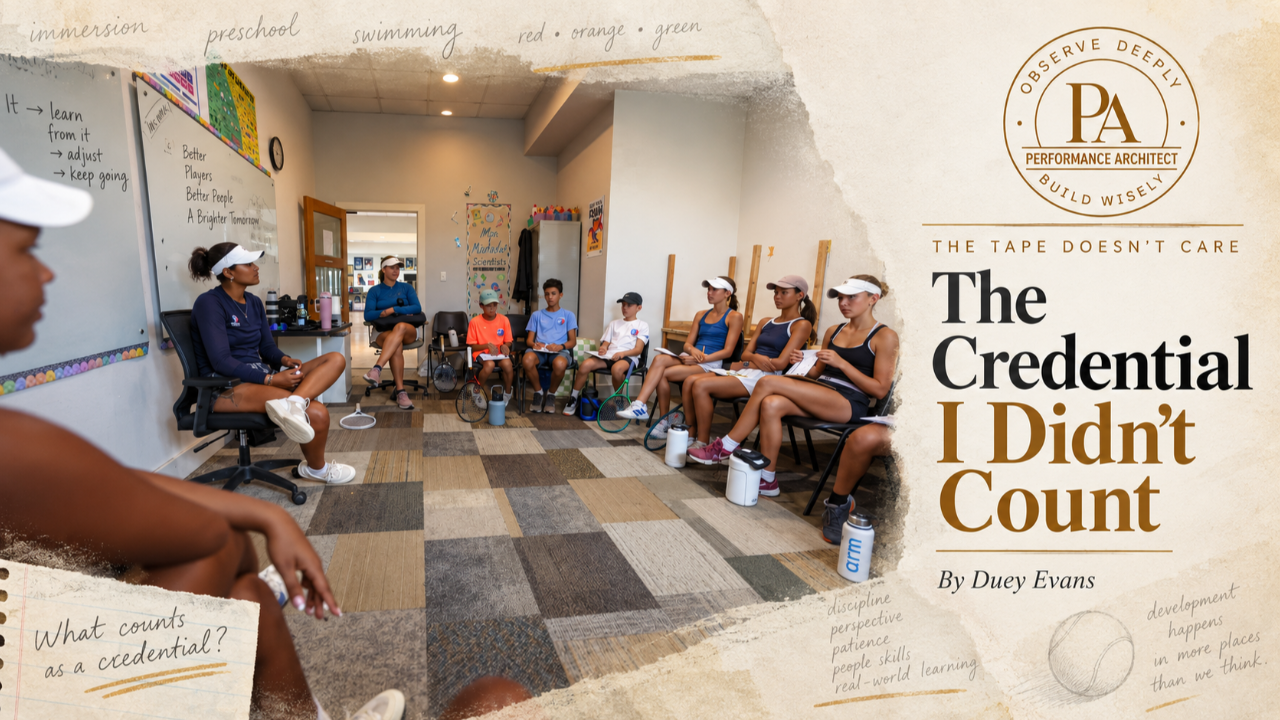
By the time I finished the first few transcripts I had found two things I wasn't looking for. I was taking up far more of the room than I believed, and even when another coach made real space for the players, the format still capped how much of one conversation fourteen people could share. Both findings pointed back at design. Talk less. Build differently. Then a third problem showed up in the same stack of paper. The person doing the best job of holding the room was my twenty-five-year-old daughter.
The sentence needs explaining, because it would be easy to tell the wrong story from it. Rhiannon did not wander into tennis last year with no background and outperform a staff of experienced coaches. She grew up in my program and worked at the tennis centers I ran. Other than home, there may be no place she spent more hours as a kid. She watched practices, lessons, tournaments, parent conversations, staff meetings and all the ordinary machinery of a junior program for years before anyone would have called it professional development. If immersion counts as training, she has had an unusual amount of it.
What she doesn't have are the credentials tennis knows how to count. She didn't play college tennis. She has no education degree. She hasn't spent thirty-five years coaching high-performance juniors or working through the certification systems our industry uses to decide who has expertise. If somebody had asked me beforehand which coach on our staff was most likely to run a player-led classroom well, I would have started with the deepest formal coaching backgrounds.
The tape didn't. When Rhiannon ran a session without me in the room, the players accounted for forty-five percent of the words, the highest share in any group session I measured. Her average turn ran about half the length of mine. She asked something, waited, took what came back and usually left it alone. A player would offer a useful answer and she would acknowledge it in six or seven words and move on. I could take that same answer, recognize three things inside it worth developing, connect it to something we discussed the week before, and spend the next minute making sure the room understood why the answer mattered. I know which version feels more like coaching to me, and I suspect that's part of the problem.
For most of my career, experience meant seeing more. You accumulate patterns. A player misses a forehand and you don't only see the miss. You see the contact point, the spacing, the decision that came before it, the court position that created the decision, and three other times you've watched the same thing happen under pressure. That's a legitimate advantage. You have more available to notice and more available to say. The classroom keeps teaching me those are not the same thing, and that the value of seeing more is sometimes knowing which part not to hand over yet.
Which brings me to where she learned it, and here I have to be careful. I don't think her tennis background is irrelevant. She grew up hearing the language and watching the work, and she knows what we're trying to do. But she also spent years in environments that were not mine. She taught preschool. She coached swimming. I keep wondering whether what makes her effective in this particular room came from experience I would never have put on a tennis résumé. I can't prove any of it from a transcript. The tape tells me what she does. It cannot tell me where she learned to do it. Preschool may matter, swimming may matter, and growing up inside my program may matter more than either. Some of it may simply be who she is. I'm not interested in trading one untested explanation for another because the second one tells a better story.
Preschool is still hard for me to ignore. You cannot keep improving an explanation until a four-year-old finally understands it, because past a certain point more language is just more language. You wait instead. You watch. You let a child struggle with something you could solve in a quarter of the time, and you accept an incomplete answer because incomplete may be exactly where the child is. Mostly you spend enormous amounts of time inside moments that look, to an adult trained on efficiency, like nothing is happening.
Experienced coaches can get very bad at this. We know the progression, the correction, and the answer we're trying to draw out, so when it doesn't arrive fast enough we can always find a better question, a clearer example, another way in. Our expertise gives us an endless supply of ways to help. And help occupies space.
So I've been reconsidering what I mean when I call somebody qualified to run a developmental room. Tennis has obvious markers. Playing background, coaching experience, technical knowledge, years spent watching good players. I have no interest in pretending those don't count because one twenty-five-year-old produced a better word count than I did across a handful of sessions.
But developmental work asks for other things, and I'm no longer confident our credentials identify them. Can you ask a question without already holding the answer you want? Can you sit through ten seconds of silence without deciding the room needs rescuing? Can you tell the difference between a moment where your knowledge is the most valuable thing available and a moment where the most valuable thing is the space around somebody else's? Those are skills. I don't remember ever seeing them listed as qualifications.
Maybe the mistake is assuming credentials only come from places that issue them. Rhiannon's tennis education started long before she was an employee, by being around the work. Preschool may have taught her a second set of habits and swimming a third. By the time she walked into this room those experiences had already mixed together. The tape isn't telling me she lacks credentials. It's telling me I was counting only the ones I already knew how to recognize.
That matters beyond our program, because organizations hire and promote in their own image. Tennis trusts tennis experience. Schools trust educational credentials. Companies trust whichever résumé markers their industry long ago decided represent competence. Then a new kind of problem shows up and we act surprised when the deepest traditional background isn't the one best equipped to solve it. Sometimes the useful experience came from somewhere nobody was looking.
I still don't know exactly why Rhiannon holds the room differently than I do. I may never be able to separate what she absorbed growing up in my program from what she learned somewhere else or what she simply brought with her. I don't need to settle it yet. The finding came first, and the finding is that the person producing the most player conversation in these sessions had spent most of her life inside my system.
She just hadn't been trained only by it.
Never Miss a Moment
Join the mailing list to ensure you stay up to date on all things real.
I hate SPAM too. I'll never sell your information.
