The Economics of Disappointment: Calibration and the Cost of the Second Chance
Dec 06, 2025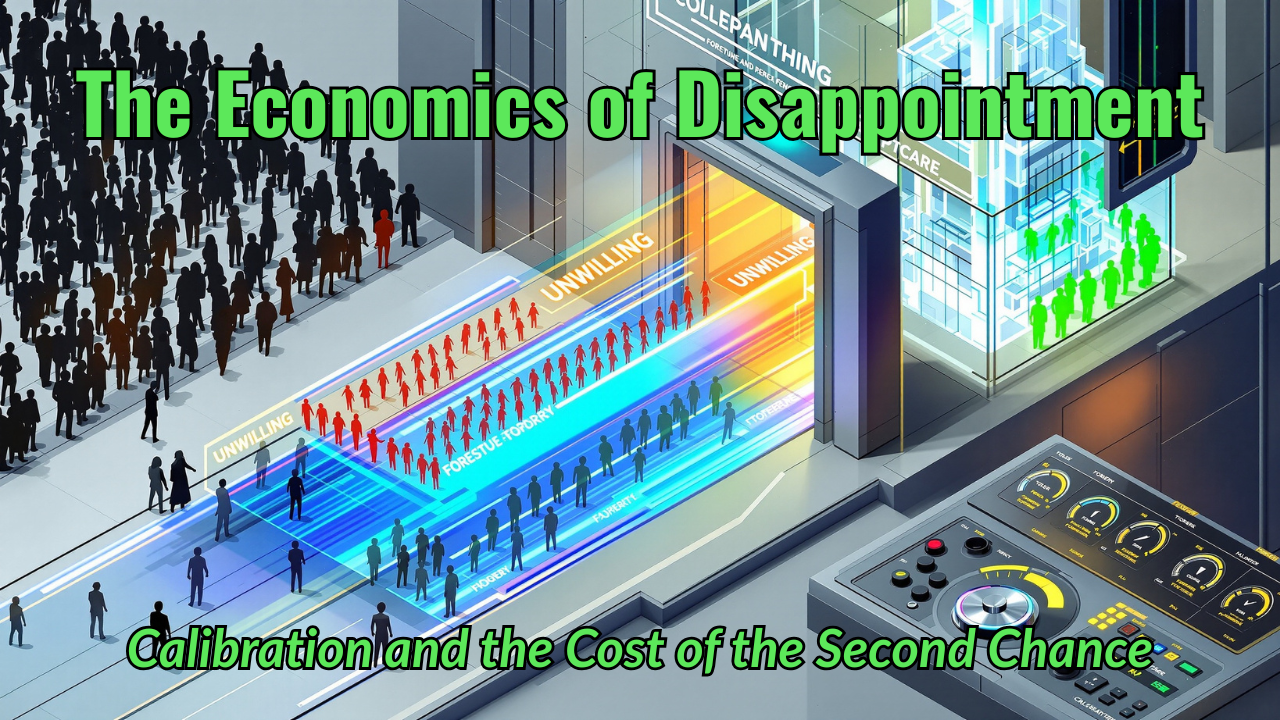
We operate in a cultural marketplace that treats attention as an unlimited resource. We are told that "unconditional acceptance" is a virtue and that boundaries are barriers to connection. But for the architect of a high-performance life, whether in business, athletics, or personal contentment, this is a dangerous fallacy.
Bandwidth is capital. Time is finite. High performance is, at its root, the accurate placement of priorities and resources. Therefore, the decision to keep new people at "arm's length" is not an act of fear or emotional unavailability. It is an act of selective permeability. It is the operational recognition that while human potential is infinite, your capacity to nurture it is not.
To protect the integrity of your ecosystem, you must understand the mechanics of disappointment, the danger of "Adult Daycare," and the critical, often missing fifth element of resilience: Calibration.
The Signal and the Representative
When a person enters your orbit, such as a potential partner, a new hire, or a collaborator, they are not presenting their raw self. They are presenting their Representative. This is the most polished, disciplined, and attentive version of themselves they can muster.
This creates a high-stakes signal detection problem. If the Representative is late, incurious, or "quibbles" over standards, it is a mathematical certainty that the Actual Self will be worse. In this context, early disappointment is not an anomaly to be forgiven. It is a data point to be respected.
The "Halo Effect" often tricks us into inventing virtues for people we find charismatic. But the veteran observer relies on Pattern Recognition. If you spot incompetence or disrespect in the foyer, you do not invite it into the living room. To do so is to bet against the house.
T-F-R-A: The Dashboard of Interaction
To understand why we let the wrong people in, and why it costs us so dearly, we must look at the T-F-R-A Framework: Tolerance, Fortitude, Resilience, and Adaptability.
Most people misconfigure these dials. They believe "High Tolerance" is a strength, perhaps a sign of patience or "Zen." But often, High Tolerance is simply High Avoidance.
Consider the "Stewer." This person has the Tolerance set to maximum. They absorb small disrespects, minor lateness, and subtle boundary violations without reacting. They are "banking" the disappointment to keep the peace. But because they wait until the pressure is at 100% to react, their Fortitude, or the ability to maintain performance during a break, collapses. They don't just correct; they crash.
By the time the explosion happens, the relationship is destroyed, and Adaptability remains at zero because no learning occurred. It was only endurance followed by ejection.
The goal is not to endure. The goal is to detect. To build a robust system, one must actually lower Tolerance to raise Fortitude. By addressing the disappointment when it is a "Level 1" signal, stating clearly that "I expect X, you delivered Y," you prevent the "Level 10" crash.
The Fifth Element: Calibration
This brings us to the missing piece of the puzzle. You can have the framework, but if the settings are wrong for the environment, the system fails. This is Calibration.
Disappointment is an economic event, but it is also a mirror. When you are disappointed, you must conduct a dual audit:
-
The External Audit: Did they fail to meet the standard?
-
The Internal Audit: Did I fail to calibrate the aperture?
If you treat a "Green" entry-level employee with the same expectations as a Senior Partner, the disappointment is your failure, not theirs. You miscalibrated. If you treat a romantic partner with the detached scrutiny of a vendor, you miscalibrated.
The "Arm's Length" strategy is not a static concrete wall. It is a smart membrane. It requires constant calibration to determine what is nutrient and what is toxin.
The Only Valid Exception: Skill vs. Will
This calibration allows us to solve the "Second Chance" paradox. If we are ruthless with standards, do we become isolated? Do we miss the "diamonds in the rough"?
We avoid isolation by distinguishing between Skill and Will.
-
The Unskilled (Green): They disappoint because they do not know what the standard is. They have never been in a Championship environment.
-
The Unwilling (Rotten): They disappoint because they do not care to meet the standard. They view "Good" as sufficient and "Great" as a hassle.
You cannot run a high-performance life if you are providing "Daycare" for the Unwilling. You cannot teach "give a damn."
However, you can develop the Unskilled. To distinguish between the two, you apply the Naked Truth Test. You state the standard clearly, without emotion or apology.
-
If they quibble, excuse, or defend: Close the membrane. They are "Daycare."
-
If they own it, apologize, and adjust immediately: Open the membrane.
The person who responds to correction with hunger is the only exception to the rule. They didn't "disappoint" you; they just hadn't read the playbook yet.
Conclusion: The Economics of Discernment
We are not obligated to be rehabilitation centers for the chronically disappointing. "Energy Democratization," or giving everyone equal access to your inner circle, is a recipe for bankruptcy.
By keeping new entrants at arm's length, you are not being cold. You are buying time to calibrate. You are observing whether they bring "materials" like effort, truth, and hunger that are worthy of your "architecture."
A life of substance over spectacle requires the courage to be selective. It requires the understanding that bandwidth is the root input for all greatness. When you refuse to settle for the "Good enough" connection that drains you, you preserve the space for the "Great" connection that sustains you.
If this work aligns with where your organization is heading, I’m open to serious conversations about partnership and collaboration.
Performance Architect | Founder, Communiplasticity Solutions
📧 [email protected]
📞 469.955.DUEY (3839)
🌐 theperformancearchitect.com
Never Miss a Moment
Join the mailing list to ensure you stay up to date on all things real.
I hate SPAM too. I'll never sell your information.
