The Fifth Variable
Dec 08, 2025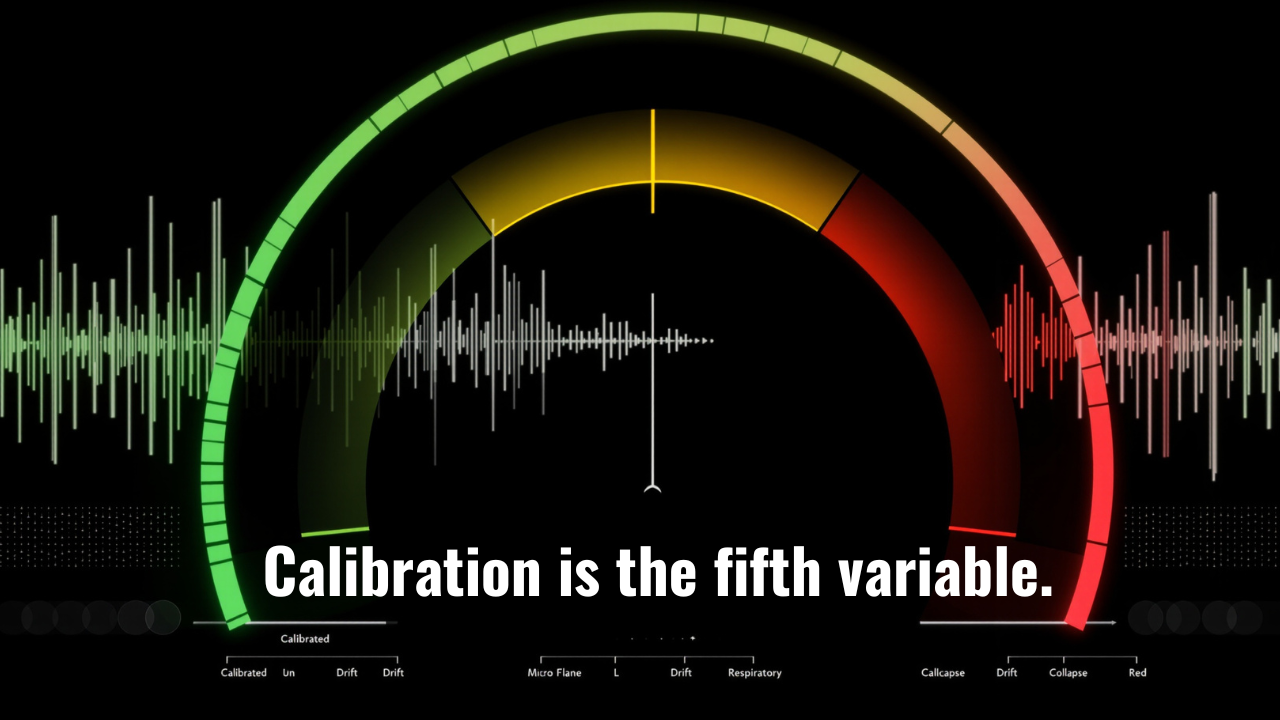
Everyone knows what "seeing red" means. The moment when perception narrows so completely that accurate information stops getting through. The player who argues a call that replay shows was correct. The parent who says something in the car ride home that damages a relationship for years. The person in any high-pressure situation who later asks, "What was I thinking?"
They weren't thinking. They had lost calibration. Their internal instruments were lying to them, and they couldn't tell.
We treat "seeing red" as an extreme, an aberration, something that happens to people who lack control. But what if it's just the visible end of a spectrum that operates constantly at lower intensity? What if most of us are drifting all the time and only notice when the drift becomes dramatic enough to have a name?
Drift
Drift is the quiet version of seeing red. It doesn't announce itself. It doesn't create pain until it's too late. Drift is the internal shift that rewrites your interpretation of reality without your permission.
A player starts mistaking recklessness for aggression. She's not trying to be reckless. She genuinely believes she's being aggressive. Her internal gauge has shifted, and she can't tell. A parent starts seeing laziness where there's exhaustion, or defiance where there's confusion. Parents interpret silence as defiance. The child is exhausted. The parent isn't malicious. They're just responding to a reality that doesn't exist anymore.
Drift looks like confidence. Drift feels like certainty. Drift hides inside the belief that you are right. By the time it becomes visible, by the time someone "sees red" or melts down or makes a decision they later regret, the drift has been operating for hours or days or weeks. The visible breakdown is just where the accumulation finally became undeniable.
For decades, I've operated on a principle borrowed from crisis management: find the fuel source, not the smoke. When something is burning, the instinct is to chase the flames. But flames are symptoms. The fire keeps burning until you find what's feeding it. Drift is the fuel. The breakdown is the smoke.
A Framework That Almost Gets There
A few years ago, I heard Alex Hormozi break down mental toughness into four components on a podcast. Tolerance: how much adversity someone can absorb before their behavior changes. Fortitude: how far they drop when they do crack. Resilience: how quickly they recover. Adaptability: whether they end up better or worse after the experience.
The framework clicked immediately. I had been watching people perform under pressure for thirty-five years without having clean language for what I was seeing. Hormozi gave me that language. I started applying his four components to everything I had observed across three decades of coaching, consulting, and building development systems. The framework works. It explains why some people hold together and others fall apart. It gives coaches and parents a way to identify specific weaknesses instead of vaguely telling kids to "be tougher."
Then I found the crack in the foundation. Every model built on those four components assumes one thing: the person under pressure perceives the pressure accurately. Tolerance measures how many adversities someone handles before behavior changes. But what if they're counting wrong? What if they perceive three adversities when only one has actually occurred? What if they miss a real threat because their instruments told them everything was fine?
The four components measure how someone behaves under stress. None of them measure whether the person understands what the stress actually is.
Calibration
This is the missing variable. Calibration is the internal measurement system that tells you whether your perception matches the conditions around you. It's the instrument that determines whether you're fighting the actual fire or swinging at smoke.
Without accurate calibration, the other four components don't matter. A player with perfect tolerance, fortitude, resilience, and adaptability will still fail if her calibration is off. She'll respond to situations that don't exist. She'll solve problems that weren't the problem. She'll hold together beautifully while marching in the wrong direction.
Here's what separates calibration from the other four variables: it's not a trait. It's a rhythm. Tolerance is a threshold you can measure and train. Fortitude is a depth. Resilience is a speed. Adaptability is a direction. These sit on scales. You can assess where someone falls and design protocols to move them. Calibration oscillates. It drifts. Some days it runs sharp, some days it wanders. No one holds perfect calibration for long. The internal instrument that tells you what's real versus what you think is real needs constant adjustment.
This changes everything about mental toughness. Building a strong mind isn't the goal. A strong mind still drifts. The goal is building a mind that detects drift faster than it accumulates.
The Micro-Flinch
The difference between low performers, high performers, and masters comes down to how often they check their internal instruments.
Low performers check only when something breaks. The match is slipping away. The conversation has gone sideways. The relationship has hit a wall. Only then do they stop and ask whether they might be seeing things wrong. High performers check regularly. Between points. Between tasks. Between conversations. They build habits of verification into their routines, pausing to ask whether what they're feeling matches what's actually happening.
Masters check continuously. They sense the tiny hesitation before a decision. They feel the wobble of conviction before it becomes doubt. They detect what I call the micro-flinch: the half-second moment where intention loses purity.
The micro-flinch is the earliest indicator of drift. It shows up in physical signals most people ignore. A tightening of the jaw. A shortened breath. A narrowing of the eyes. A slight hesitation in the take-back. A shift from observing to explaining. That last one matters most for my work. The moment someone starts explaining their decision, they have already drifted. Narrative is assembled after the fact to maintain coherence. By the time the story forms, the drift that produced it is already running. Explanation is a lagging indicator. The micro-flinch is a leading indicator. Masters feel the flinch and recalibrate before anyone else notices something was off.
How Recalibration Actually Works
The human system runs on three internal timekeepers. A neural clock that governs thought. A physiological clock that governs arousal. A respiratory clock that governs breath. When all three align, performance sharpens. When they separate, performance distorts. The mind races ahead of the body. Or the body outruns the mind. Anxiety and panic aren't emotions. They're timing errors. The clocks have come out of sync.
Most performance interventions target symptoms. Slow your breathing. Calm your thoughts. Relax your body. These help. But they don't address the underlying mechanism: clock synchronization.
The exhale clears noise. It slows the system. But the true recalibration happens at a specific moment most people rush past. It happens at the bottom of the breath. The moment the lungs are empty, the system pauses. All three clocks cross zero at the same point. The neural clock quiets because the brain is prioritizing oxygen over narrative. The physiological clock settles because the body isn't preparing for action. The respiratory clock holds at its natural reset point. This pause is brief, a second or two, but it's the mechanical heart of recalibration. It's the only moment where the story falls away, where silence returns, where the clocks lock back into sync.
This isn't relaxation. This is alignment.
Two Laboratories
I think about my work now in terms of two conceptual spaces. I call them Court 4 and the Founders' Room.
Court 4 represents physical performance under pressure. It's where drift shows up in the body: the rushed approach, the tight grip, the tentative swing. Every drill becomes an opportunity to create small misalignments and practice catching them earlier. Every point becomes a chance to feel the micro-flinch before it becomes a behavioral change. The laboratory is physical. The feedback is immediate. You can see calibration loss in real time if you know what to look for.
The Founders' Room represents a different mode. It's the space where people explain themselves. Parents describing why their child isn't progressing. Players narrating why they lost. Coaches justifying their methods. Anyone under pressure who has shifted from reporting to storytelling. Drift becomes audible in these conversations. The person who walks in and reports what happened is calibrated. The person who walks in and tells a story about what happened is drifting. The narrative itself reveals the misalignment. They're not lying. They genuinely believe the story. But the story has replaced the data.
Both laboratories train the same thing. Court 4 works through the body. The Founders' Room works through language. In both spaces, the goal is the same: detect drift earlier, recalibrate faster, return to accurate perception before the cost becomes too high.
What IEDE Becomes
I've used a framework called IEDE for years. Intention. Experience. Debrief. Evolution. It's a cycle for learning that applies across contexts. The calibration insight reframes every phase.
Intention requires calibrated perception of the challenge ahead. If you set intention based on a misread of the situation, execution is compromised before it begins. The first question isn't "What do I want to do?" It's "Am I seeing this accurately?" Experience tests whether calibration holds under pressure. The doing reveals where instruments start to lie. Stress doesn't create drift. It reveals drift that was already forming. Debrief becomes about identifying where drift occurred and why. Not just "What did I do wrong?" but "When did my perception stop matching reality? What was the earliest signal I missed?" Evolution means building faster detection for next time. The goal isn't to stop drifting. Everyone drifts. The goal is to catch it one moment earlier than you did before.
The Master's Distinction
The master is not the one who never drifts. Everyone drifts. The master is the one who returns fastest.
Masters have trained themselves to feel the micro-flinch, the earliest signal of misalignment. They have built the habit of checking their instruments before problems become visible. They can sit at the bottom of the breath long enough for the clocks to sync again. This is trainable. Not easy, but trainable. It requires learning to feel internal shifts that most people ignore. It requires building the pause into high-pressure moments when everything screams to keep moving. It requires trusting the recalibration process even when confidence feels adequate.
Mental toughness isn't a trait you either have or you don't. It's a timing system. The ability to detect drift and return to alignment before the cost becomes too high.
Hormozi gave me a framework that made four components visible. The fifth variable, calibration, came from pressure-testing that framework against thirty-five years of watching people perform, fail, recover, and grow. The four components explain behavior under stress. Calibration explains whether the behavior is aimed at what's actually there.
We are not training skill. We are not training resilience. We are not training character. We are training the ability to see what's real.
If this work aligns with where your organization is heading, I’m open to serious conversations about partnership and collaboration.
Performance Architect | Founder, Communiplasticity Solutions
📧 [email protected]
📞 469.955.DUEY (3839)
🌐 theperformancearchitect.com
Never Miss a Moment
Join the mailing list to ensure you stay up to date on all things real.
I hate SPAM too. I'll never sell your information.
