The First Coach Sees More Than Strokes
Jun 17, 2026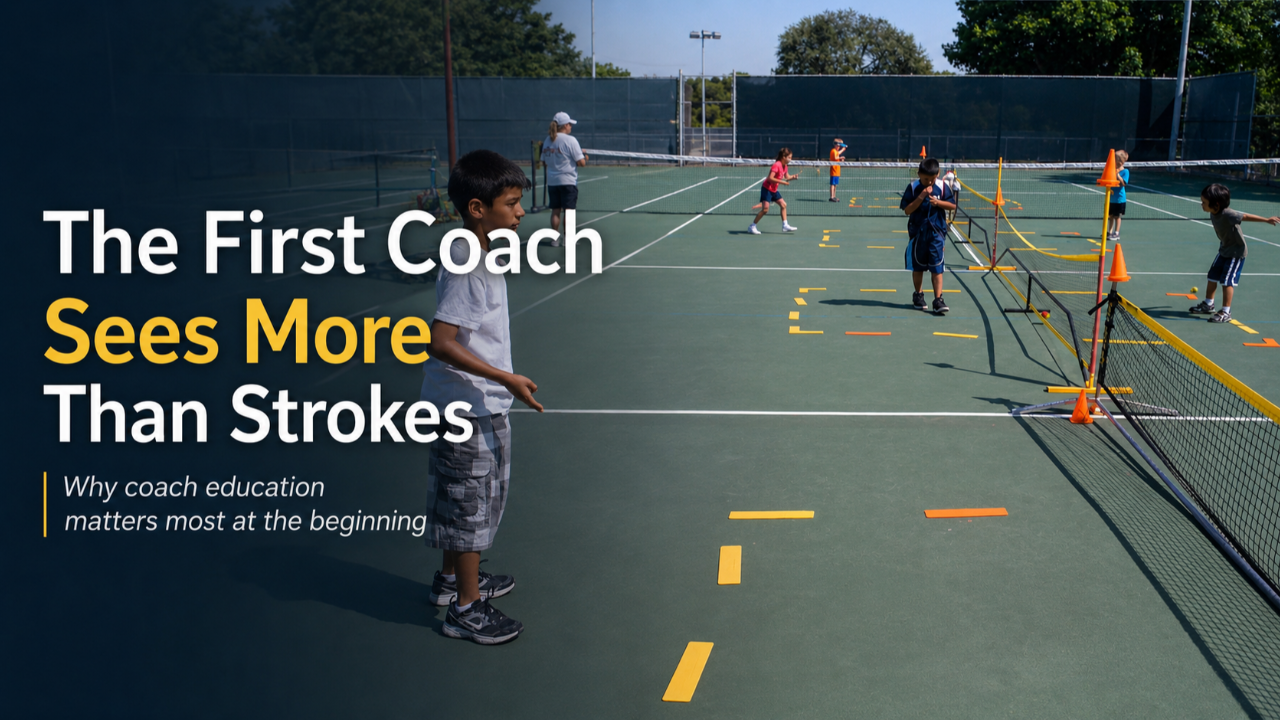
Tennis tends to treat coach education as something that matters more the better a player gets. The logic seems obvious. Advanced players are working on complicated things, so they get the most experienced eyes in the building. Beginners are just learning to make contact, so almost anyone with energy and a basket of balls can handle them.
I think that has it backwards.
At the earliest stage, the coach isn't only teaching forehands and backhands. The coach is shaping what the sport feels like, what the child learns to notice, and what the parent slowly comes to call progress. None of that shows up in a lesson plan, but all of it gets installed anyway, and it gets installed early, before anyone with real developmental intentions is paying close attention.
That kind of work doesn't ask for less skill than advanced coaching. It asks for a different kind, and in some ways a harder one.
The quality of what a coach sees sets the ceiling on what a coach can teach. A coach who sees only the obvious will teach only the obvious, and the lesson stays shallow no matter how much energy goes into it. A coach who can see balance, spacing, timing, where the child's attention is drifting, and how a young player is organizing the task in front of them can make a lesson far more useful without making it any harder for the child to receive.
That matters most with the youngest players, because the early game isn't a smaller copy of the adult game. The game has to grow in the player. The court, the ball, the racket, the rules, the decisions, and the emotional demand all have to fit the child standing in front of you, and they have to keep adjusting as that child changes. Moving a player from red to orange to green as fast as possible isn't development. Knowing when to move forward, when to hold, and when to quietly step back is.
So the picture most programs carry around is wrong in a specific way. They imagine beginner coaching as the simple version of the job, the place you start before you earn the right to work with the players who supposedly matter. The truth is that the beginning is where the most precise reading is required, because the patterns set there are the ones every later coach inherits whether they know it or not.
And children notice. They don't yet have words for what's missing, but young players are far more perceptive than we tend to give them credit for, and they can feel whether what's being poured into them is actually building toward something or whether they're just being kept busy. When the early environment is thin, a child rarely says so out loud. They drift instead, toward whatever makes them feel like they could actually be good at something, and once a young player decides tennis isn't that place, winning them back is far harder than reaching them well the first time.
None of this came from conviction, and I want to be honest about that. By 2010 I was not new to the top of the game. A few years earlier I'd taken a player from their very first ball at age seven to a national gold ball at twelve, and I'd coached others to silver and bronze balls and worked full-time with a junior US Open semifinalist. So when I took over a twenty-court facility that had brought in only $42,000 the year before and was told to start over from nothing, I had every reason to chase the high end. There was no high end to chase. There were barely any players in the building at all, so the only place to start was the front door.
Starting there well turned out to be harder than it sounds, because the tools were new to me too. Everything I'd done to that point had been on full-compression yellow balls on a full-sized court, since red, orange, and green didn't exist in the United States yet. When those lower-compression balls and smaller courts finally arrived, I didn't consider myself the right person to teach my staff how to use them, so I went and found people who'd lived inside that system for years. I brought in coach educators from the United Kingdom, including one of the co-authors of the ITF's Tennis 10s, and had them stay in my home for a week while they trained my staff.
What they told me has stayed with me. Everywhere these tools had been adopted, they showed up first as a recreational product and only later got taken seriously as real player development, which was the only thing I cared about. So I built the front door as if development started there, because it does. My first full-time hire was a coach I relocated from California for a program she'd built called Mommy, Daddy, and Me, which got the youngest kids into the game in a way they actually enjoyed and wanted to keep coming back to. What followed was revenue growth, year over year, for fifty-seven of our first fifty-eight months.
The first coach does more than introduce tennis. They decide whether tennis becomes something the child wants to keep doing at all.
Never Miss a Moment
Join the mailing list to ensure you stay up to date on all things real.
I hate SPAM too. I'll never sell your information.
