The First Four Serves Are the Opening Battlefield
Jun 16, 2026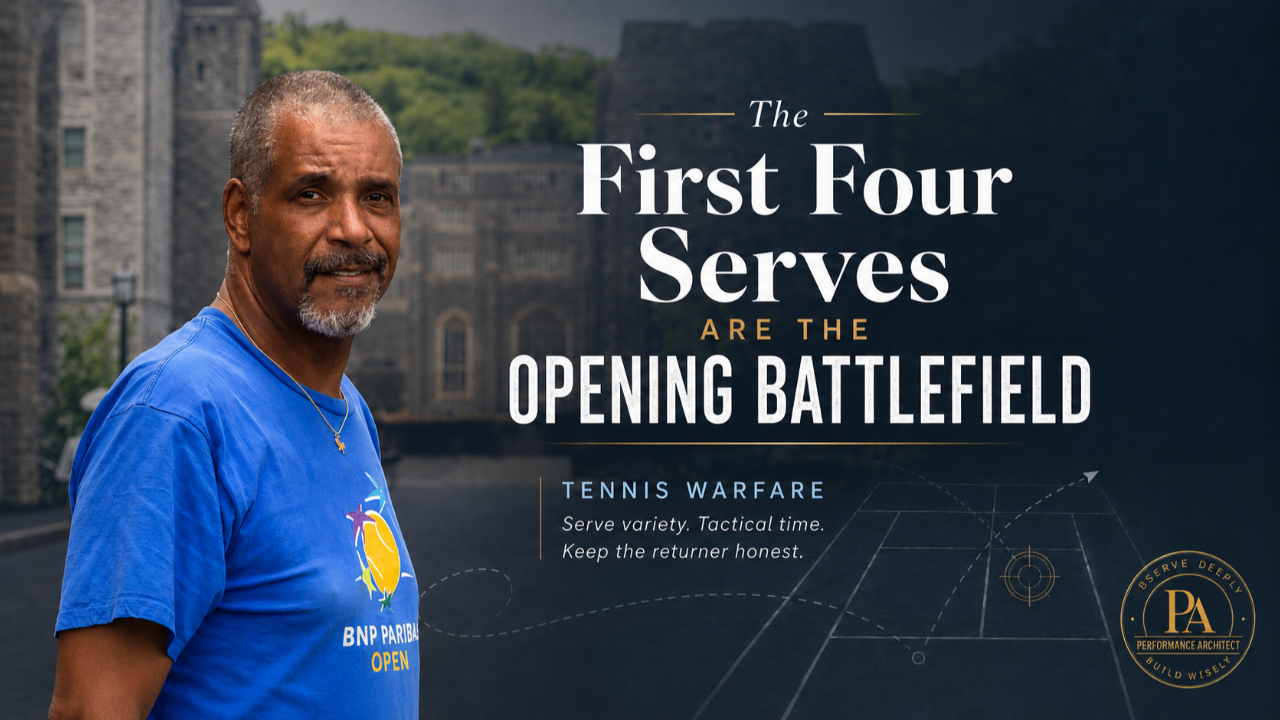
Most junior players think about the first game of a match in a way that makes sense. They want to get started, make first serves, settle their nerves, and avoid handing over an early break.
None of that is wrong. It's just small.
In Tennis Warfare, the start of a match isn't a warm-up. It's the first exchange of information. Both players begin learning what the other can handle, what they're protecting, and how fast they adjust. The score is fresh, but the campaign has already started.
That's why I want a player to open with enough variety to hit the first four first serves with two wide serves and two T serves, in some purposeful order.
Wide, T, T, Wide. T, T, Wide, Wide. T, Wide, Wide, T. The exact order can change match to match. The requirement isn't the pattern. The requirement is that both locations are alive early enough that the returner believes both have to be defended.
A player who can't reach those locations on command doesn't really begin the match with a tactical choice. He begins it with hope.
A first serve isn't just a way to start the point. It's a way to ask a question. Can you cover wide? Can you protect the T? Do you lean before I toss, or do you wait and read? The player who can only hit one serve isn't asking anything. He's announcing himself.
That works against a weaker player. It can even work for a while against a good one. But at some point the opponent reads the battlefield. Once the returner knows where the serve is going, the match starts to narrow. He can cheat. He can sit on the pattern. He can take away time and make the server feel like his best weapon stopped working.
In that moment the serve didn't always break down technically. Sometimes it broke down tactically. The player never had enough variety to keep the opponent honest.
That phrase matters, so let me be clear about it. Keeping the returner honest doesn't mean every serve has to be equally dangerous. Most players still have a favorite serve, one location or shape they trust most under pressure. That's fine. The problem is when the opponent knows it too soon.
A player doesn't need four favorite serves. He needs enough willingness and command to make the returner defend more than one possibility. Wide. T. Body. A change of spin or pace. The returner doesn't have to be beaten by all of them. He only has to believe each one is alive, and that belief changes the return.
Once the returner has to honor the wide serve, the T serve gets better. Once he has to honor the T, the wide serve gets better. Once he has seen the server go to the uncomfortable location with conviction, he can't fully sit on the favorite. That's where the server starts buying time.
Not clock time. Tactical time. The server stretches out the part of the match before the opponent can settle into the return. He delays recognition and slows down the opponent's ability to cheat.
This is why a serve the player doesn't love can still be valuable. It may not be the serve he wants at break point. It may not be the one he trusts when the match gets tight. But if it's shown early and shown with conviction, it becomes a diversion that protects the main weapon. The favorite serve is most dangerous when it hasn't been announced.
A player who loves the wide serve may need to go T early, not because the T is better, but because wide has to stay available later. A player who loves the T may need to stretch the returner wide early, not because wide is the plan, but because the T gets stronger when the returner can't lean inside.
You don't reveal your best weapon every time simply because it's your best weapon. Sometimes you move the opponent's attention somewhere else so the weapon still matters when the match reaches the points that decide it.
That's also why the first four serves are more than a serving drill. They're reconnaissance. The first wide serve isn't only an attempt to win the point. It's a way to see how the opponent moves, reaches, and recovers. The first T serve isn't only a percentage play. It's a way to test whether he's leaning wide, guarding the sideline, or soft through the middle.
The value isn't only in the serve. It's in what the serve reveals. If the first wide serve pulls a weak, floating return, that matters. If the second one does the same, it matters more. If the opponent starts cheating wide and the server then goes T, the server has set a diversion and punished the adjustment.
That's Tennis Warfare. Not just execution. Control.
A player who can open with two wide and two T, in whatever order the moment calls for, is making a statement. Both sides of the box are alive. Guessing will cost you. You don't get to settle into a comfortable return position early.
That doesn't mean the player has to serve big. It means he has to serve on purpose. At the junior level too many players think of the serve almost entirely in technical terms. Toss, rhythm, racquet drop, contact, pronation, finish. Those things matter, but they aren't the match. A clean serve that always goes the same place is easy to organize against. A slightly less impressive serve, placed with intent and varied with intelligence, creates far more pressure. The second player is playing the opponent, not just the ball.
Once the returner has to hold wide and T in his mind at the same time, he has to carry more possibilities at once. That hesitation may be a fraction of a second, but tennis is full of fractions. A fraction late on the return, a fraction off balance after contact, a fraction slower to the next ball. Those fractions become territory.
There's one more reason this can't be left to chance. Players who don't practice serve variety under pressure usually don't trust it when the match is real. They can hit the wide serve in a warm-up. They can hit the T on a practice court. But when the score counts, they retreat to the one serve that feels safest. The opponent may not know that consciously, but he feels it, and the match starts to reveal the player's limits.
So practice opening games with tactical responsibility. First four first serves, two wide and two T, arranged on purpose. The order isn't the lesson. The lesson is that the player learns to begin the match with more than one available action. This isn't reckless serving, and it's not serving away from strengths just to prove variety exists. It's having enough command to choose.
Choice is the weapon. Without it, the player is locked into a frontal assault whether the frontal assault is working or not. With it, he can probe, stretch, jam, surprise, repeat, or redirect. He can notice when the opponent starts leaning. He can turn the serve from a shot into a campaign.
The player who can only hit his favorite serve is predictable. The player who can hit the favorite, hide it, protect it, and come back to it when the score demands it has begun to serve like a tactician.
The match has already started before the first rally develops. The server who understands that doesn't simply start the point. He starts the battle.
The serve is one front in a larger campaign. Tennis Warfare is the full methodology, the way I've taught players to read the battlefield, gather intelligence, set diversions, and decide when to launch an all-out assault. I laid out the complete framework in an article called Tennis Warfare by Duey Evans. If the way you just read the first four serves made you see the rest of the match differently, that's where to go next: https://www.linkedin.com/pulse/tennis-warfare-duey-evans-1e/
Never Miss a Moment
Join the mailing list to ensure you stay up to date on all things real.
I hate SPAM too. I'll never sell your information.
