The Fourth Participant
Mar 20, 2026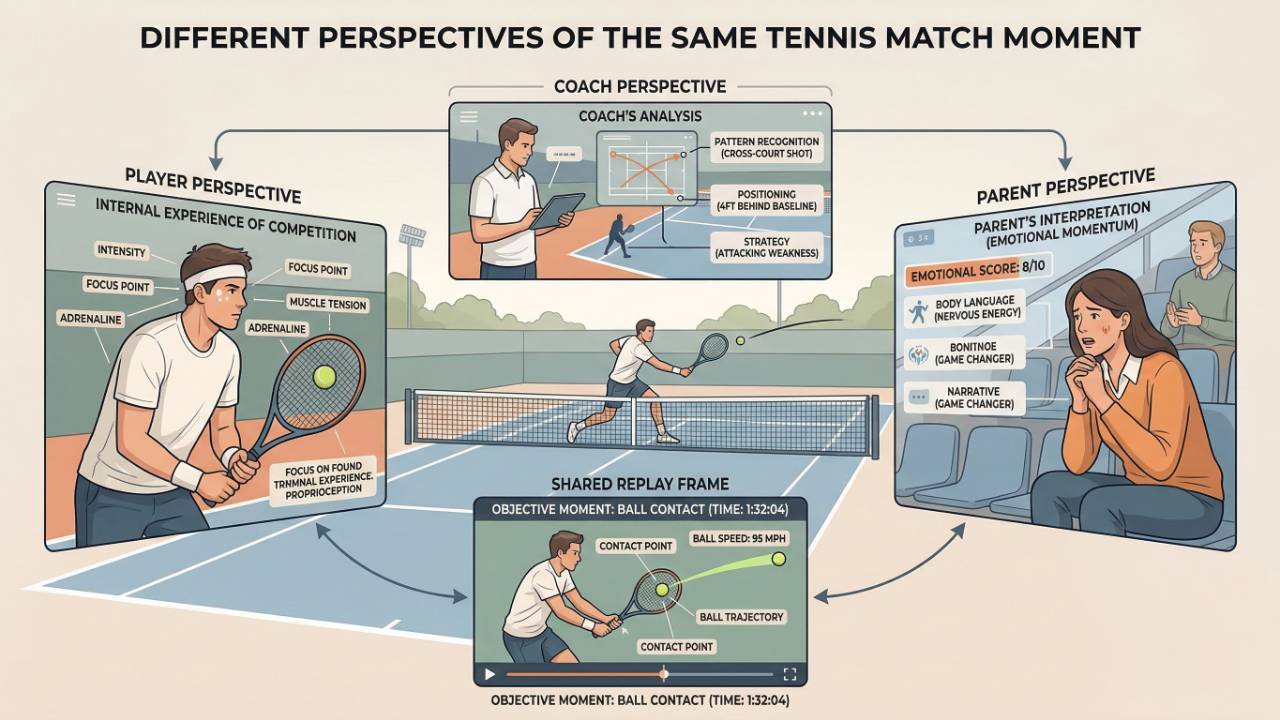
Human to the Power of AI — Essay Ten
The assumption built into most conversations about the debrief is that it involves two people. A coach and a player. A teacher and a student. A mentor and a learner. The assumption is understandable because those are the roles the environment officially recognizes. It is also wrong in almost every development context that involves young people. The debrief in youth development has always involved at least three participants, and the third one is the reason the examination stage is harder to stabilize than any framework for it acknowledges.
The player, the coach, and the parent each watch the same event. They do not watch it the same way, and by the time the debrief begins, the event itself no longer fully exists. It has already been reconstructed.
Human memory does not preserve experience the way a recording does. It reconstructs experience from whatever details carried the most emotional or cognitive weight in the moment. The reconstruction begins almost immediately and continues through the conversation that follows. What survives in each person's memory is not the event itself but a version of it shaped by where they were standing, what they were responsible for, and what they were most afraid of or most hoping for while it was unfolding. By the time three people sit down to examine what happened, they are not working from the same material. They are working from three different versions of the material, each internally consistent, each capturing something real, and none of them complete.
This creates a structural problem that runs beneath the surface of even well-intentioned development conversations. The player who just competed carries the experience from inside it. A missed shot at a critical moment is not a tactical observation from the player's vantage point. It is a physical memory of the pressure preceding the decision, the adjustment made in a fraction of a second, the gap between what was intended and what the body did under stress. That experience resists clean articulation after the fact because the conditions that produced it no longer exist. The explanation the player offers in a parking lot twenty minutes later is a reconstruction that simplifies something that was not simple while it was happening.
The coach is watching from outside the pressure and through a specific interpretive lens shaped by developmental priorities that extend well beyond the result of the match. A coach who has been working with a player for months is watching for patterns: whether the player executed intentions established before the match, how decisions under pressure aligned with what the practice environment has been building toward, where the gap between understanding and execution opened and at what point in the match it opened. The coach's reconstruction is more structurally organized than the player's but it is still a reconstruction, filtered through those developmental priorities and through whatever the coach was most focused on during the critical moments.
The parent has watched the same match while carrying an emotional investment that neither the player nor the coach shares in the same way. What registers most vividly for most parents is not tactical pattern but emotional arc: the moments where the player appeared confident or deflated, where momentum shifted and what the player's body language suggested about how the shift was being processed internally, whether the competitive experience produced the kind of engagement the parent believes matches the player's capability. That reading is real. It captures something the coach's developmental lens and the player's internal experience may both miss. It is also the version most likely to be expressed in emotional terms that pull the conversation away from examination and toward comfort or reassurance.
None of these perspectives is the wrong one. Each sees something the others do not. The difficulty is that when three partially overlapping reconstructions meet in a conversation organized around trying to understand what happened, the conversation rarely produces understanding. It produces negotiation. Each participant subtly defends the version of events that matches their own reconstruction, not because anyone is being dishonest but because each person's version feels accurate from where they were standing. The exchange that was supposed to examine the experience ends up adjudicating among competing accounts of it. The loop completes on paper. The understanding it was designed to produce does not form.
Development environments have accepted this as a structural reality because there was no reliable alternative. The debrief depended on memory, and memory reconstructs rather than preserves. Thoughtful conversation could push toward better understanding, but it could never fully recover the signal of the experience once reconstruction had reshaped it in three different directions simultaneously.
What enters this conversation when captured interpretive dialogue is part of the environment's architecture is not a fourth opinion about what happened. It is something more useful and more rare: a stable reference point that the other three participants do not have to reconstruct because they did not experience it through pressure, developmental investment, or emotional stakes. The player can return to a specific decision point that felt chaotic in real time and examine it without relying on a compressed post-competition memory. The coach can identify the pattern across multiple games rather than defending an interpretation of a single moment. The parent can see how the emotional arc they observed corresponded to specific decisions on the court. All three can begin from the same material rather than attempting to triangulate between three separate versions of it.
The nature of the debrief changes when that shared reference point exists. The conversation stops being about what happened, because what happened is no longer in dispute, and starts being about what it means for the next cycle of intention. Participants stop defending their interpretations because the interpretations no longer need to carry the full explanatory weight. The examination can move toward understanding rather than remaining in the territory of competing reconstructions. The evolution stage that follows becomes more deliberate because it is informed by a clearer and more shared account of the experience that preceded it.
This is a more complete version of the loop that Essay Nine described. The IEDE framework stabilizes the debrief structurally. The fourth participant stabilizes the material the debrief examines. Both forms of stability matter, and the absence of either one limits what the loop can produce. Most development environments have neither. Environments designed around captured interpretive dialogue can have both, which changes what the most fragile stage of the loop is capable of generating across multiple cycles and across multiple cohorts.
The implications compound in the same direction the previous essays identified. Each debrief that produces genuine understanding rather than negotiated reconstruction adds to what the environment can surface the next time a similar situation arises. The reasoning that emerged from a clear examination is more useful than reasoning that emerged from competing accounts. The architecture that accumulates inside the environment grows more reliable as the quality of the examinations it is built from improves. Better signal going in produces more useful architecture coming out.
The next essay moves outward from the loop itself. What kind of environment would you design if you actually built around the assumption that this compounding is possible? What does the institution look like when it is organized to hold thinking, stabilize perception, and accumulate judgment across generations rather than resetting with each transition of personnel?
This is Essay Ten of the Human to the Power of AI series.
Never Miss a Moment
Join the mailing list to ensure you stay up to date on all things real.
I hate SPAM too. I'll never sell your information.
