The Half Nobody Repeats
Sep 18, 2026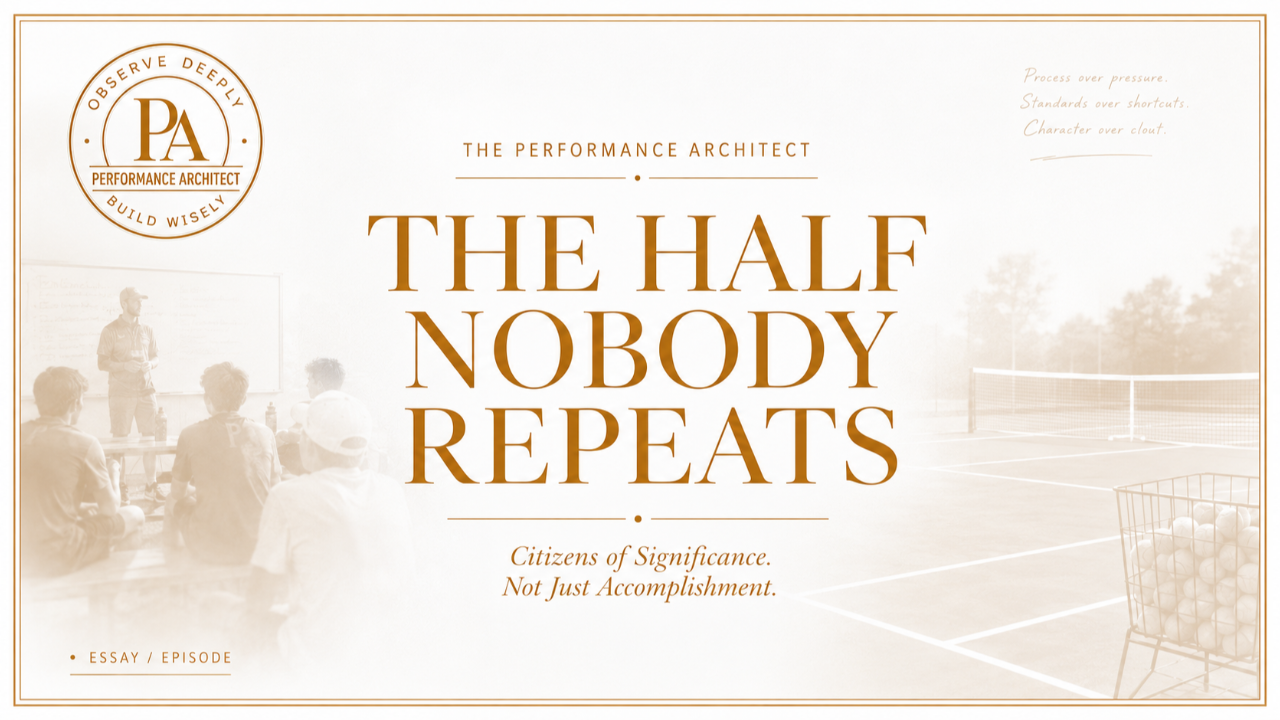
A week ago or so, I stood in a classroom at Austin Tennis Academy and ran the same ten minutes six or seven times, once for each group rotating through, and I opened every session by asking whether anybody had heard the coaches here talk about building citizens of significance. Hands went up every time, because they've all heard it. It's in the emails, it's how the coaches talk, it's stitched into the place. Then I asked for the second half of the saying and the room went quiet. One kid guessed "leaders in the community," which was a decent read of the context and still wrong, and across every group that came through, almost nobody could finish the line.
The full saying is citizens of significance, not just accomplishment. The half nobody repeats is the half doing the work. The language belongs to ATA, and I want to be clear about that, but the idea underneath it has felt like mine for most of my life.
Accomplishment Isn't the Goal. It's the Assumption.
When I asked what the phrase meant, the answers were thoughtful and all pointed in the same direction. One girl said we're not only looking for a ten UTR and good test scores, we want someone who can build a relationship with almost anyone. A boy said it means being more than a person who collects accomplishments, and another said it means being someone you can be proud of. Every one of those answers was about the first half of the sentence, which is why I stopped running the guessing game and just told them: accomplishment is a given.
At a place like this one, accomplishment is the operating assumption. Come here, do what the coaches ask, stay with it for years, and the entire apparatus is organized around making you an accomplished tennis player. That isn't a hope, it's the arrangement. Rankings, wins, UTR, trophies, college offers, position on the ladder, technical improvement, fitness gains, all of it can be measured and all of it is expected. So "not just accomplishment" doesn't mean instead of accomplishment. It means the achievement half is settled and the attention goes somewhere harder to see.
Accomplishment is about what you achieve, and significance is about the effect you have, which means the question is what happens to your environment because you were in it. I told each group their environment was the nine or twelve kids sitting in that room with them, not the sport and not the academy and not their future, just those people on that afternoon. What happens to this group today because you're in it?
Practice Is Where Significance Gets Built
Character doesn't get built in the big moment, it gets built in ordinary practice moments repeated until they stop being choices, and that's why the timeline matters as much as the intention. Jack Newman has a philosophy I've heard him state many times: he'd rather give one player ten years of tennis than give ten players one year of tennis. When I asked the kids what he meant, a few of them got close: one said he wants to put his energy toward the person who'll stick through the hard days and the good days, and another said he wants to give somebody enough attention to become the best version of themselves instead of making everybody mediocre. Both answers were in the neighborhood, but what he actually means is he wants kids for a decade, because the impact he believes he can have on a young person only shows up over that kind of time. He doesn't want a revolving door.
The proof is sitting on his ladder. The number one player is a senior in high school and the number four player is his younger brother, both of them started here in red ball more than a decade ago, and the same coach has worked with the older one that entire time. You can't manufacture that in a summer, and nobody attends eleven weeks of camp and walks out a citizen of significance. It arrives in small pieces over a long stretch, which is exactly what makes it so easy to skip.
The Questions That Are Only Rhetorical Until They Aren't
I read the kids a short list and warned them first these were rhetorical questions, meaning if they answered anything other than yes we were going to need a different conversation. When you're tired, can you still give your partner a quality ball? When you're losing, can you compete without complaining, blaming, or withdrawing? When you're winning, can you stay engaged without getting careless or disrespectful? They said yes every time, in every group, fast and loud, the way kids answer a question whose shape they already recognize.
Then I told them the yes was never in doubt, because of course they can, and the real question isn't whether you're capable of it but whether you actually do it. For some of them the honest answer is sometimes, and the entire project is turning sometimes into most of the time. The one I care about most is the fourth question on the list, which asks whether your standard changes when a coach isn't watching, and that one got a much softer response. A couple of no's, some shrugging, not much conviction, and I said so out loud.
What Happens When Nobody's Watching
Years ago I saw an indoor program in Massachusetts where the kids had been trained so thoroughly that when they let a ball go by without chasing it, they immediately turned and looked up at the office windows to see whether the director had seen them. They weren't checking their effort, they were checking their exposure, because if he'd been watching there was going to be a price and he'd be coming through the doors any second.
My friend Rodney Harmon is now the women's coach at Georgia Tech, and before that he ran men's tennis for the USTA, coached the men at the University of Miami, and reached the quarterfinals of the US Open while he was still in college. While he was at Miami he arranged a day where his players had every reason to believe he wasn't going to be around, gave them their practice plan, and then watched the entire session from his office above the courts. He was not happy with what he saw. These were grown young men on scholarship at a Division I program, and the standard they carried when they thought nobody was watching was not the standard they carried when their coach was standing on the court.
Those are the same story from opposite directions. The kids in Massachusetts had learned surveillance so well they checked the windows on instinct. The players in Miami showed what was underneath once the surveillance went away. If a standard only holds while somebody is watching, what got built was compliance.
I told the kids they're lucky, since there's a coach on nearly every court here and the only real gap is courts ten through twelve, where sometimes one coach is working with somebody at the far end and nobody is watching the middle. Then I told them what I'd said to one of the coaches the day before: I bet we could run this entire practice with three coaches. Not because we should, but because a standard that needs enforcement is a standard that didn't take.
The Missing Fourteen Hundredths
Here's the part they didn't expect. If you rate the group on a scale of one to five and everybody in it is a five, the group is a five. But if the group comes out at 4.86, somebody contributed to that missing fourteen hundredths, and it could have been one kid having a rough afternoon or six kids each shading a little.
I told them nobody wants to be the anchor, and then I told them the useful question isn't who dragged the average down. Scanning the room for the deficient person is easy work and it teaches you nothing. The useful question points the other way: how much of the missing fourteen hundredths belonged to me? It isn't a character judgment, because everybody has bad days. It's arithmetic, and arithmetic is a useful thing to sit with when you're honest about which side of it you were on.
A Better End-of-Practice Question
For most of my career the end of practice pulled naturally toward performance. How did you hit, what worked, what broke down, what do we fix tomorrow. Those are good questions and I'd add one more.
Did I make practice better because I was here?
Not did I play well, but was the environment of this group better because I was part of it today. Better doesn't mean nicer, and I want to be exact about this, because a kid can hear all of it as an instruction to be pleasant. Encouraging a struggling partner is one way to make practice better. So is competing hard enough that somebody has no choice but to raise their level, or asking the question nobody wants asked, or refusing to let a teammate coast through the last ten minutes, or beating a friend badly enough to show him what he actually needs to work on. Significance isn't agreeableness. It's understanding your presence changes the room and taking responsibility for how. I've got an H-E-B bag at home full of little handheld mirrors and I keep thinking about bringing them in, because the mirror makes the con harder to run. You can sell a coach, sell a parent, sell a teammate, and you can sell yourself in the retelling, but the mirror at least asks you to try the story one more time while looking yourself in the eye. The questions underneath it are simple enough to ask there: when your partner is struggling do you add frustration or help steady the environment, when you make a mistake do you hide from it or defend it or learn from it, and when you aren't the center of attention can you still contribute? Some kids need to be the center of attention badly enough to act a fool in order to get there.
Being a citizen of significance doesn't require being perfect. It requires understanding your ability bought you an opportunity and your choices decide what you do with it.
The Answer I Didn't See Coming
At the end of each session I asked who in the room would do the best job of making practice better for everybody else, and the kids looked around and named their friends and named the obvious leaders. In the first group I said I'd bet on one boy in particular, because he's the sort of kid who thinks about other people before he thinks about himself, and even his mother says he's odd like that. In a good way.
Then a boy in that first group raised his hand and said we should all be saying ourselves.
He was right, and he was more right than he knew, because if you're about to walk out and make everyone's practice better, betting on somebody else to do it better than you makes no sense. You wouldn't walk onto a court planning for somebody else to compete harder than you. I had walked into that room to teach them something about significance, and a thirteen-year-old had just improved the lesson. So I carried his answer into every group after that, telling them somebody in the first session had said something worth hearing and asking whether anyone could guess what it was, and group after group figured it out. They knew the answer was "me," and every one of them could reason their way there. Only one other kid, in the last group of the day, said it out loud on his own before I gave it away. Both of them got MVP at the end of the night and I told the whole staff why.
That's the distance we're talking about. Almost every kid in the building could identify the right answer, and two of them volunteered it. Knowing the standard and claiming the standard are separated by something small and hard to name, and whatever that gap is made of is the actual curriculum.
What Remains
Long before I ever heard the phrase citizen of significance, I got interviewed on a television segment called Hometown Hero, back when I was running a program for kids whose families couldn't pay for tennis. I watched the tape again not long ago. I said on camera I'd rather watch one of those kids receive a Nobel Prize than sit in the coach's box with them at Wimbledon. I've felt that way ever since and I said as much to the kids yesterday.
You aren't only practicing your forehand and your serve out there, you're practicing who you're becoming, and the little habits you build on a tennis court turn into the things you're known for later as a college teammate, an employee, a boss, a friend, a parent. None of that suddenly appears at eighteen. It accumulates. Meanwhile the tournament that feels enormous at fourteen becomes a blur by thirty, the ranking that runs a family's whole calendar turns into a line in an old bio, and even the accomplishments worth remembering settle into a much longer life.
What stays is the person built while chasing them.
The forehands matter, the trophies matter, the rankings matter, and the doors they open matter. Done right, though, they become raw material for something bigger: a person capable of accomplishing difficult things whose presence also has consequence.
Citizens of significance. Not just accomplishment.
Written with Reggie, Claude, Gemini, Otter, and 64+ trips around the sun.
Never Miss a Moment
Join the mailing list to ensure you stay up to date on all things real.
I hate SPAM too. I'll never sell your information.
