The Instrument That Makes It Visible
Mar 24, 2026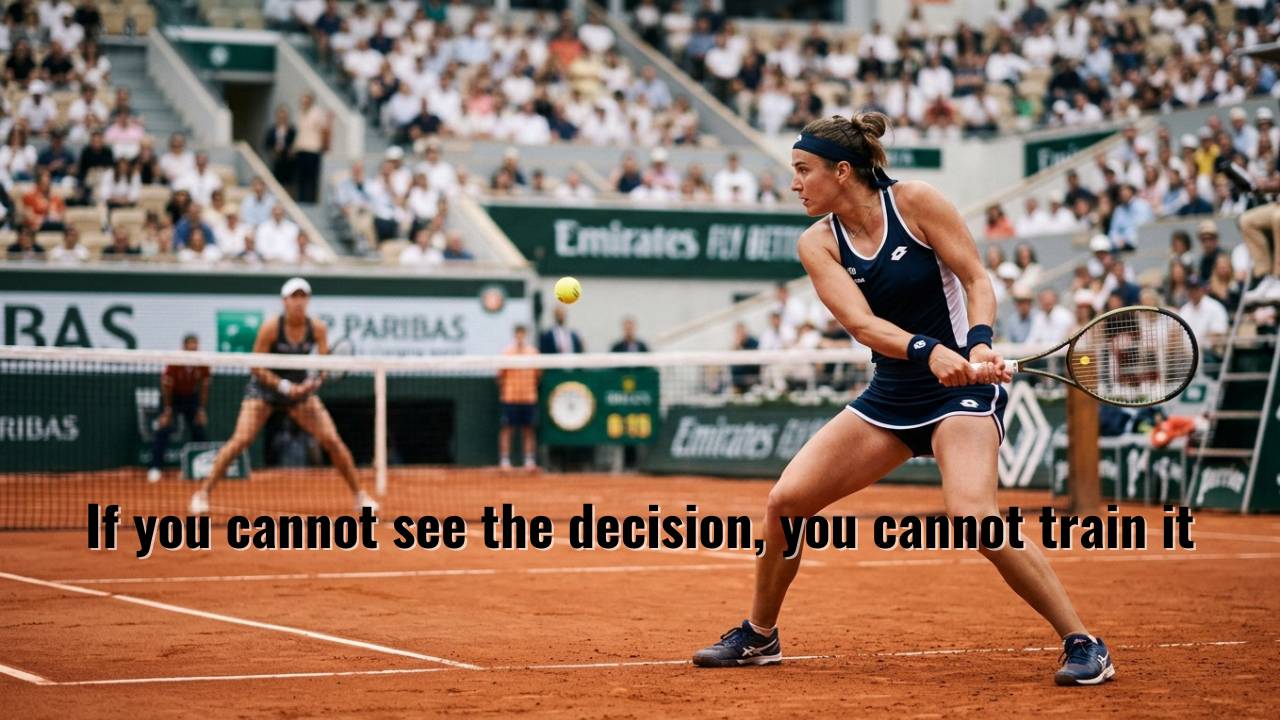
Human to the Power of AI — Essay Fourteen
Galileo did not improve the naked eye. He changed what the night sky could offer to someone willing to examine it. The telescope made certain observations possible that had previously been structurally inaccessible, and once those observations were available, they did not slot quietly into the existing astronomical frameworks. They shattered those frameworks from the inside and rebuilt them around what could now be seen. The instrument did not improve the science. It changed what science was capable of producing.
Development environments have operated in a pre-instrument condition for as long as development has been a field. Coaches observe. Teachers watch. Leaders interpret. Remarkable intuition has been built within those constraints, and the practitioners who cultivated the deepest judgment did so by learning to notice with more precision, ask questions with more discipline, and hold their interpretations more lightly. But precision within the constraints of unaided perception is not the same as having an instrument. Partial visibility has a ceiling.
That ceiling appears at the moment of decision. Outcomes are visible after the event. Sequences can be reconstructed from what practitioners remember of the match. Patterns can be inferred across repeated exposure. What has never been reliably accessible in the form the learning loop actually depends on is the interior of the event: the moment where a player reads the incoming ball, feels the court position, weighs the options under pressure, and commits. The camera has shown where the ball landed for decades. What it has not shown, with the fidelity development requires, is what the player understood was happening in the half-second before they decided to put it there, whether the hesitation in the approach was a tactical read or a confidence failure, whether the decision formed early enough to produce execution or late enough to guarantee it wouldn't. The interior of the decision remains, in the most structurally important sense, an inference. Inference is the instrument development has been relying on.
An instrument designed for this environment must address a specific limitation, and the specificity determines what the instrument actually is. Preservation of outcomes is not the requirement. Film already provides that. Expansion of tracking data is not the requirement. Statistics departments have been producing that for years. The requirement is the preservation of experience at the level of decision, captured in real time before memory begins reconstructing it, in a form the player, the coach, and the parent can all return to without any of them having to defend or negotiate their version of what occurred.
This is what Court 4 was designed to do. Not as a product, but as an instrument class: the kind that accesses what was previously structurally inaccessible rather than improving resolution on what could already be seen. The moment of decision has not been difficult to see more clearly. It has been unavailable in the form the Debrief stage requires, and the design of the instrument reflects that specific constraint rather than a general desire for more information about what happened.
Three functions define the class. The instrument must capture experience as it unfolds, before memory begins its reconstruction, which means the capture happens during the event and not in retrospect. It must translate raw experience into a form participants can actually examine. A recording of a match is not the same as an examination of what occurred inside it, and closing that gap requires interpretation capable of surfacing patterns without collapsing them into premature conclusions, which is the specific role a thinking partner trained on the environment's history fills. And it must synchronize the perspectives of participants who would otherwise leave the same event with three different accounts of it, making shared examination possible rather than a negotiation among competing recollections. Capture, translation, synchronization: any instrument failing on one of those three functions cannot fulfill the role the learning loop requires at the Debrief stage.
None of those functions makes the coach less important. The decades of pattern recognition, the eye for what a player's movement reveals about their internal state, the ability to connect present decisions to priorities extending months into the future: none of that disappears when a stable reference exists. What changes is the material the judgment is applied to. Interpretation no longer operates on reconstruction. It operates on something re-examinable when the first interpretation proves incomplete. The instrument does not replace the practitioner's eye. It gives the practitioner's eye something reliable to look at.
The compounding effect of this change is what eventually separates environments built around instruments from environments built on intuition alone. When each Debrief begins from a stable reference, adjustments become more precise. When adjustments become more precise, the next cycle produces cleaner information. The loop tightens not because more effort enters the system but because the signal is preserved long enough for effort to connect to something real. Development speed is not purely a function of effort or resources. It is a function of how quickly reality becomes visible and how much of what becomes visible carries forward into the next cycle.
Before Court 4, the learning loop began from what participants believed had occurred. After it, the loop can begin from what actually occurred. That is not a refinement of the existing system. It is the condition under which the system can finally do what it was always designed to do. What this arc will reach in the essays ahead is how what becomes visible gets metabolized into judgment: how the signal captured by an instrument becomes the understanding carried forward by the people inside the environment.
This is Essay Fourteen of the Human to the Power of AI series.
Never Miss a Moment
Join the mailing list to ensure you stay up to date on all things real.
I hate SPAM too. I'll never sell your information.
