The Knowledge That Moves Sideways
Jan 17, 2026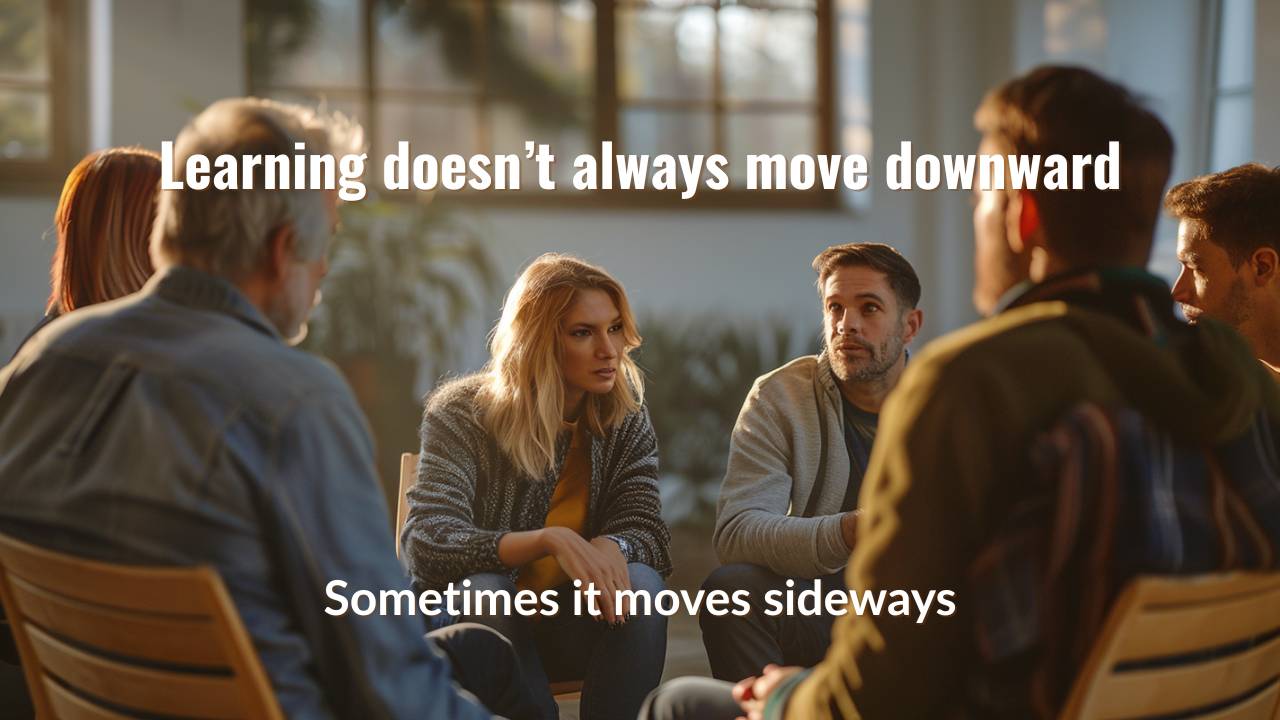
Most people think learning flows downhill, from expert to novice. It doesn't. Real learning moves sideways between people who recognize themselves in each other's questions.
Think about the last time you faced a decision that felt heavier than it should. Not because it was complicated, but because the standard advice didn't quite fit. The expert answers were technically correct but somehow beside the point. That's when you stopped looking up for guidance and started looking around for someone who had already walked through what you were walking through. That's when sideways learning became the only learning that mattered.
This matters most when the stakes are high and the pathways unclear. Parents navigating youth sports don't wait for permission to figure things out. They find each other. They compare notes. They test assumptions against lived experience rather than official guidance. Over time, these exchanges create an infrastructure that shapes behavior more than any formal curriculum ever could.
The exchanges work because they don't announce themselves as teaching. Nobody performs for an authority figure. Nobody pretends to have all the answers. People speak from inside the problem rather than above it. They describe what happened, what surprised them, and what they would pay attention to if they started again. This kind of knowledge doesn't tell you what to do. It helps you see what you're already doing more clearly.
Clarity rarely arrives through instruction in complex systems. It arrives through recognition. Someone describes a situation and you realize you've been living inside the same pattern without language for it. Confusion loosens its grip because you're no longer guessing alone.
Formal systems underestimate this sideways movement because it doesn't scale neatly. It can't be standardized without losing texture. It resists compression into bullet points or best practices. But this is how humans actually learn to navigate uncertainty. We learn not by being told what works in general, but by hearing how others managed when the rules stopped being clear.
Peer learning becomes most visible at transition points. New people accept instruction. Established people rely on habit. But in the middle, in what I call the uncertain middle, people reach laterally. This is when old assumptions no longer fit and the next phase hasn't revealed its shape. This is when looking sideways becomes necessary rather than optional. They look for others who are close enough to understand the terrain but far enough ahead to offer perspective. Authority matters less than proximity. Experience matters more than credentials.
What makes these exchanges powerful is alignment, not agreement. People don't need consensus to learn from each other. They need enough shared context to interpret what they're hearing. A story from someone who has already crossed a threshold carries weight not because it predicts outcomes, but because it reframes effort. It helps others understand which struggles are part of the process and which ones signal misalignment. That distinction is rarely visible from the outside.
Peer knowledge carries implicit permission. When someone admits uncertainty without consequence, it opens the door for others to do the same. When someone describes a mistake without embarrassment, it normalizes course correction. Over time, this creates an environment where learning accelerates because defensiveness recedes. People stop managing impressions and start managing reality.
Environments that rely exclusively on top-down instruction often produce silence rather than clarity. People learn quickly which questions are rewarded and which ones are risky. They learn to perform competence even when they feel lost. Systems reward this performance because it looks like progress. But humans need the opposite. They need permission to be genuinely uncertain without consequence. The cost of performance culture is isolation. Each individual believes their confusion is unique when in fact it's shared. Peer learning breaks that illusion. It reveals that uncertainty is not a personal failing but a predictable feature of growth.
The most effective peer learning environments are contained, not expansive. They're designed to reduce social risk rather than amplify status. Hierarchies flatten. Titles recede. The focus shifts from outcomes to process. People speak from where they are rather than where they wish they were. This containment isn't about exclusivity. It's about creating the cognitive safety required for genuine processing rather than performance. When people stop managing how they're perceived, they can finally manage what they're learning. Without careful design, peer spaces can quickly replicate the same dynamics they're meant to counteract. Comparison creeps in. Posturing replaces honesty. Learning slows.
When peer knowledge circulates freely, patterns emerge that no single participant could have seen alone. Individual experiences begin to cluster into recognizable arcs. What felt like randomness starts to look like sequence. This is where meaning compounds. Not because someone synthesized it from above, but because it surfaced organically from many vantage points at once.
This kind of knowledge has a long memory. People remember the conversation that helped them reframe a difficult decision far more vividly than any formal lesson. They carry it forward and pass it on when the roles reverse. Peer learning creates lineage. Not through institutions, but through shared recognition. Each generation inherits not just techniques, but judgment.
Most systems don't know how to hold this kind of learning without trying to own it. Once something proves valuable, the instinct is to formalize it, brand it, and distribute it at scale. This often destroys the very conditions that made it effective. What was once a space for honest exchange becomes another channel for instruction. The sideways movement is replaced by a vertical one. Participation drops, even if reach increases.
Preserving peer knowledge requires restraint as much as intention. It requires acknowledging that not all learning should be optimized for growth metrics. Some learning needs time, trust, and repetition to do its work. It needs to remain close to lived experience rather than drifting toward abstraction. It needs stewards rather than owners.
When this balance is struck, the impact extends far beyond the original context. People approach new situations with better questions rather than premature answers. They develop tolerance for ambiguity. They learn to distinguish between urgency and importance. They gain confidence in their ability to navigate unfamiliar terrain without constant external validation.
Expertise gets most of the attention. But systems that rely exclusively on expertise miss something fundamental. They lose access to the actual mechanism by which humans navigate genuine uncertainty. They lose the collective pattern recognition that no single expert can replicate. They lose the transfer of judgment across generations, which happens through shared recognition rather than formal instruction. Most critically, they lose the knowledge that's already present in their communities, waiting not to be created or delivered, but simply to be connected. What looks like a knowledge gap is often a connection problem. And connection doesn't require more expertise. It requires better architecture for sideways movement.
Never Miss a Moment
Join the mailing list to ensure you stay up to date on all things real.
I hate SPAM too. I'll never sell your information.
