The Library Exists
Mar 10, 2026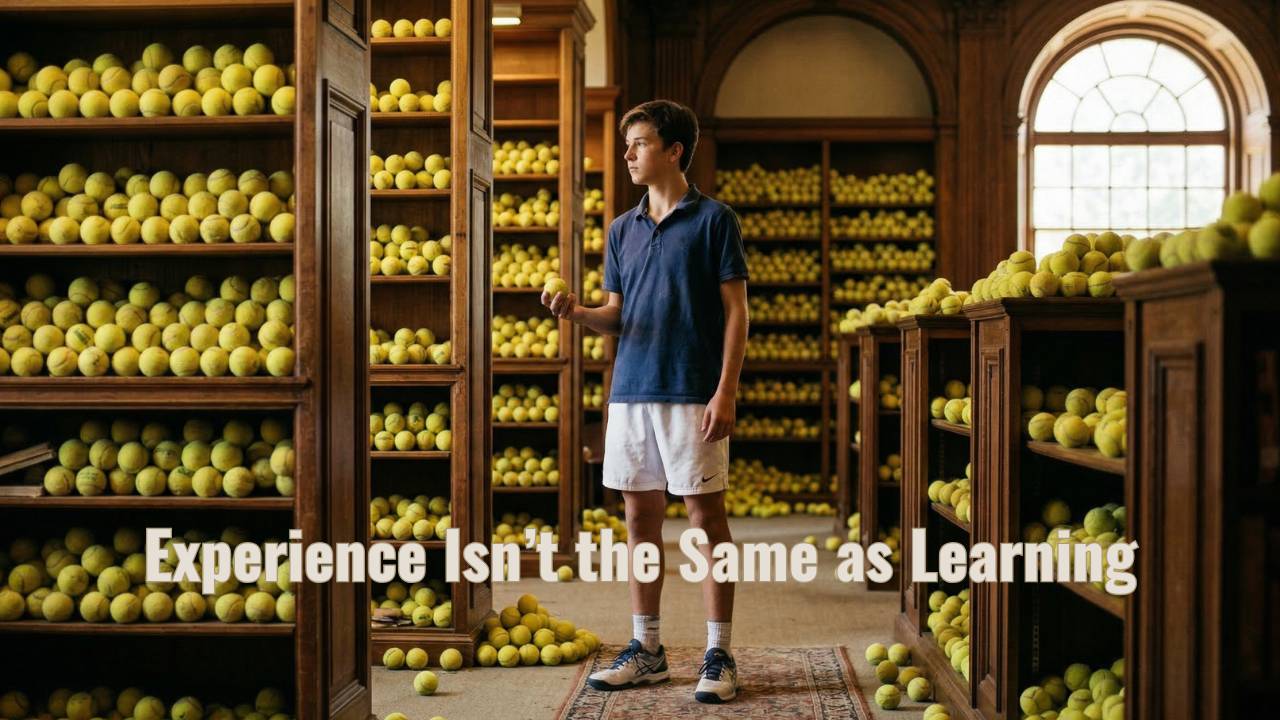
A parent wrote to me after watching her son walk off a court and say something she had heard so many times it had almost stopped registering. She asked him why he hit the shot he hit at a critical point in the match. His answer was the same one she had been getting for months. He said he did not know. She had been reading that answer as a sign that he was not paying attention, not focused enough, not doing the cognitive work that competing seriously requires. She was wrong about what she was looking at.
Her son had been playing tennis since he was young, and his first coach had recognized something real in him. The kid loved to rally. He could keep a ball going back and forth across the net almost indefinitely, and his coach leaned into that. They spent the majority of their time doing exactly that. The approach kept him engaged, and it produced results. He competed in local tournaments and won enough to feel like the work was going somewhere. What nobody involved saw was that most of those early wins were happening without a systematic technical foundation beneath them. He did not need precise footwork or a clear tactical framework to beat the players he was beating at twelve years old. So neither was being built.
When the competition eventually caught up, the gaps became visible. His opponents had cleaner habits, sharper patterns, and language for what they were doing on court. When things broke down under pressure, they could identify why and make adjustments. He could not. His game had been assembled the way a lot of young players assemble their games, through trial and error, through exposure, through hundreds of repetitions of solving problems during competition with no one watching over the method. That is not nothing. It is actually quite a lot. The problem was that none of it had ever been organized.
I told her that the grammar was probably not absent. It was more likely untagged.
His slice backhand was a good example of what I meant. That shot did not come from a drill or a lesson plan. It emerged during a match when his footwork broke down and his body needed an alternative. His system had been problem-solving the whole time, discovering solutions under pressure and storing them somewhere. The library existed. The books were not labeled. The correction her son needed was not a rebuild from scratch. It was a system for getting his hands on what he already possessed.
Most of what looks like a learning problem in competitive juniors is actually a retrieval problem.
The player has accumulated experience, but the experience has not been processed into anything usable. Development moves in a loop, not a line. Intention leads to experience, experience leads to debrief, and debrief leads to adjustment before the whole cycle begins again. The problem is that most players complete the first two parts of that loop hundreds of times without doing the third. They form an intention, they have an experience, the match ends, and everything gets filed away without meaningful processing. The next match starts with the same unexamined patterns intact. Repetition happens. Learning does not.
She started changing the conversations she had with her son after matches. Instead of asking how he played or what the score was, she began asking three consistent questions. What did he intend to do? What pattern did he actually fall into? What would he try differently the next time he faced the same situation? The goal was not evaluation. The goal was vocabulary. If he could name what happened, he could begin working with it instead of around it.
What followed was not dramatic or immediate. That matters to say out loud, because the junior tennis environment tends to measure progress in tournament results and ranking points, neither of which captures what was actually shifting for this kid. Within a few weeks she told me the questions had opened up conversations she had not expected. He started connecting things. A pattern he recognized from one match started showing up in how he thought about the next one. The vocabulary was building the architecture.
The first clear evidence of what had changed came at a tournament later that season. Her son drew an opponent rated significantly higher and fell behind early. Instead of getting frustrated and pressing, he got curious. He started studying his opponent's serve. He wanted to stay in the match not because he believed he was going to turn the result around, but because he could feel himself learning something while it was happening. When rain stopped play before the match could finish, the family had already made plans to attend a community event the following morning. He asked to go back to the courts instead.
When the match resumed, he extended rallies, won several games, and competed in a way the early scoreline had not suggested. When it ended, he did not talk about the result. He pulled up the match recording and started identifying what he wanted to adjust: his preparation time between points, his footwork patterns approaching the ball, his ready position. He was studying the experience rather than reacting to it.
She described that weekend as a turning point. She was not talking about improved shot selection or cleaner footwork, though both would follow. She was talking about his ability to learn from competition instead of just survive it. She used the word priceless to describe what the process had produced. That word is accurate. The capacity to extract information from experience rather than simply accumulate it is the capability that separates players who continue to develop from players who plateau. Not effort, not investment, not natural ability. The interpretive system surrounding the experiences.
The physical skills in her son's game did not change in those weeks. What changed was how he related to the information his own body had been storing for years. She moved from spectator to thinking partner. He moved from defending results to studying patterns. Those two shifts, in almost every case I have seen across thirty-five years of this work, are where real development actually starts.
If any of this sounds like a conversation you have been having in your own house, reach out. The most useful conversations I have with parents usually begin with someone saying they cannot quite put their finger on it, but something is not adding up. That is usually the right starting point.
Duey Evans [email protected] 469.955.DUEY (3839)
Never Miss a Moment
Join the mailing list to ensure you stay up to date on all things real.
I hate SPAM too. I'll never sell your information.
