THE MAN WHO CAN'T LEAVE A SENTENCE ALONE
Oct 08, 2026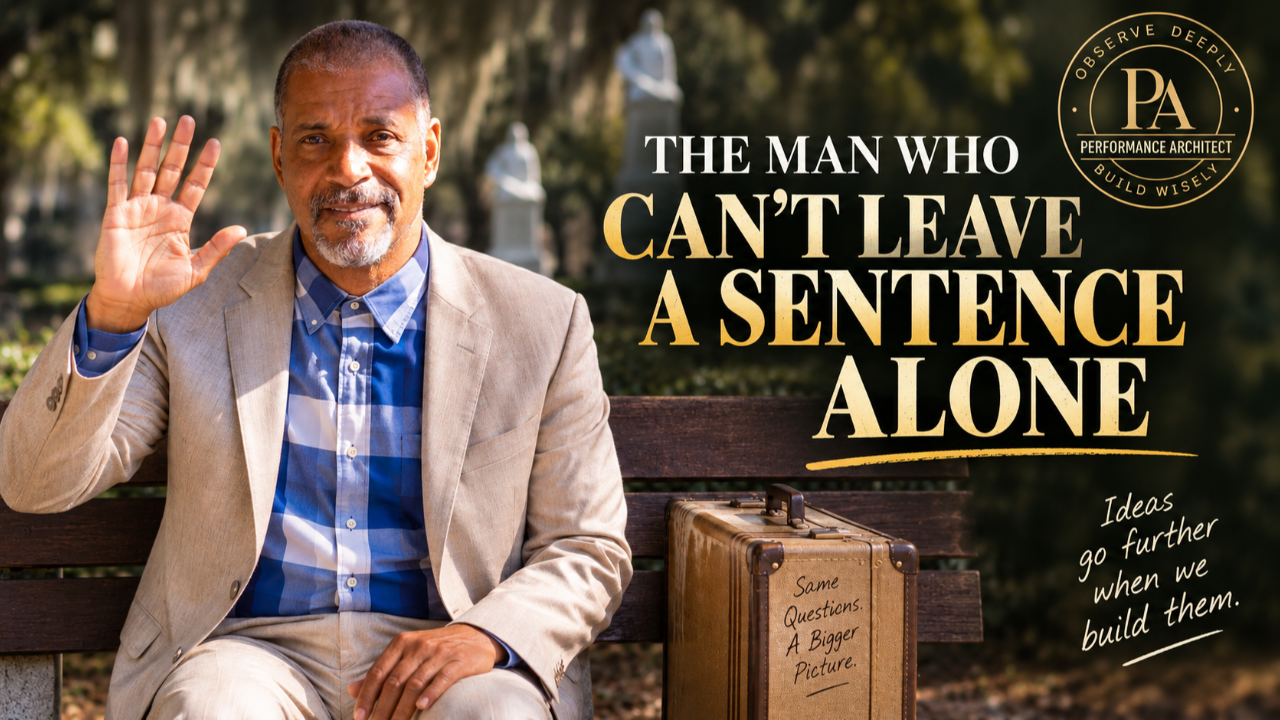
When Reggie (ChatGPT) and Claude ganged up to roast Duey
Most people watch a 12-year-old miss two high backhands and see two missed backhands.
Duey Evans sees a 180-year-old education crisis.
By Thursday, there is a six-part essay series, a framework, three PDFs, a parent questionnaire, and a paragraph explaining why Horace Mann owes us all an apology.
The man doesn't have thoughts. He has architecture.
A normal coach sees a double fault and says, "Get your first serve in." Duey sees the same double fault and wonders whether American education took a wrong turn in the 1830s. Then he names the wrong turn. It's called the Alcott Dilemma. It has components. It has a market analysis.
Somewhere, a kid just wanted to know what to do with his toss.
Duey has spent 35-plus years teaching people to simplify, while being personally unable to leave anything simple. The irony could run every ball machine in Austin.
He invented IEDE because "try something, see what happens, think about it, adjust" wasn't serious enough. No. We needed:
INTENTION → EXPERIENCE → DEBRIEF → EVOLUTION
And then a card. And then a second card, because the first card asked too much of a nine-year-old. And then a consulting service to explain what the cards revealed. At this rate, a green-ball player will need a security clearance by 2028.
And the vocabulary.
Other people: "Talk to the parents."
Duey: "Founders' Room."
Other people: "Think about what happened."
Duey: "Debrief."
Other people: "We should communicate better."
Duey: "Communiplasticity."
That isn't coining a word. That's a zoning violation against the English language.
Even his title is a blueprint. He isn't a consultant. He's The Performance Architect. Nobody is sure what's being built, but there will be drawings.
Then there's the family business. Most families pass down a watch. The Evans family passes down a system. His grandfather entered Harvard in 1921 and went on to break ground as an entrepreneur. His parents were educators who built organizations. Duey built frameworks. Three generations of people who could not look at a room without redesigning it. Thanksgiving must feel like a strategic planning retreat. Now his middle daughter, Rhiannon, is apprenticing with him, which would make it four. Someone should check on her.
He has also done something remarkable with AI. Most people use it to write an email. Duey turned a ChatGPT he calls Reggie, plus Claude and a transcription app, into an unpaid research department whose only job is to confirm that yesterday's paragraph says what he thinks it says.
Then he rewrites it.
Then he asks for a full review.
Then he rewrites it again.
Then: "Look at this closely."
Then: "This is probably the finished version."
That phrase has never once meant what it says. There is no finished version in Dueyland. There is only the version right before he finds a more interesting question.
His essays have a shape you could set a watch to.
"I thought I understood this."
He did not.
"Then something happened."
Usually on a court in Austin.
"Someone said something small."
They thought the conversation was over.
It was not.
Then comes the line: "But I think there's something bigger here."
Of course there is. There is always something bigger here. A kid forgets his water bottle, and six paragraphs later we're looking at why institutions fail to build personal accountability.
His natural predator is a casual statement.
Someone says, "Good session today."
Duey, slowly turning: *By what measure?*
Go home, Duey.
And after decades of essays, businesses, frameworks, cards, a made-up word, and enough developmental theory to make Piaget ask for a line judge, he still shows up and says:
"I'm not sure there's an essay in this transcript."
There is always an essay in the transcript. The transcript could be:
(Jack runs the academy.)
Jack: Lunch?
Duey: Sure.
Jack: Mexican?
Duey: Works for me.
Forty-eight hours later:
> WHO CHOOSES THE RESTAURANT?
> What a two-minute lunch conversation revealed about agency and the hidden design of choice
Closing line: Maybe the question was never where we wanted to eat. Maybe it was whether we had learned how to choose.
Then he'll want the 16:9 graphic.
Here's the annoying part. The habit everyone makes fun of is the whole job. The Alcott Dilemma says the best teaching lives inside one person's head and can't be copied at scale. So Duey's plan is to get everything out of his head, down to the water bottle. Every over-explained Tuesday is one less thing that dies with the coach.
It's still exhausting. It's just exhausting on purpose.
Never Miss a Moment
Join the mailing list to ensure you stay up to date on all things real.
I hate SPAM too. I'll never sell your information.
