The Match Nobody Remembers
Mar 31, 2026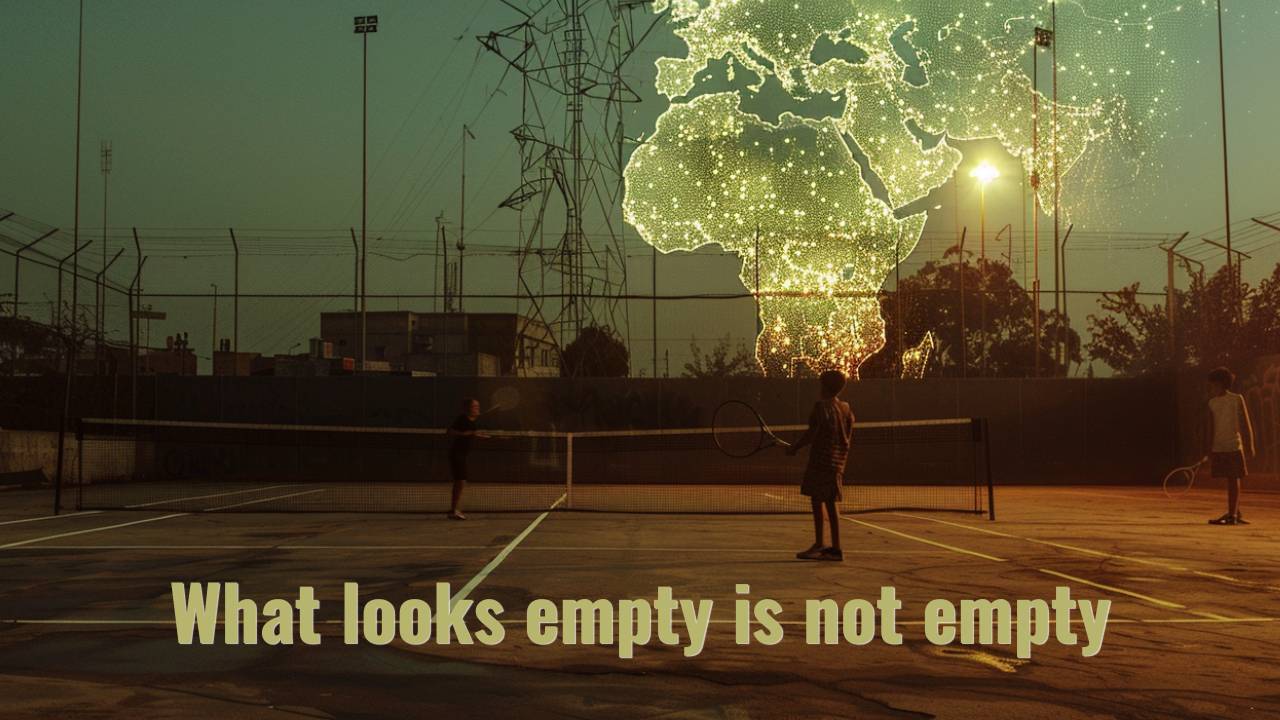
Two Billion Children Are About to Change Tennis Forever
By Duane "Duey" Evans
Editor's note: This story includes a brief description of gun violence.
A 16-Year-Old Beat Kafelnikov
In 1989, a kid named Charles Hardison stood across the net from a Russian player at a USA/Soviet goodwill tennis tour and won. His opponent was Yevgeny Kafelnikov, future World #1, two-time Grand Slam champion, Hall of Famer. Charles beat him on a day nobody in the tennis world thought to write down. Ten months later, Charles was murdered in his basement, shot four times by his mother's ex-boyfriend, at 16 years old: captain of his tennis team, co-founder of Students of African Descent at Milton High School, a kid his coach described as having "the personality every man in the world would like to have."
His mother had moved them to Milton, Massachusetts specifically to escape urban violence, believing systematic education and tennis development would create the kind of opportunities her son couldn't access in the city. She understood the architecture of upward mobility: get your child into a structured environment, surround him with serious people, let the system work. She was doing everything right, Charles was doing everything right, and systematic barriers, the kind my family has spent four generations fighting, destroyed him anyway. I've been carrying Charles for 35 years, and I didn't fully understand why until I started looking at maps.
I've been telling this story for 35 years and only recently understood what it is actually about. It is not about violence. It is not about tragedy. It is not even about tennis. It is about what happens when talent exists inside a world with no architecture to receive it. Charles had everything. His mother built everything she could build. The system had no place for what they brought to it, and the system won. That is the story I have watched repeat itself, in different forms, at every level of development I have ever touched, not because the talent was wrong, but because nobody built the architecture to convert it into something the world could see. For 35 years, building that architecture at any real scale was impossible. That is what has changed.
What Was Also Happening in 1989
Also on that goodwill tour was a player named TimiKano Solomon, my first high-performance student, a coaching relationship lasting over a decade, whose full given name was literally TimiKano, after Kano, Nigeria. I didn't understand the significance of the connection until years later, when I was running Midcourt Tennis Academy in Charlotte and had hired three Nigerian coaches: Kyrian Nwokedi, former Nigerian #1 and Davis Cup player; Yakubu Suleiman, who competed when tennis was an Olympic demonstration sport in 1984; and a coach I knew as Ras Ra I. Kyrian and I, along with two Nigerian physicians, also formed Eagle Management Group specifically to support Nigerian Davis Cup players, which meant I was spending real time with people who had learned the game under conditions I hadn't considered.
What those coaches taught me took thirty years to fully process. They had learned to play tennis as ball kids at Lagos Tennis Club, watching from the fence while members played, and when those members were done with a set of balls, when there was literally no life left in them, they'd hand them over to the kids. So these coaches learned the entire game with two or three dead balls, no basket feeding, no lines of students rotating through groundstroke progressions, just rally and develop strategy and make points from wherever you happen to be. Tactical thinking wasn't introduced later as an advanced concept. It was the first thing they learned, because tactical thinking was the only thing their circumstances allowed. All three of those coaches helped develop Thai Kwiatkowski from ages 9 through 14, and Thai became the nation's top recruit out of high school and won the 2017 NCAA Men's Singles Championship at Virginia. The Nigerian approach, tactical from the start, strategic intelligence forged through resource constraint, had already proven it could produce American champions, and I was watching it happen without understanding what I was seeing.
Two Billion People. Zero Tennis Infrastructure.
Africa has approximately 1.4 billion people, with a median age below 20 across most of the continent and roughly 600 million children under 18 in Sub-Saharan Africa alone. Nigeria's 95 million under-14s are not an anomaly. They are a representative sample of a continent-wide demographic reality the tennis world has not seriously reckoned with. Add the Middle East and North Africa: another 500 million people, Egypt at a median age of 24, Iraq at 21, and you are looking at two entire regions of the world with young, hungry populations, rapidly expanding urban centers, and almost no systematic tennis development infrastructure.
For comparison: the United States has a median age of 38, France 42, Spain 46, Italy nearly 49, and right now, Italy and Spain are producing the two best players on the men's tour. The nations generating Grand Slam champions are among the oldest populations on the planet, their youth pipelines narrowing in ways no amount of federation investment can reverse, because you cannot manufacture young people. Meanwhile, Africa and the Middle East hold the largest concentration of under-20s on the planet, and the tennis world's response has been to essentially ignore this fact. The talent isn't absent from these regions. The architecture is.
The Math Everyone Gets Wrong
People hear demographic numbers and assume participation rates need to match them before development becomes viable, which is exactly backwards. France built their tennis dynasty with hundreds of thousands of juniors, not tens of millions, and Spain did the same, yet Nigeria alone has a youth population larger than France's entire population across every age group. Africa doesn't need Western participation rates to change the sport; it needs functional development infrastructure reaching a fraction of one percent of its kids, which at 0.1% of Sub-Saharan Africa's under-18 population produces 600,000 players. That is not a pipeline. That is a flood the current ATP and WTA structures have no framework for absorbing.
The math resolves differently depending on what a country already has, and understanding those differences is what separates a real development strategy from a demographic fantasy.
Some countries have infrastructure but it's pointed at the wrong people. Egypt has 105 million people, Cairo and Alexandria together holding over 25 million, and real tennis history: it hosted the Egyptian Open, produced players who competed internationally, built courts and clubs and federation structures. Almost none of that infrastructure touches the population that could power a generational shift. Morocco produced Hicham Arazi at a career-high World No. 22, developed a French-influenced tennis culture with genuine proximity to the Roland Garros tradition, and has the foundation of a serious program. That foundation serves a narrow demographic slice and has for decades. South Africa has more tennis infrastructure than any other country on the continent, built over generations, and the legacy of apartheid is the reason almost none of it sits where the talent does. These are not development problems. They are distribution problems. Fix the access and you are not building from nothing; the architecture already exists.
Other countries have the competitive DNA and nothing else. Kenya has produced world-class distance runners for fifty years through training approaches that look, in their essential logic, almost identical to what my Nigerian coaches described at Lagos Tennis Club: resource-constrained, tactically demanding, built on competitive instinct rather than technical abundance. Ethiopia mirrors it. These are cultures that already know how to manufacture champions under conditions of scarcity. They have done it so consistently, in another sport, that the rest of the world treats it as natural talent rather than engineered development. Apply a serious tennis framework to that culture and the question is not whether competitive players emerge. The question is how quickly.
Then there is a third category the tennis world hasn't thought about seriously: countries with investment capacity and no tennis vision. Saudi Arabia, the UAE, and Qatar are currently spending billions reshaping the global sports landscape across golf, Formula 1, soccer, and boxing. They are acquiring leverage in every major sport except the one still largely owned by the countries that invented it. Tennis hasn't appeared on their radar with any seriousness. Jordan and Lebanon sit at a different kind of crossroads, Arab and Mediterranean influences converging, educated middle-class populations with real appetite for individual sports, young enough demographically to have a genuine development window, and essentially invisible to the tennis development world. The capital is present in the Gulf. The cultural conditions are present in the Levant. Neither has been connected to a methodology that could do something with them.
Why Every Previous Attempt Has Failed
After I left Charlotte in 2008, the Carolina Youth Tennis Foundation continued under Kyrian Nwokedi, former Nigerian #1, Davis Cup player, with elite playing credentials anyone in the sport would respect without question. Within a year, CYTF had dissolved, and this still haunts me because Kyrian had everything the tennis development world says you need: playing pedigree, coaching experience, technical knowledge of the game at the highest levels. What worked in our program lived in my instincts rather than in any documented system, and what I did intuitively could not be transferred through observation alone. The coaching intuition was real; the architecture to transmit it was not.
Then in 2009, working on a development project called Sunaskeo, I brought in Cory Ann Avants, USTA National Champion, Junior US Open semifinalist, a player I'd begun coaching shortly after she turned professional, and despite her credentials and our history together, the coaching relationship had communication failures I couldn't explain or resolve. Myers-Briggs eventually did the explaining: I tested ENTP, wired for pattern recognition, conceptual frameworks, and intuitive leaps; Cory Ann tested ISFJ, wired for concrete evidence, systematic proof, and step-by-step process. We had been speaking different cognitive languages for years without either of us knowing it, which meant everything I communicated in the shorthand of pattern-recognition was being received as noise, and everything she needed in terms of systematic proof I was skipping entirely because it felt obvious to me. That's when I understood the principle behind every failed tennis development program I've ever witnessed, in Nigeria, in Charlotte, in Dallas, everywhere: communication translation is the bottleneck, not tennis expertise.
Research confirms it broadly. Seventy to eighty percent of kids quit organized sports by age 13-16, thirty percent citing negative adult behaviors as the reason, but those "negative behaviors" aren't character flaws in the adults involved. They are communication failures: coaches speaking pattern-language to evidence-thinkers, adults turning up their volume when they can't make themselves understood, frustration becoming yelling and yelling becoming the reason a talented 14-year-old decides she has better things to do with her Thursday afternoon. This pattern isn't African or Middle Eastern or American; it is universal, and it has destroyed more talent across every continent than poverty ever has.
What 2009 Couldn't Do
Between 2018 and 2023, my partner Kim and I invested everything in cinema equipment and media production, building EKH Media and learning to capture and transmit systematic knowledge in ways tennis development had never seriously attempted. At the time this felt like abandoning the sport, like a detour making no sense relative to everything I'd spent 30 years building on the court. Looking back, I was acquiring the one capability tennis development has always been missing: how to make intuitive expertise visible, documentable, and replicable across coaching relationships where the two people involved don't share a cognitive language.
Here is what I still couldn't do in 2009, even after the Myers-Briggs revelation with Cory Ann made the problem clear: I could name the cognitive mismatch but I couldn't fix it in real time, across every player, at a volume that development work in Africa or the Middle East would require. Knowing an ISFJ needs concrete evidence before they can absorb a conceptual framework doesn't help you if you have forty players and four coaches and no system for translating between the two modes consistently. The knowledge sat in my head. It transferred imperfectly and only in one direction at a time. That is the version of this work that dissolved CYTF inside a year despite Kyrian Nwokedi having every coaching credential anyone could ask for. The bottleneck was never expertise. It was the ability to make expertise legible to every mind receiving it, and there was no infrastructure for doing that.
What used to require finding the rare coach wired for translation no longer does. What used to live only in individual instinct can now be held outside the individual and applied consistently across every player, every session, every context where cognitive mismatch has historically been the reason a development program loses the kid before the kid loses interest in the sport. The EKH Media years were about learning to make what I know visible. That removed one constraint. What has changed since 2009 removes the other. Put those two things together at this specific demographic moment, with 600,000 potential players sitting in cities that didn't have the urban density to support serious tennis infrastructure fifteen years ago, and you have conditions that have not existed before in the history of the sport.
Urban Density Changes the Equation
When tennis development people talk about building a new national program, they count courts: how many facilities, what's the federation budget, how many certified coaches are in the pipeline, and this is 20th century thinking applied to a 21st century problem. Lagos will approach 25 million people by 2035, Kinshasa is on a similar trajectory, and Cairo already holds more people than all of Australia. Ten quality facilities in Lagos can reach tens of thousands of players annually through layered programming; twenty hubs across West Africa means hundreds of thousands touched; the same math scales across North Africa and the Gulf in ways no dispersed rural development model ever could, because the density does the work geography previously made impossible.
When I ran Samuell Grand Tennis Center in Dallas, we took a facility described as "run down and unsafe" to 56 consecutive months of revenue growth and the 2014 USTA National Outstanding Facility Award, and the key wasn't coaching genius at every station. It was progression systems kids could pursue independently, self-directed learning pathways that didn't require a master coach present for every ball struck, building in the kind of autonomous development my Nigerian coaches had learned at Lagos Tennis Club because the alternative was waiting for someone to hand them a dead ball. That scalability model, applied to the urban density of Lagos and Cairo and Nairobi, is not theoretical. It is exactly the same architecture producing different outcomes at a different order of magnitude.
The Exchange Goes Both Directions
People hear "development program in Africa" and they picture charity, one-directional investment flowing from the wealthy tennis world toward the developing one, and this framing is not just wrong. It is the reason every previous attempt has failed to attract the kind of sustained investment that actually builds something lasting. Within 18-24 months of solid development, players from Lagos, Nairobi, or Cairo will be challenging top American and European juniors competitively, because the tactical thinking my Nigerian coaches carried, born from dead balls and no basket-feeding and having to construct points from resource constraints Western academies have never experienced, is not a limitation to be overcome. It is a competitive weapon Western programs spend hundreds of thousands of dollars trying to manufacture in players who grew up with every resource available.
Families from established American programs will pay premium rates for two-week training exchanges putting their kids across the net from players who learned to think tactically before they learned to hit technically, and this is a two-way market. Kenyan competitive culture meeting European technical precision, Gulf investment meeting African demographic momentum, Nigerian tactical grit meeting U.S. structure: these are exchanges that benefit both sides in ways conventional program development, confined to a single national context, can never produce. The developing world has something the Western tennis world desperately needs, and the infrastructure to deliver it is what has been missing.
What I Know That I Didn't Know in 1989
Thirty-five years ago Charles Hardison beat the future World #1 in an exhibition match nobody thought to record. I've carried that story without fully understanding it for three decades, and spent those same three decades watching, in Charlotte, in Dallas, in Austin, what happens when architecture meets demographic timing in ways nobody planned for. Teresa Wang's mother was principal of the local Chinese school in Charlotte, she started recommending our program, and within eighteen months we had an organic Chinese-American tennis community that produced a Yale captain and multiple Division I players without any targeted recruitment, without any demographic strategy, simply because we were positioned correctly when a specific population hit optimal development age with parents who understood systematic investment. The pattern was invisible until it wasn't, and by the time it was visible it had already produced results nobody in the program had predicted.
That pattern is preparing to happen again, except this time it's not a neighborhood in Charlotte. It's two continents with a combined population approaching two billion people, the largest concentration of young athletic talent in the world sitting almost entirely outside the framework of systematic tennis development. The methodology exists to reach them in a way previous attempts could not. The technology exists to translate coaching across cognitive languages in ways impossible in 2009. The demographic window is open right now.
Somewhere in Lagos there is a 12-year-old constructing points with three dead balls and no coaching, developing the kind of tactical intelligence American and European academies spend hundreds of thousands of dollars trying to replicate.
The only remaining question is whether the architecture gets built before the barriers find her first.
Duane "Duey" Evans Founder, The Performance Architect 35+ Years Elite Junior Tennis Development Former Director, Samuell Grand Tennis Center — USTA National Outstanding Facility Award (2014)
Never Miss a Moment
Join the mailing list to ensure you stay up to date on all things real.
I hate SPAM too. I'll never sell your information.
