The Middle Moment
Dec 19, 2025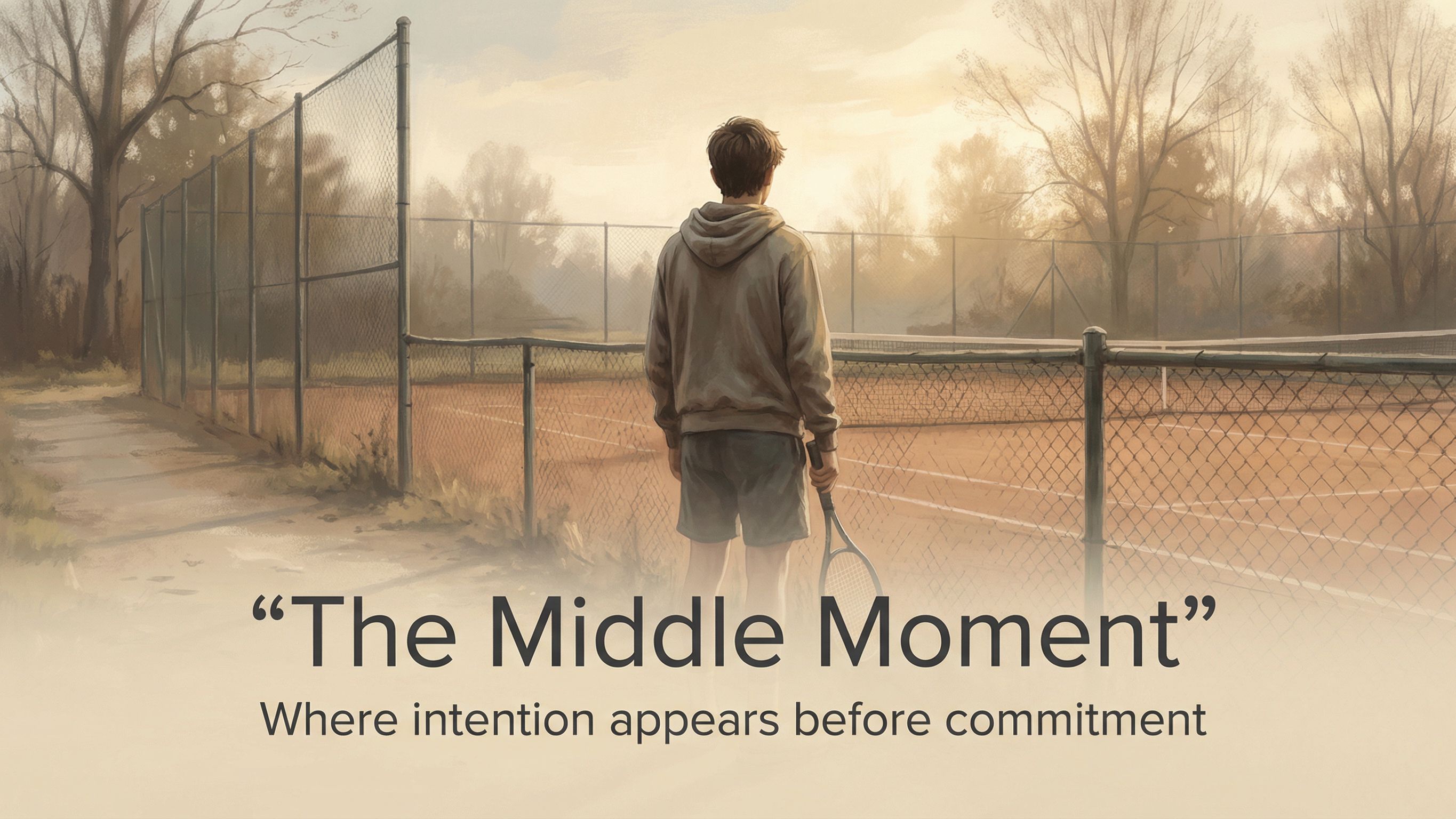
There is a moment in a family's life that does not announce itself with trophies or rankings. It arrives quietly. A child does not say they want to be famous. They do not say they want a scholarship. They do not say they want to be the best. They say something simpler. They say they really want this. And for the first time, the effort behind the words feels different.
It is not enthusiasm. It is not novelty. It is not a phase. It is intention beginning to take shape.
Most systems do not recognize this moment. Youth sports culture tends to speak either to the very beginning or the very end. On one side are entry points and participation pathways. On the other are rankings, commitments, and outcomes. The space in between is treated as a blur.
But that middle moment is where the most consequential decisions are made.
This is where my work lives. Not in motivation or inspiration. Not in technique refinement or tournament strategy. In helping parents understand that the window between intention and commitment is where clarity matters more than action. Most voices in youth sports tell parents what to do. I help them understand what questions to ask before they do anything irreversible.
I am not focused on families just getting started. Nor am I focused on athletes nearing the conclusion of their competitive journey. I work with parents who sense that their child wants something real and are trying to respond responsibly. The fear they carry is rarely about failure. It is about regret. They imagine a conversation years down the line. A son or daughter, now twenty four, looking back and saying they enjoyed the sport and wonder what might have happened if the adults around them had understood the process better. Not whether they made it. Whether anyone helped them explore what was possible.
Parents do not want guarantees. They want clarity. They want to know they did not miss the moment that asked something of them. The problem is that this moment is almost always misunderstood.
Many families interpret intention as a call to narrow. To go all in. To choose performance to the exclusion of everything else. Once that decision is made, the system becomes brittle. Identity collapses onto results. Losses carry too much weight. Optionality disappears long before it needs to.
This shows up in recognizable ways. A fourteen year old stops taking advanced math because practice schedules conflict. A parent declines a family vacation because it falls during tournament season. A coach suggests the player drop band or debate to focus on conditioning. Each decision seems reasonable in isolation. Together they create a player whose entire identity depends on outcomes they cannot control.
I believe that once a family has decided that tennis must come at the expense of education, curiosity, or identity range, they have already chosen the wrong path. Serious pursuit does not require foreclosure. It requires structure.
One of the most misunderstood elements of development is time. Real development is not linear. It requires enough runway for habits to be removed, capacity to be added, and certain traits to be intentionally left alone. In my experience, this takes time measured in years, not months.
That is why I consistently advocate for a three year horizon once a player moves from trying to building. Not as a promise of results, but as a minimum investment window. Before that, what appears on court is largely inherited. Previous coaches. Family habits. Survival adaptations. Only after enough time passes does the athlete's performance begin to clearly reflect the relationship that shaped it.
Three years is not a motivational number. It is a systems number.
Shorter timelines can produce improvement. Longer timelines produce authorship. This is also why evaluation too early almost always produces false conclusions. Early volatility is not failure. It is transition. Removing old scaffolding destabilizes performance before it clarifies it. Expanding choice increases error before it improves judgment. Without understanding this, families interrupt the very work they asked for.
All of this assumes something critical. The initial choice was made intentionally. Research before commitment matters more than loyalty after.
Choosing a coach is not a service decision. It is a structural one. Whoever enters the core of a young athlete's team shapes far more than technique. They influence decision making, emotional regulation, and how pressure is interpreted. Most parents research credentials and results. Fewer ask how a coach handles a player's first serious injury. How they communicate after losses. Whether their philosophy about childhood accommodates intellectual curiosity alongside athletic ambition. These questions reveal structure. Changing that relationship later is not neutral. It rewires things that were never meant to be modular.
I have seen what early alignment can produce when it is done well. One of my proudest experiences as a coach was working with a player from the day she hit her first ball at age seven through and beyond winning a USTA National Surface Championship gold ball. That outcome was not the result of early specialization. It was the result of patience, restraint, and a relationship that evolved as the child grew. That experience convinced me that accidental permanence is dangerous.
The most underdeveloped element in this entire system is the parent. Parents will spend extraordinary sums on their child's development. Lessons. Travel. Equipment. Coaches. Specialists. What they rarely spend on is themselves. And yet the parent is the longest tenured member of the team. They are there from the first lesson through the point when the athlete often becomes financially independent through college. When parents are not supported, they default to instinct. Instinct under stress reaches for control, reassurance, or avoidance. None of those scale well in high performance environments. This is not a criticism of parents. It is a design flaw.
There are very few places for parents to invest in their own development in a structured way. Parent education exists mostly as fragments. Stories. Posts. Opinions. There is almost no infrastructure that treats parenting a developing athlete as a discipline with progression, language, and standards.
As I step into 2026, my explicit goal is to help build that missing layer. Mentors who have lived the arc. Parent coaches who help translate moments into meaning. Symposiums that normalize uncertainty instead of pretending it can be eliminated. I believe parents could spend less money overall if they spent some of it earlier on guidance. Trial and error is expensive. Confusion is expensive. Panic driven decisions are expensive. Upstream clarity reduces downstream waste.
The future I am arguing for is not narrow. I believe it should be possible for a child to pursue the highest levels of junior tennis while also diving deeply into other intellectual pursuits. To chase Grand Slam level competition while building real fluency in fields like human robotics. To arrive at a place like Stanford not only as an athlete, but as a leader, a captain, and a student moving toward a meaningful future beyond sport.
Not every child wants this path. Not every family should pursue it. But if that pathway does not clearly exist for those who do, then the ecosystem is behind reality.
Excellence does not require monomania. It requires coherence. Range. Adults willing to resist compression and tolerate ambiguity. Systems designed to support additive identities rather than exclusive ones. The tragedy is not trying and falling short. The tragedy is never being allowed to try well.
The work I am committed to is about protecting that middle moment. Helping parents recognize it. Slowing it down. Giving it structure. So that years later, regardless of outcome, the answer to the question of support is clear. We saw you. We learned. We stayed present. And we gave you room to become more than one thing.
If this work aligns with where your organization is heading, I’m open to serious conversations about partnership and collaboration.
Performance Architect | Founder, Communiplasticity Solutions
📧 [email protected]
📞 469.955.DUEY (3839)
🌐 theperformancearchitect.com
Never Miss a Moment
Join the mailing list to ensure you stay up to date on all things real.
I hate SPAM too. I'll never sell your information.
