The Most Important Tournament Might Not Be a Tournament
Oct 14, 2026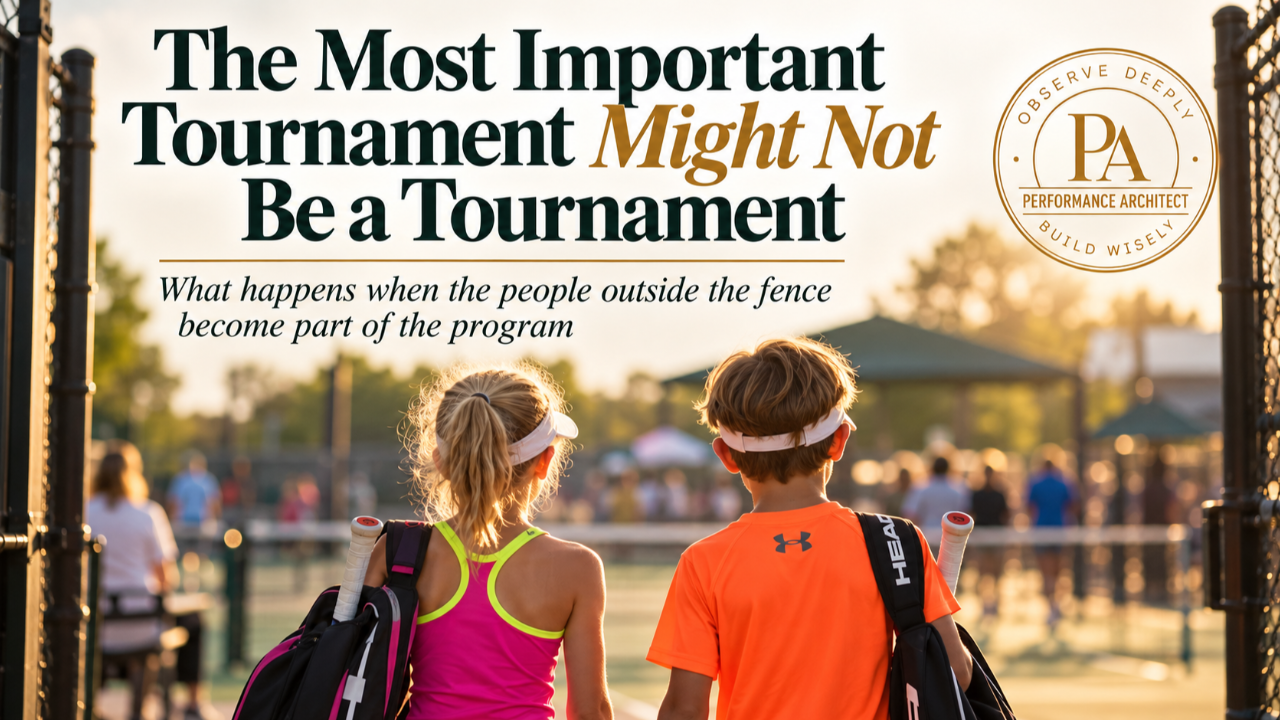
What happens when the people outside the fence become part of the program
I've spent more than thirty-five years around junior tennis tournaments, and I know what most people come for. A family books a hotel, pays the entry fee, and travels to a site where everyone's attention points at the same rectangle. They want to know who won and who looked ready for the next level. That's the event. Everything else is waiting around.
I've come to think the waiting around is where the real opportunity sits.
Look past the courts at any serious junior tournament and you'll see something rare. Families who care a great deal about how a young person grows up are standing next to coaches with decades of experience between them. Parents who've already made hard calls about school, training, and money are sitting a few feet from parents about to make those calls for the first time. They're all in one place for several days with time on their hands, and most of what they know goes home unshared, because the weekend was built to do one thing, which is produce results.
There's nothing wrong with matches. Competition is one of the few places a young person finds out what they actually do under pressure, as opposed to what they do in practice. But a tournament that's only a tournament leaves a lot of value standing outside the fence.
So I've been sketching an event designed to use everyone a tournament brings together. It would run five days for serious players age eleven and under. For three days, the players train, the parents learn, and the coaches study one another's work. Then, over the weekend, the children compete. I'd design every part of it around the kids. And I suspect the people who'd learn the most wouldn't be eleven.
The weekend is what holds the design together, because it's where three days of ideas run into reality. Picture a player who has spent the week working on how to steady herself between points, and now she's down 5-2. A father who sat through a discussion about letting kids solve their own problems is watching his son struggle against a style neither of them has seen before. A coach who spent the week talking about raising independent decision-makers has to watch the player make those decisions alone, because in most junior tournament matches, once the player walks on court, the coach isn't coming with her. Now there's something real to look at together.
For the players, I'd want the training to feel different from home. Their home coaches may be doing fine work. Eleven is simply still an age for meeting unfamiliar ideas. A young player is still working out what kind of learner and competitor she's becoming, and that picture gets sharper when she spends time with someone who sees the game a little differently than the adults she's used to.
The faculty would come from some of the finest junior-development coaches I know, and I wouldn't ask them to run drills or fix forehands. Each of them would bring something they believe. One might hold that tactical understanding should come before technical polish, while another builds everything on movement or has a distinct way of teaching kids to compete and think for themselves. Then I'd ask them to show it on court, with real children, and explain why they do it that way.
I wouldn't expect them to agree. I'd be a little disappointed if they did.
Families in this sport usually meet coaching philosophies as rival sales pitches. This coach says one thing, that coach says another, and the parent is left trying to figure out who's right. What if accomplished coaches laid out their reasoning side by side and disagreed in front of parents, with nobody required to declare a winner? A parent who watches smart people disagree in good faith learns something no single coach can teach, which is how to ask better questions of everyone, including the coach they eventually choose.
Parents may need this more than anyone. We ask them to decide how much a child trains, which tournaments to play, what kind of school fits, and which coach to trust. There's no shortage of advice about any of it. What's missing is a place to test that advice against their own child, alongside people who understand the decisions they're actually facing. So most parents sort it out with whoever is standing next to them at the fence, with social media, or with whichever coach sounds most certain.
That's why the parent sessions would draw on people who've spent careers on these questions. A sports nutritionist who understands growing athletes and an educator who knows how school and sport pull on each other would work alongside specialists in physical development, sleep, recovery, and adolescent psychology. So would coaches who can explain why a strong eleven-year-old and a capable seventeen-year-old are not the same thing, even though people confuse them all the time.
A parade of lectures would only fill notebooks nobody opens again, so the learning has to turn practical before the weekend arrives. If the nutritionist talks about tournament fueling, each family should leave with a plan they'll actually use on Saturday. If a psychologist talks about emotional control, parents should study their own reactions during a match, not only their child's. A session on independence should end with each parent naming one job they're still doing that their child is ready to take over. Knowing more only matters if parents leave acting differently, or at least seeing clearly what they might need to change.
Then there are the coaches, and this is the part of the design I find most interesting.
Coaching has always passed from one adult to another across decades. What Coach Tighe and others gave me, I passed on, and some of the people I coached have passed it on again. Not everything handed down deserves to survive, though, and an inheritance is worth more when each generation tests it instead of simply carrying it. Most of that passing down happens by accident, through proximity and luck. An event like this could make it happen on purpose, and out in the open, where an idea has to hold up in front of people who see things differently.
Imagine a visiting coach explaining a developmental principle in the morning and then demonstrating it with players while other coaches watch. Later, they sit down together and pick it apart. What did we see, and what do we think it means? Which part surprised us, and what would it take to change our minds?
Over the years I've grown more interested in the gap between observation and interpretation. Experienced coaches get very confident in what they think they're seeing. Sometimes that confidence is earned. Sometimes it's the very thing standing between them and something important. Put several accomplished coaches in front of the same session and I'd bet they won't all notice the same things, and even when they do, they won't all agree on what those things mean. That isn't a flaw to fix. It's where the lesson starts. Disagreement alone doesn't teach anybody much. It pays off when coaches have to go back, look again, and test what they think they saw.
I'd want the host program's own coaches in those rooms too, including the ones who aren't running player sessions. A host should come out of the week better than it went in, not just get five days to show off what it already does. Any institution willing to invite accomplished people with different ideas into its house is saying something about how seriously it takes learning.
What interests me most is where the three groups overlap. Say a visiting coach builds Tuesday's session around letting players make their own tactical choices. The parents hear why she works that way, and the other coaches study how she sets it up. When a player runs into that kind of problem on Saturday, the player, the parent, and the coach have all lived the same week from different seats. They may still read the match differently. But they'll be arguing about one shared experience instead of three private versions of it, which at least gives them something to check their readings against.
None of this should make the tournament soft. The players should care about winning, and the titles should mean something. A developmental purpose ought to sharpen the competition, not water it down.
Format matters, though. If a family invests five days, a child shouldn't be finished after one bad match. The structure should guarantee several meaningful matches and still produce legitimate champions. I'd also guard against the weekend turning into a coached exhibition, with adults hovering at every chance to reinforce Tuesday's lesson. The children need to compete. They need to hit problems nobody warned them about and make their own calls, then find out what happens when the person who usually has the answers isn't there.
The adults need their own practice, too. A parent who spent three days talking about autonomy now gets to feel how uncomfortable it is to watch a child make a choice the parent thinks is wrong. A coach who preached independent problem-solving gets to see whether the player can actually do it. Those moments are worth talking through once the matches are done. Not every match has to become a lesson, though. Sometimes a kid needs to play, lose, be disappointed, and get on with her day. Knowing when to leave a moment alone might be the most useful thing the adults take home.
Why eleven? Because for many families, it sits right before the decisions get heavy. Training loads start to climb. Schedules get complicated and school expectations change. Physical growth begins to open gaps between kids that are easy to mistake for gaps in long-term potential. Families start hearing about rankings, national events, specialized schools, and college tennis, along with plenty of advice about what it supposedly takes. Some of that advice is useful. Some of it just manufactures urgency.
At eleven, there's still time to shape how a family thinks about the next five or six years before too many assumptions harden. Instead of a longer to-do list, I'd want families to leave with better questions. Is my child learning to take responsibility? Are we picking tournaments for the right reasons? Does our training ask her to think, or only to follow? Are we confusing early growth with long-term promise? Does she still enjoy the work, and what does success actually look like at this age?
Those questions hold up wherever the child ends up, whether that's college tennis, the pro tour, or deciding at fourteen that something else is more interesting. They're really questions about how a young person builds a sense of who she is. Tennis just happens to be the place where this family is asking them.
Measuring any of this is where I'd want to be most careful. It would be easy to call the event a success because we drew strong players, built an impressive faculty, sold out, and crowned deserving champions. Those things might tell us we ran a good event. They wouldn't tell us whether we built a good developmental experience.
By Sunday, I'd want to know whether players ran into questions they hadn't considered before and whether parents had challenged a few of their own assumptions. For the coaches, the test is simpler. Did they take home anything that changes how they work the following Monday? Even then, five days can only start something. Whether it lasts shows up months later, in how a family chooses its next tournament or how a coach runs the next practice.
None of that requires turning eleven-year-olds into research subjects or scoring every behavior. You can learn a great deal by watching the adults instead, especially how often they step in when they could have given a child room to think.
I organize this kind of learning around a framework I call IEDE, which stands for Intention, Experience, Debrief, Evolution. You set an intention, have the experience, look honestly at what happened, and decide what to change. It could run through the whole week. A player might set a competitive intention, test it in a match, and fill out a Match Card afterward, while a parent sets an intention about their own behavior at the fence and checks how well it held. Coaches can test their assumptions against what the week actually showed.
The organizers should be held to the same loop. If we put on an event about development and then repeat the same format every year without examining what we learned, we've missed our own point.
When I call this idea preeminent, I'm thinking about what families carry home more than the size of the draw, the trophies, or the names on the faculty. Great coaches would want in because the people around them make them think. Parents would leave a little more skilled at their part of the work and a little less sure of things they'd been certain about. And the kids would have a great time playing, meeting each other, and running into ideas that stay with them.
There's plenty I haven't worked out. Selection, size, cost, faculty, format, and how to make it reachable for families who couldn't otherwise afford it are all still open. So is the fair question of how much structured learning children and parents can absorb in five days. Those are design problems, and they're worth the work.
But I keep coming back to one thing. Close observation and honest conversation are two of the best tools we have for developing young people, and they're also among the scarcest, because there's only so much expert attention to go around. That's what makes a national tournament so interesting. It already pulls a remarkable amount of that attention into one place for a few days. Gathering it is a long way from putting it to work, though, and very little in how we run tournaments does the second part. When the last ball is struck, nearly all of it scatters.
What if we built the gathering around that attention and made the tournament one part of it? What if the most important event an eleven-year-old attended wasn't the one that earned the most ranking points, but the one that changed how she, her parents, and her coaches approached the next five years?
I'd like to find out.
*Written with Reggie, Claude, Gemini, Otter, and 64+ trips around the sun.*
Never Miss a Moment
Join the mailing list to ensure you stay up to date on all things real.
I hate SPAM too. I'll never sell your information.
