The Question That Replaces the Coach
Apr 23, 2026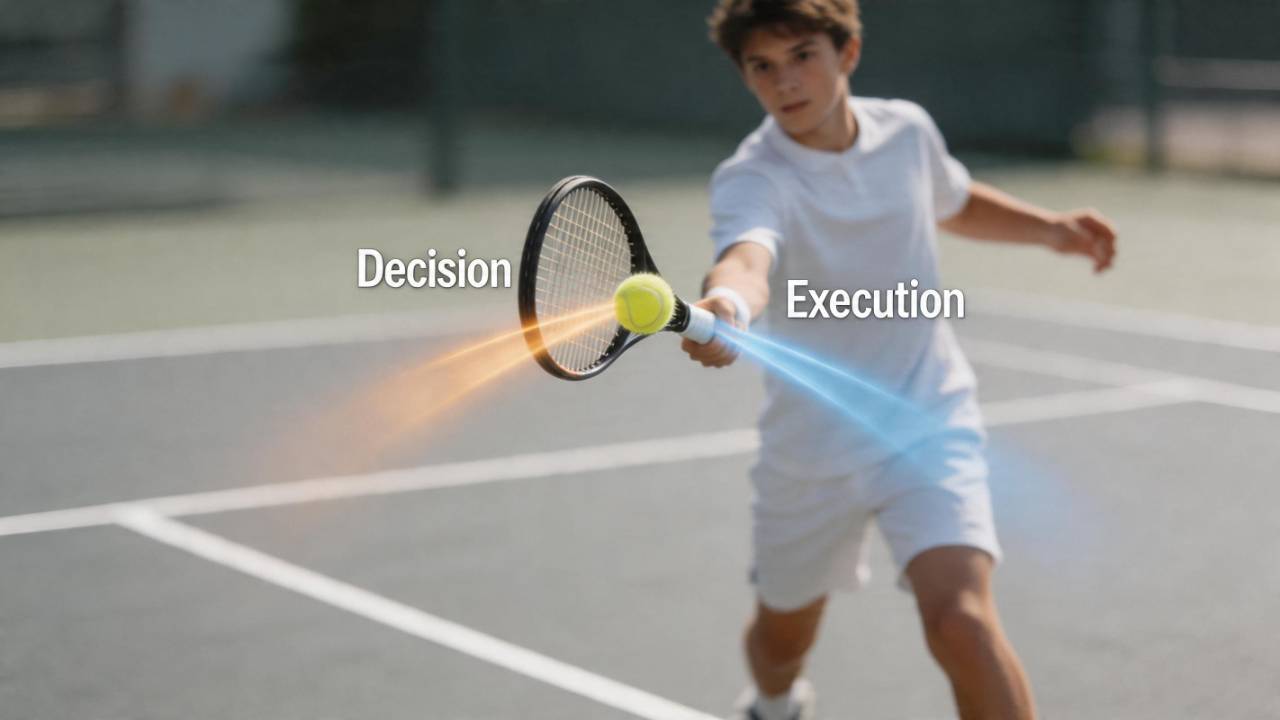
Thursday 23April2026
Walk onto enough junior courts and the pattern becomes familiar before the point is over. The coach is active, the voice is constant, and corrections arrive immediately after each error, then again during the changeover, then again in the car on the way home. From the outside it reads as thorough, invested coaching, but if you stay long enough and watch what the player is actually doing, a different picture emerges: the player is not learning how to think. The player is learning how to wait.
They wait for the correction that explains what happened. They wait for the voice that organizes the point into something meaningful. Over time the coach becomes the processing unit and the player becomes the executor, and that arrangement can produce short-term results in conditions where the coach is present and calm and the match is moving at a pace that allows for it. The structural limit of the arrangement surfaces the moment the coach is absent, or the moment the match moves too fast and too emotionally for anyone to wait for instruction, because the player has never been required to run the moment for themselves.
There is a different way to intervene, and it does not begin with better instruction. It begins with a better question. Not "why did you do that?" Not "what should have happened?" Not even "what happened?" Just this: decision or execution?
At first it seems too simple: two words, no instruction anywhere inside it. But what that question does, used consistently and correctly, is shift the entire architecture of what the learning environment produces. It forces the player to locate the error, not emotionally but structurally. Was the problem the choice that was made, or the way a chosen action was carried out? That separation is the difference between confusion and clarity, because without it every miss collapses into the same undifferentiated experience of something having gone wrong, and when everything feels the same, nothing becomes learnable. With the classification in place the moment begins to organize itself. A bad decision is not the same as a bad swing. A good decision with poor execution is not a failure of understanding. A good execution of a bad decision is still a bad decision.
What makes the question more valuable than instruction is not that it replaces the coach's knowledge. It changes where that knowledge is required to live. In a prescriptive environment, knowledge lives with the coach, who observes, interprets, and delivers the conclusion while the player receives it. In a question-based environment the player is required to observe and interpret before anything else can happen. The coach stops being the source of the answer and becomes instead the constraint that forces the player to generate one. That shift is where independence actually begins, and it cannot be shortcut by offering better or more precise corrections, because the corrections, however accurate, are doing the cognitive work that belongs to the player.
There is something else happening beneath the surface that most coaches miss. When a young player is asked what they were thinking after a missed shot and says "I don't know," that answer gets misread as a lack of focus or effort. It is neither. It is the absence of a trained pathway. When there is no structure for what to do with the moment after a point ends, the mind fills the gap with whatever is most available, which is usually frustration, self-criticism, or the habit language absorbed from coaches and parents over years of development. None of it is organized. None of it is useful. "Decision or execution?" replaces that noise with a repeatable entry point, something the mind can actually do immediately after the point ends rather than a performance of understanding that serves nobody, and it is the structure that makes everything following it possible.
This is where most coaching environments break, and the break point is not dramatic. A player in the early stages of this process will hesitate, guess, get it wrong, and produce answers that reveal clearly they are not yet tracking their own experience with any precision. The coach who sees the answer instantly and jumps in to supply it has not helped. The speed of that correction is the cost of the learning, because the player has just been shown again that waiting produces the answer. The coach who holds the question, even when holding it is uncomfortable, produces something different over time: the player begins to recognize patterns. They begin to notice that certain categories of error repeat in certain situations, that decision errors cluster under specific conditions, that execution errors follow a shape that becomes visible only when the player is the one doing the categorizing. Matches start to organize themselves not as a blur of outcomes but as a series of identifiable situations. The language tightens. The player starts saying "I shouldn't have gone down the line there" or "that was the right play, I just rushed it" or "I liked the decision but I needed more net clearance." At that point the coach does not need to say much, because the player has begun to install the processing system internally.
Instruction can fix a moment. A question can build the process that makes the next ten thousand moments navigable without a coach at the edge of the court to interpret them. The distinction is not minor and it is not about coaching philosophy. It is about what the environment is actually building. A player who has spent years learning to wait for the coach's version of events will not suddenly generate their own version when the match is on the line and the coach is across the net or not present at all. That capacity has to be built, incrementally, through repeated exposure to the requirement that the player locate the problem before anyone else does. The question is the structure that creates that requirement, and until it exists, everything else the coach knows is knowledge delivered to a player who has not yet learned to receive it.
Never Miss a Moment
Join the mailing list to ensure you stay up to date on all things real.
I hate SPAM too. I'll never sell your information.
