The Remediation Cycle
Mar 18, 2026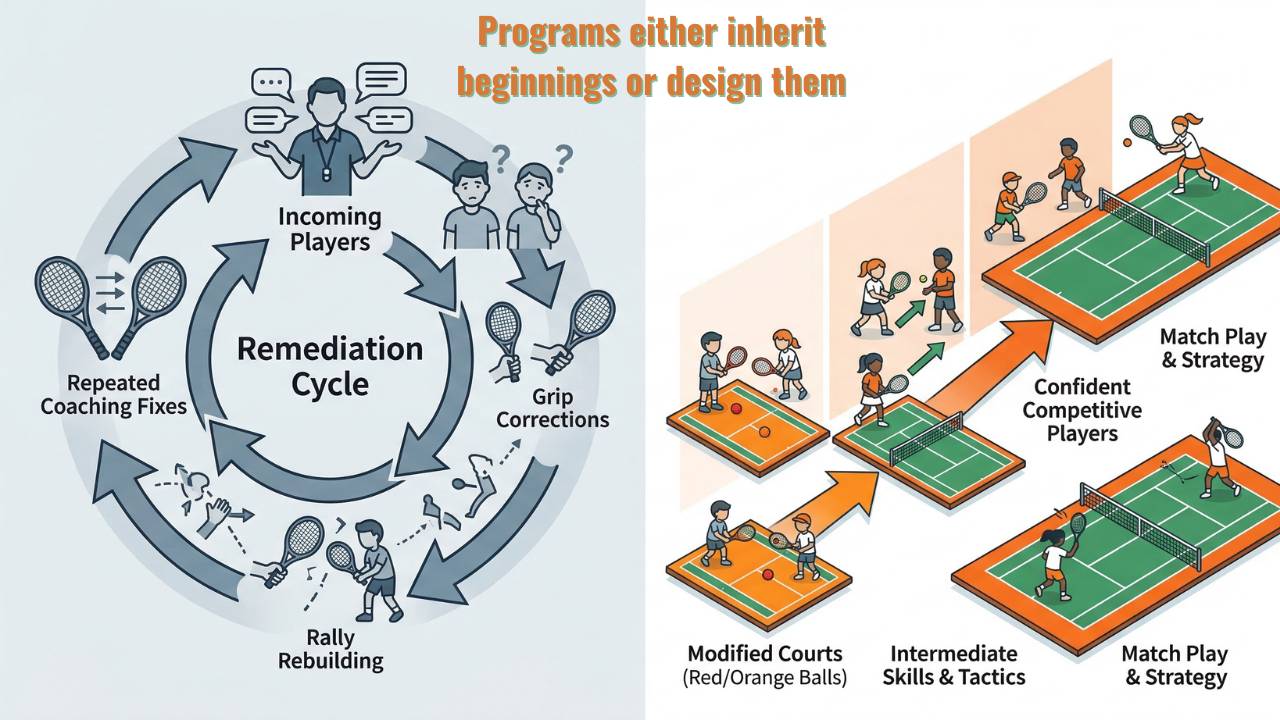
The Front Door of Development — Essay One
The players who arrive at a serious development program with three or four years of tennis already behind them are not the easy cases. They are often the hardest ones.
That runs counter to what most people assume. Experience looks like a head start. A child who has been playing since age six, who has taken lessons, who has competed in tournaments, and whose parents describe as dedicated, arrives carrying the appearance of a foundation. What the first few sessions reveal is something different. The grip is unstable under pressure. Rally tolerance collapses before any real information can be gathered from a point. The player reads the ball late because nobody ever taught them one of the basic perceptual standards of the game: a player should be able to identify most of the ball's flight characteristics within the first third of the first third of its first arc off the opponent's racket, and no early environment ever trained that habit into them. Footwork patterns appear when the situation is comfortable and disappear when it is not. Decision-making inside a point is inconsistent not because the player lacks awareness, but because the player is still solving a more fundamental problem: simply keeping the ball in play long enough for the point to have shape.
Coaches see this constantly, and because they see it constantly, most of them have come to accept it as the natural condition of incoming players. The appropriate response, as the conventional thinking goes, is to begin addressing the gaps. Adjust the grip. Rebuild rally consistency. Introduce spacing habits. Develop tactical awareness in early competitive situations. The work is familiar, the progress is real, and coaches who do it well become skilled at it over time.
The problem is not that this work fails. The problem is that it never ends.
The next player arrives carrying the same structural gaps. The one after that looks slightly different on the surface but requires many of the same repairs underneath. Programs develop a rhythm around the pattern, and after a while the rhythm starts to feel like the program itself. New players, familiar problems, familiar corrections, incremental progress. Repeat. What most program directors interpret as the natural pace of development is actually the signature of a structural condition that was set in motion long before anyone in their program made a decision.
When children are first introduced to tennis, the environment where that introduction happens shapes the relationship they form with the game. Most of those introductions occur in recreational clinics, summer camps, private lessons, school programs, or informal settings where the organizing purpose is participation, not development. There is nothing wrong with those environments on their own terms. The problem is architectural. Each one carries assumptions about what early tennis should look like, how fast to introduce competition, how much emphasis to place on stroke mechanics versus rally development, and how to handle the basic challenge of getting a child to enjoy the game enough to continue. Those assumptions are rarely connected to one another, and almost never connected to the development program the child will eventually enter years later.
By the time a player with serious potential walks through the door of a program built around real development, the early years have already happened. Perception habits are in place. Rally relationships with the ball are formed. Competitive responses to pressure are established. The coach is not starting fresh. The coach is inheriting the accumulated result of every environment that touched the player before, most of which were not designed with this moment in mind.
This is the remediation cycle, and it is not a phase in the life of a program. It becomes the permanent operating condition of any program that has no control over the beginning of its own pathway.
The cost is real and it compounds in ways that rarely get measured directly. Players spend years catching up to concepts that should have been present from the beginning. Coaches invest the majority of their professional energy repairing foundations rather than extending them. Programs with strong developmental intentions still struggle to produce consistent results because the raw material entering the system varies so widely, not because of the players themselves, but because of the randomness of what happened to them before they arrived. The program's ceiling is set by whatever floor the entry point produces, and if the program does not control the entry point, it does not control the floor.
Every program director eventually arrives at the same fork. On one side is the decision to accept the remediation cycle as the cost of doing business, to develop staff who are excellent at repair work, and to measure progress by how effectively the program closes gaps that were opened somewhere else. On the other side is a more demanding decision: to take ownership of the beginning. To build or design the front door of development rather than inheriting whatever happens to walk through it. To become responsible for how the game first appears to the players in the system, not just for what happens to them after they arrive.
Those two directions produce different programs. They also produce different players, not because one group has more ability than the other, but because the architecture installed at the beginning of the pathway shapes what the player is capable of noticing, deciding, and sustaining under pressure years later. Development systems rarely announce which path they are choosing. They simply produce players who behave accordingly.
Controlling the beginning of the pathway is not a beginner-level problem. It is the foundational decision of a serious development program, and everything that follows in this series is organized around understanding what that decision actually requires.
Next: Why the entry point of a tennis program deserves the most thoughtful coaching design, not the most available instructor.
Never Miss a Moment
Join the mailing list to ensure you stay up to date on all things real.
I hate SPAM too. I'll never sell your information.
