The Room That Has to Do More Than Teach
Jun 04, 2026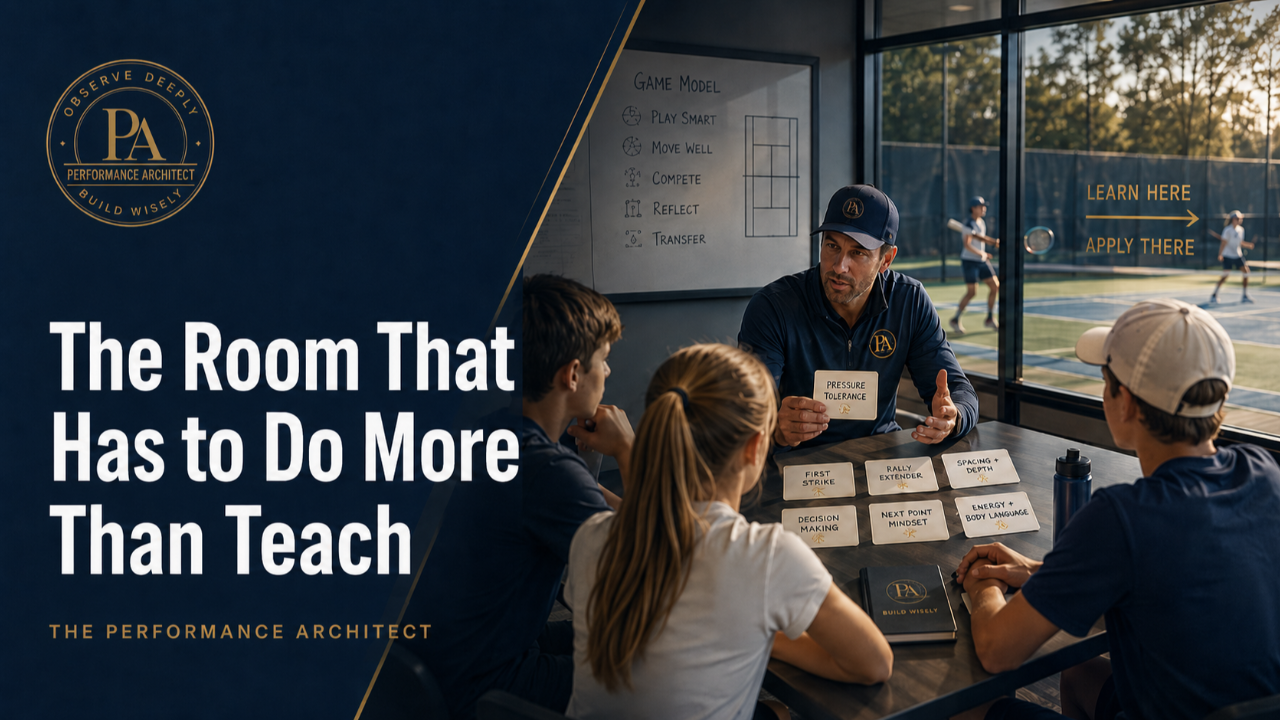
Most summer camp classroom rotations are built around a reasonable assumption: players come in, the coach explains something useful, they go back outside with better information. The assumption is wrong, and the evidence is visible by Wednesday of every camp week when the concepts from Monday's classroom session have not made it onto the court.
The problem is not the content. In most programs the content is solid. The problem is what the room is being asked to do. Information delivery is the wrong job for that room, and any classroom that is designed primarily to explain things will underperform the same twenty minutes if the room had a different function entirely. Specifically: the function of changing the state the player is in before sending them back out with a job they can actually perform.
That is the redesign. Not a curriculum shift. A function shift
The framework I have been working with is called FASTER, and I want to be honest about where it came from. About five years ago I was working through Jim Kwik's accelerated learning material and wrote the acronym in my notebook because the structure mapped almost exactly onto what I had been trying to build intuitively across years of session design. Forget. Act. State. Teach. Enter. Review. The sequence is Kwik's. What I am offering here is how it applies specifically to training card work inside a summer program rotation, because that application took some time to get right and is worth sharing.
Players walk into the classroom carrying whatever just happened. That could be heat, a missed sequence at the last station, an argument with a teammate, the distraction of knowing watermelon is coming after the session ends, or the frustration of not understanding something they feel they should already understand. None of that clears on its own just because the room has chairs. The coach who starts with explanation before clearing that noise is delivering information into static.
**Forget** is the first move, and it is an active move, not a passive one. It does not mean telling players to relax or settle down. It means giving them something specific to set down before the session begins. Look at your training card. What is still pulling your attention from the last station? Name it. Write one word if you need to. Now we're here. Fifteen seconds. That is what Forget actually takes, and it is not a soft opening. It is the mechanism that makes everything following it more likely to land.
This week I watched what happens when Forget gets skipped. A group came into the classroom already two stations removed from ball machine and had to fill out their training cards for it from memory. By that point the experience had already reorganized around the result. Players who had struggled wrote that their slice was bad. Players who had handled it wrote that it went pretty well. Almost nobody could get back to what they had actually been trying to do at the moment they were doing it, because enough time and enough intervening experience had passed that the original account was gone. What I had was not reflection. I had reconstruction, and reconstruction is not the same thing. The Forget step exists because the window between experience and interpretation closes faster than most coaches realize, and once it closes, the best a player can do is tell you a story about what they think happened.
**Act** is the protection against the room turning passive. An active learner in this context is defined precisely: they leave with a job, not a thought. Not a quote they liked. Not a concept they found interesting. A job with a specific station, a specific thing their eyes or body or reset will be doing when they get back out there. If the classroom cannot answer the question "what is the job I am carrying out," the session has not yet done its work. I use this as a literal diagnostic: before players leave, someone names their job out loud. The room is not done until that happens.
**State** is the piece that most programs skip because it sounds optional. It is not optional. Learning is state-dependent, which means that what gets understood in a calm, air-conditioned room in the presence of the coach exists in a physiological and emotional context that is entirely different from the context in which it will need to function. A concept understood only while sitting comfortably will not show up under pressure, not because the player forgot it, but because the state it was learned in does not match the state it will need to be retrieved in. The session has to address this directly. A short reset before the teaching begins, feet down, shoulders low, one breath, eyes on the card, is not a mindfulness exercise. It is infrastructure. And you can make this explicit: what you learn in this room has to transfer to a moment when you are down a break in the third set and nobody is standing next to you. So we are going to learn it, rehearse it, and then enter the next station with it, because the gap between understanding and performance is a state problem as much as a knowledge problem.
**Teach** is where the system gets compounding value and most programs leave it sitting on the table. The research here is strong enough to matter: people who learn with the expectation that they will teach the material tend to recall it more completely, organize it better, and hold the main points more reliably than people who learn only with the expectation of being tested. The mental posture is different. Someone planning to teach pays attention differently, organizes what they are hearing differently, and notices gaps in their own understanding that passive reception conceals. Before players leave the room, ask one of them to explain the concept to someone who was not present. Not a quiz. Not a performance. Just: how would you say this to a teammate who missed this session? That question often does more for retention than reviewing the material a second time.
It also solves the drop-in problem that plagues every summer program. When a player misses Monday and shows up Thursday, the concepts have already spread through the group through the act of players teaching each other. The language is alive in the environment rather than locked inside a single session.
**Enter** is the commitment point, and it is the hinge between the classroom and the next station. Before players leave, they name what they are entering with. Not what they learned. What they are taking into the next physical environment as a specific job. "My eyes are watching ball height before the decision." "My reset is visible." "At this station I am training my intention before the point starts." The training card is the mechanism that holds this. Players look at their card, name the intention for the next station, and go. The classroom has become the launchpad rather than the lecture room.
**Review** operates in two layers. The first is a ten-second exit before they leave the room: one thing you are carrying out. The second is the training card review after the station, connecting what they said they were going to do with what actually happened. That connection is where the loop closes. The card is not a record-keeping tool. It is the instrument that makes the gap between intention and execution visible, and it only works if the classroom session has established what the intention was before the station began.
The full sequence across twenty minutes runs like this. The first two minutes are Forget and State: clear attention, reset the body, name what is still pulling focus from the previous station. The next two minutes connect the room to the court: this state has to travel. Minutes four through ten are the teaching, one concept only, something a player could name, apply, and explain before leaving the room. Minutes ten through thirteen are Act: not "what did you think of that?" but "what is the job that comes from this at your next station?" Minutes thirteen through sixteen are Teach: one player explains the concept to a hypothetical absent teammate, the room corrects if needed. Minutes sixteen through eighteen are Enter: each player looks at their card, names what they are carrying into the next station, and commits to it. The final two minutes are Review setup: when you finish the next station, your card should answer whether the job you just named actually happened.
The classroom is not where development lives. The court is where development lives. But the classroom, designed this way, is where the conditions for development get established each rotation, and that distinction determines whether the twenty minutes compounds or disappears.
Most camps are running strong content through a weak operating sequence. FASTER gives the room that sequence. The training card gives the sequence somewhere to land. The theme of each session changes week to week as the card work deepens. The structure stays the same. Players know what the room is doing even before the coach speaks, which means the room's function becomes self-reinforcing rather than dependent on individual sessions being particularly good. That is when a classroom starts to do more than teach.
Duey Evans
[email protected]
469.955.DUEY (3839)
Never Miss a Moment
Join the mailing list to ensure you stay up to date on all things real.
I hate SPAM too. I'll never sell your information.
