The Scoreboard Is Not the Problem. The Problem Is What We Use It For
Mar 09, 2026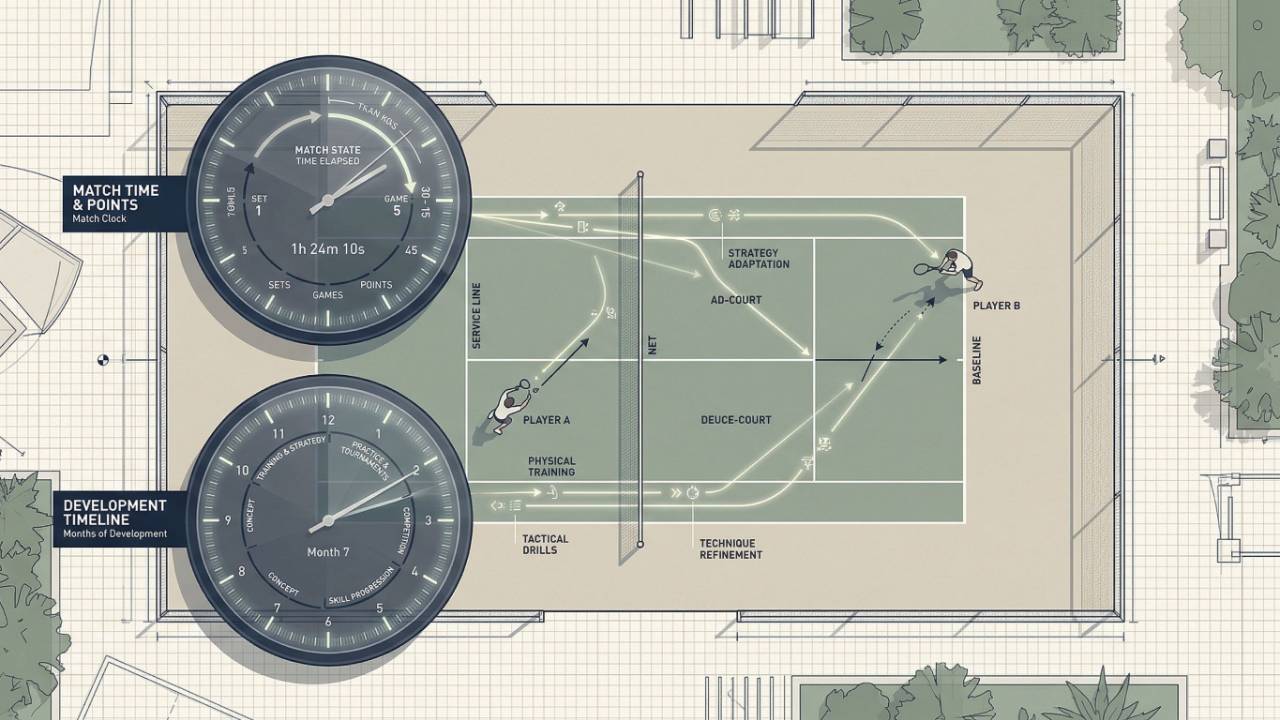
A match outcome compresses hundreds of decisions into a single number. Win or loss. Games won, games lost. A scoreline that appears to tell the story of what happened on court and, if you're not careful, what is likely to happen next season.
The scoreboard is not lying. It is simply incomplete. And when you use an incomplete instrument to make decisions it was never designed to make, the instrument is not what fails. The process is.
This is the final structural problem that calibration architecture has to solve. Perception can be preserved before memory reconstructs it. Perspectives can be integrated into shared direction before urgency forces someone to act alone. But none of that holds unless the system also stabilizes the timeframe through which progress gets evaluated. Because the clock that governs competition and the clock that governs development are running at completely different speeds, and most development decisions get made in the uncomfortable space between them.
Two Clocks, One System
A match unfolds across minutes. A player's recognition patterns evolve across months. Emotional regulation stabilizes only after a player survives enough pressure situations to understand that tension is a condition, not a verdict. None of these changes reveal themselves inside a single scoreline or even a single tournament. They accumulate gradually, across competitive experiences that only become legible when you hold enough of them in the same frame.
The competitive environment does not support that kind of patience. It is designed around immediacy. A loss on Saturday produces evidence that feels urgent before Monday's lesson begins. Parents are not irrational for feeling that urgency. They are responding to a clock that is real. The problem is that the developmental clock is also real, and when no infrastructure holds both clocks visible at the same time, the faster one wins every time. Urgency rewrites interpretation. Short-term noise starts masquerading as long-term evidence. Families make decisions that feel reasonable in the moment and destabilize the exact process that would have produced progress if it had been allowed to run.
What the Scoreboard Sees and What It Misses
A player can lose a match while solving a recognition problem that persisted for months. A player can win a match while repeating a mechanical flaw that will collapse against stronger opponents. The scoreboard captures neither of those realities. It records outcomes, not mechanisms. It rewards the player who performed better on a given day against a given opponent, which is valuable information. It cannot tell you whether the margin between those two players is closing or widening, and it cannot tell you which player is building something durable.
When a system evaluates development through results alone, it is consistently measuring the wrong thing. Not because results are unimportant, but because results are downstream of the mechanisms that produce them. Coaches who understand this are watching something different than the scoreline. They are watching how early a player recognizes a pattern in the rally, how quickly they recover after an error, whether decisions are happening before or after a window of opportunity has already closed. These are the indicators that tell you whether development is compounding. The scoreboard tells you what happened after the compounding either worked or didn't.
Without a structure that holds the longer view, competitive results will dominate the conversation every time. They are louder, more concrete, and more emotionally immediate than anything a development system can offer as an alternative.
How Temporal Compression Distorts the System
When timeframes collapse under competitive pressure, the entire development environment changes in ways that are mostly invisible until the damage has already accumulated.
Coaches begin feeling pressure to produce visible results quickly enough to maintain trust. The interventions that would produce durable change over six months get replaced by interventions that can produce a more impressive scoreline by the next tournament. That substitution rarely gets announced. It happens gradually, through small adjustments to training priorities that individually look responsible and collectively represent a different development philosophy than anyone consciously chose.
Players feel the pressure and begin interpreting each point, each match, each session as evidence about their future rather than information about their current constraint. That shift in interpretation has real cognitive consequences. A player managing existential questions about whether they belong in the sport is not using the same mental resources as a player managing a specific tactical problem in the current rally.
Parents who lack a developmental timeline to reference will fill that absence with whatever timeline feels closest, which is usually the competitive one. The next match. The next ranking update. Whether the number moved in the right direction.
None of these people are doing anything wrong. They are responding rationally to the information the system is giving them. The system is giving them the wrong information because it has no mechanism for giving them the right kind.
What Stabilized Timeframes Actually Do
Timeframe stabilization does not mean ignoring results or asking families to be endlessly patient while the development process runs its course. It means building a structure where results and mechanisms are visible in the same system at the same time, so that each can be interpreted correctly without overriding the other.
A player working on decision speed during tempo transitions will likely lose some matches against opponents who apply that pressure before the adaptation is complete. The scorelines across three consecutive tournaments may look identical. From the outside, nothing has changed. When perception has been preserved across those same weeks and integrated into a shared framework, a different picture is available. Recognition begins earlier in rallies. Hesitation appears less frequently. Recovery after a mistake accelerates. The player starts articulating what the constraint is before the coach identifies it. Those are the real indicators of progress, and they precede the scoreline improvement by weeks or months.
Timeframe stabilization keeps those signals visible long enough for them to compound. When integrated perception is held across months rather than reset after each competitive event, progress becomes something everyone can observe in the same system at the same time. Not something the coach sees, the parent doubts, and the player cannot articulate.
That shared visibility changes what families can do with a difficult result. A losing weekend becomes a data point inside a trajectory rather than a referendum on the program. A temporary plateau becomes legible as a transitional phase rather than a signal that something fundamental is broken. The decisions that follow a difficult month look different when the preceding three months of development remain visible and interpretable.
Why Players Carry the Weight of Temporal Mismatch
The people who absorb the most cost from unstable timeframes are not coaches or parents. They are players.
When development feedback arrives through competitive results alone, identity becomes a moving target. A loss means something about who the player is and where they are headed. A win revises that story in the other direction. The player is left building a sense of self from a signal that changes every weekend, which produces the kind of emotional volatility that looks like confidence problems from the outside and feels like groundlessness from the inside.
When a player can see their own developmental trajectory, identity stabilizes. A loss carries specific information about a specific constraint rather than carrying existential weight. Progress is no longer something the coach claims to see while the player cannot find evidence of it in their results. The architecture holds the evidence where the player can access it too, which changes the fundamental relationship between the player and the development process. The player stops being evaluated and starts being a participant in their own trajectory.
That is a different experience of sport. It produces different players, and eventually different adults.
What the Architecture Makes Possible
Three structural requirements now exist in the same system. Perception gets recorded before memory reorganizes it into something more comfortable or more alarming than what actually happened. Integrated perspectives convert preserved observations into shared direction before urgency forces someone to act on incomplete information. Stabilized timeframes hold that shared direction across the longer arc of development so that what was understood on one side of a difficult stretch remains visible on the other side of it.
When all three are present, the system stops resetting. Knowledge about a player accumulates across competitive cycles rather than disappearing into the urgency of the next event. Coaches design interventions that address mechanism rather than symptoms because the mechanism is documented and visible. Parents evaluate trajectory rather than reacting to isolated outcomes because the trajectory is held in a shared system rather than reconstructed from memory after every match. Players invest in their own development with less existential interference because progress is legible before results confirm it.
This is not a communication improvement. It is not a relationship strategy. It is a structural shift in what the development environment can hold, which determines what the people inside it can see, and what the people inside it can see determines what they can build.
Development that compounds instead of resets is not a product of commitment or talent or even coaching quality in isolation. It is a product of architecture. Build the architecture and development becomes durable. Leave it out and even the most committed families, the most experienced coaches, and the most capable players will keep rediscovering the same patterns and wondering why effort is not translating into direction.
That question has an answer. Now you have the structure it requires.
This is Essay 9, the final installment of the Calibration Series.
Never Miss a Moment
Join the mailing list to ensure you stay up to date on all things real.
I hate SPAM too. I'll never sell your information.
