The Show I Never Made
Apr 28, 2026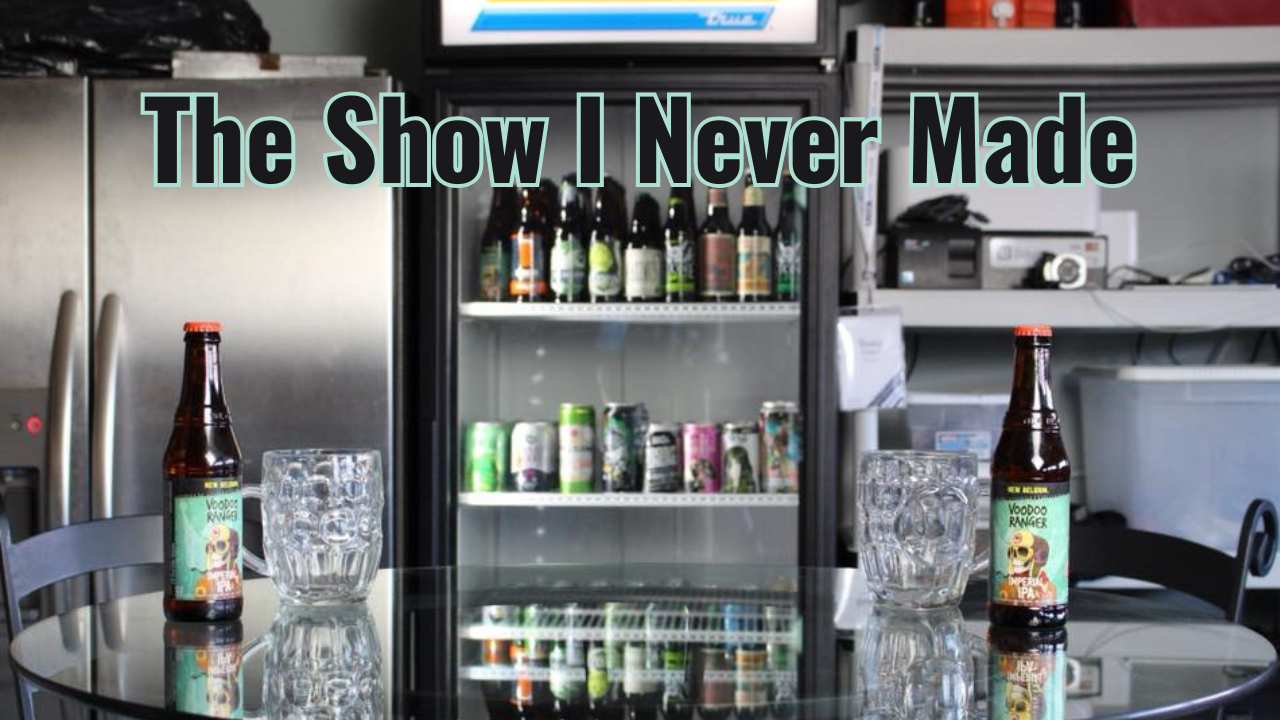
Tuesday — April 28
In 2017, I built a set in my garage. Two chairs and a round glass table, facing a commercial beer cooler we had carried over from a tennis facility we no longer needed, stocked with IPAs. On top of it sat a black canvas sign my oldest daughter had hand-lettered and given me for Christmas that read the I.P.A. Show. None of it was purchased for the occasion. It was assembled from actual life, which is the only way a set like that could have worked. What I have not said yet is that all of it sat inside a three-car garage we had converted into a working broadcast studio — blue walls, dressed lighting, a board, a camera, software that could have put the whole thing on the internet the same afternoon. The idea was simple enough that it didn't need a pitch: invite someone over, open a beer, sit across from each other, and talk about something we didn't agree on. Not to win. Not to perform. Just to see what would surface if two people stayed in the conversation long enough for something real to emerge. We never made an episode.
I never made the show. At the time I told myself it just didn't come together — life moved, other things took priority, and it sat there as one of those ideas that felt right and never found its moment. Looking back, I think the honest answer is different. The show would not work now even if I tried, and not because the idea was flawed. Because the ground it was standing on has shifted in ways I did not see coming when I was arranging the furniture.
What the IPA Show depended on was not the chairs or the table or even a shared willingness to disagree. It depended on something quieter: two people could sit down without already knowing what the other one represented. They could begin with the experience itself and let the differences take shape from there. Shared ground first, then disagreement building from it. The argument arrives second, anchored to something both people can still see. Position comes from inside the conversation rather than being carried into the room before anyone sits down.
That sequence has inverted.
Most of what we think we know about each other now arrives before any interaction does. Feeds sort us before we speak. The specific words someone uses signal which side of a line they stand on before they have finished a sentence. By the time two people would sit down at that table, the categories are already in place. The conversation does not begin with a shared experience. It begins with competing positions looking for confirmation, and the material in the room gets recruited into that project rather than allowed to do anything else.
This would already be a meaningful shift if it were only about disagreement. But disagreement is not the problem. People have always disagreed, and the productive kind of disagreement — the kind where something moves — has always required that both participants be reacting to something they both recognize. The IPA Show was built on that requirement. Two people who disagree about what they just watched are having a different conversation than two people who disagree about what the other one believes. The first conversation has somewhere to go. The second one does not, because the reference points have already diverged before anyone opened their mouth. The gap that emerges is not between positions. It is between versions of reality that were assembled in different rooms and are now being asked to make contact with each other.
You feel it in smaller places before you can name it in larger ones. Conversations that stall before they start. Topics that get avoided not because of conflict but because of the effort required to establish any shared ground at all. Friendships that attenuate over time without a clear moment where something actually broke. The silence is more common than the argument, and the silence is harder to see because it does not announce itself as a failure. It just looks like two people who have less to say to each other than they used to.
What is entering the picture now is not an acceleration of the same problem. It is a different problem. The thing itself is no longer stable. Images indistinguishable from documentation can be generated in minutes. Voices can be replicated from a few seconds of source material. Events can be constructed with a production quality that exceeds what most people are equipped to evaluate on inspection. This is not primarily about deception, though deception is part of it. It is about what happens to shared reality when the cost of fabricating a plausible version of it drops to nearly zero. The question two people at a table used to be able to assume — that they were both reacting to something that actually happened — is no longer safely assumed. Each of them may be responding to a version of events assembled by a different process, optimized for a different purpose, and delivered through a different channel. Shared verification, the ability to point at the same thing and say that is what occurred, is not guaranteed anymore. When that goes, the conversation does not just become harder. It becomes structurally different in kind, because the thing the conversation was supposed to be about may not exist in the same form for both people in the room.
The show I built only works if two people can sit down and trust that they are reacting to something real. Not agreeing. Not fully understanding each other. Just beginning from a place that both of them recognize as the same place. The structure of the conversation that follows depends entirely on that starting condition. Without it, the conversation does not fail loudly or dramatically. It dissolves before it forms. There is nothing to push against because there is nothing held in common long enough for productive tension to do its work. The disagreement never arrives, not because the people in the chairs are unwilling to engage, but because the conditions that make engagement possible are no longer present.
What I was building in that garage was not complicated. Two chairs and a table and the belief that two people with different views could begin from the same room and end up somewhere neither of them expected. That belief was an assumption, and I did not recognize it as one at the time because it had never needed to be stated. It was just how conversations worked. You started from somewhere shared. The differences emerged from there.
The reason it needed to be stated now is that we are already inside the condition where it no longer holds. Not approaching it. Not at risk of it. Inside it. The place where the conversation was supposed to begin is the part that is gone, and most of what we are calling a crisis of dialogue is a description of what happens when two people try to have a conversation that has nowhere to start.
Never Miss a Moment
Join the mailing list to ensure you stay up to date on all things real.
I hate SPAM too. I'll never sell your information.
