The Signals Nobody Teaches You to See
Feb 02, 2026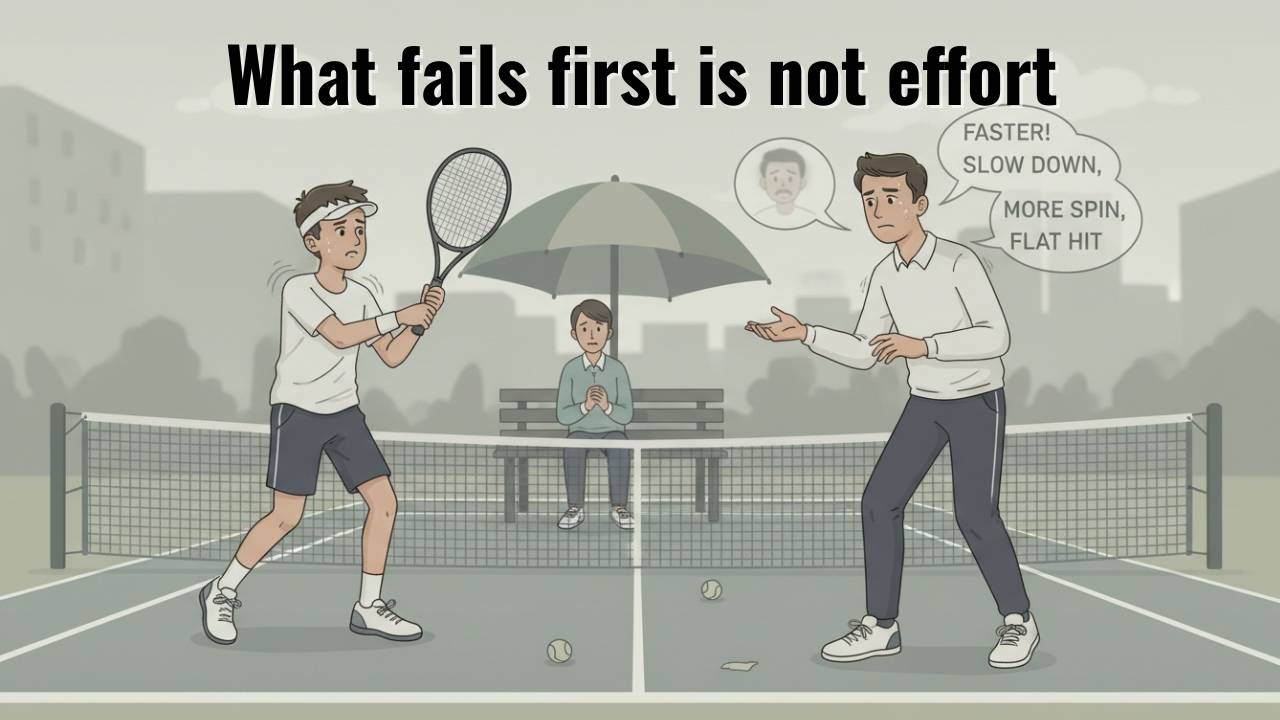
Most families realize something is wrong only after rankings drop or their player starts talking about quitting. By then the breakdown has been active for months, sometimes years. The system did not suddenly fail. It drifted slowly while everyone believed the right things were happening.
Calibration failure announces itself long before results collapse. It shows up in quieter signals that are easy to dismiss because they do not look urgent. Learning to see those signals is the difference between course correction and damage control.
Why Outcomes Tell You Almost Nothing Useful
Wins and losses are blunt instruments. They arrive late and carry too much noise to explain what actually changed underneath the result. A player can win while completely misunderstanding the patterns that produced the win, and they can lose while developing critical perception that has not yet consolidated into execution that shows up on scoreboards.
Outcome-based evaluation compresses complexity into a single number. That compression feels efficient. It also hides the mechanisms that matter most for development. By the time outcomes shift consistently enough to force attention, calibration failure has already been shaping training decisions and resource allocation for weeks or months.
Families usually respond to poor results by increasing volume or intensity. More private lessons, more tournament travel, more emphasis on mental toughness. Those responses feel proactive because they involve spending money and adding pressure. They are downstream responses. They rarely address cause because cause is not visible through outcomes alone. The player was already confused before the losses started accumulating. The losses just made the confusion impossible to ignore anymore.
The First Signal That Looks Like Nothing
The earliest sign of calibration failure is not poor performance. It is increasing explanation without increasing clarity. Coaches start repeating concepts they believe the player already understands. Parents start offering reassurance that does not land the way they intend. Players start nodding at feedback while feeling more lost than they were before the feedback arrived.
When instruction volume rises but comprehension does not track with it, something fundamental is misaligned. The system is working harder without producing better understanding. This is not a motivation problem. It is not an effort problem. It is a perception problem that lives in the gap between what is being said and what is being processed.
You can see this pattern when players execute correctly in controlled practice but hesitate in matches without being able to explain why the hesitation happened. The technical knowledge exists somewhere in the system. It is not accessible under the time pressure and cognitive load of actual competition. That gap between practice performance and match performance is usually treated as a discipline issue or a confidence issue. It is a calibration issue. The instruction format does not match how the player's brain processes information when processing has to happen fast.
When Effort Stops Producing Learning
Another early signal appears when effort increases without producing insight. The player is training seriously, paying attention during instruction, trying to apply feedback in matches. Despite all that visible effort, the same breakdowns repeat in slightly different forms. The pattern stays consistent even as the work volume increases.
This pattern is often misread as stubbornness or limited processing capacity. In reality it signals that instruction is not matching how this particular player organizes information under time pressure. The work is happening. It is happening in the wrong format for this brain at this stage of development. Adding more work in the same format just produces fatigue and frustration without generating the insight needed to break the pattern.
When calibration is intact, effort produces learning even when competitive results lag behind the learning. When calibration fails, effort produces exhaustion without insight. The player can feel themselves working hard and still not understanding what they are supposed to be understanding. That experience creates a quiet desperation that looks like lack of commitment from the outside but feels like drowning from the inside.
The Parent Signal That Gets Dismissed
Parents are often the first to sense calibration failure, but they rarely trust that signal enough to act on it. The signal shows up as persistent unease rather than a specific complaint they can articulate clearly. Something feels off even when the coach is experienced and the training plan looks professionally structured.
This unease often leads parents to seek reassurance instead of diagnosis. They ask whether this developmental phase is normal or whether their child's confidence will return naturally over time. Reassurance can be temporarily comforting. It does not resolve the underlying misalignment that is creating the unease in the first place.
When parents find themselves managing their child's emotional state more than they are understanding what is causing the emotional state, calibration has likely already slipped. Emotion becomes the primary focus because clarity about actual cause is missing. That shift from seeking understanding to managing symptoms is an important signal, not parental overreaction.
The Coach Signal Hidden in Repetition
Coaches experience calibration failure as repetition without resolution. They can recognize patterns in a player's competitive struggles but cannot quite explain why those patterns persist despite focused technical work addressing them. Small adjustments help briefly but do not hold when pressure returns.
This often leads coaches to protect certain developmental priorities without having language that convinces parents or players those priorities matter. They sense that simplifying the tactical approach too early would be a developmental mistake, but they cannot make that case persuasively when parents are anxious about short-term results. The result is tension that feels interpersonal but is actually structural. Everyone wants the same outcome. Nobody can see the same picture of how to get there.
When a coach knows something critical is developing but cannot demonstrate it clearly enough to maintain confidence from the family, calibration support is missing from the system. The coach is seeing something real about the player's development trajectory. The system they are operating within cannot hold that observation long enough for it to prove itself through results.
The Player Signal That Creates Damage
Players experience calibration failure as self-doubt without clear cause. They feel responsible for breakdowns they cannot explain to themselves or others. They hear feedback that does not match their internal experience of what happened under pressure, and they assume the gap between feedback and experience means something is deficient about them personally.
This is where identity damage begins. Not through harsh criticism or unreasonable pressure. Through confusion that never gets named as confusion. The player starts to believe their effort is not translating into results because something about their character or ability is fundamentally insufficient.
Once that belief takes root, development becomes fragile. Even correct instruction struggles to land because the player is protecting themselves from additional confusion that will confirm their growing belief that they are not capable of understanding what they are supposed to understand. Calibration failure becomes psychological damage only after it has been structural for long enough that the player has internalized it as personal failure.
What These Signals Share
These signals are not dramatic. They do not demand immediate action. They are easy to explain away as normal developmental variability or temporary phases that will resolve themselves. That is precisely why they persist long enough to create compound damage.
What they all share is a mismatch between what the system is doing and what the system is seeing. Instruction is present. Effort is present. Support is present. Shared understanding of what is actually happening is not present. Everyone is acting on their own interpretation without access to the interpretations driving everyone else's behavior.
Calibration failure is not loud. It does not announce itself through crisis. It reveals itself through friction that never quite resolves despite everyone's continued effort to reduce it.
Why Systems Cannot See These Signals
Most development systems are designed to respond to outcomes and observable behavior. They are not designed to monitor perception alignment across different people operating in different roles with different timeframes. That kind of continuous observation requires distance, systematic memory, and integration capacity that normal human attention cannot maintain without support infrastructure.
As a result, early signals get treated as noise instead of data. The system waits for clearer evidence, which usually arrives in the form of poor competitive results or visible player distress. By the time evidence becomes clear enough to force action, corrective intervention is harder and trust between coach, player, and parent is already strained.
This is not negligence. It is not incompetence. It is a design limitation. Systems built without calibration infrastructure cannot see misalignment early, even when everyone involved is experienced and operating with good intentions.
Why Early Recognition Changes the Intervention
When calibration failure gets recognized early, before it consolidates into identity damage or resource waste, intervention changes completely. Instead of adding pressure or volume to force breakthrough, the system slows down interpretation. Instead of correcting behavior, it clarifies perception. Instead of pushing harder on execution mechanics, it builds shared understanding of what is actually breaking down and why.
Players regain language for their competitive experience that does not require them to take full personal responsibility for systematic mismatches. Coaches regain ability to protect developmental priorities without sounding vague or defensive when parents want explanations. Parents regain confidence in what they are observing without defaulting to anxiety about whether they are seeing accurately.
Nothing magical happens when calibration gets restored. Training still takes time. Competitive results still fluctuate. Breakthrough still requires sustained work over months. The difference is that effort starts producing insight again instead of just producing fatigue. Development becomes coherent instead of exhausting. The player stops carrying invisible weight that does not belong to them.
What This Means for Next Week
The first essay showed the cost of solving the wrong problem. The second essay showed why systems could not see the right problem at scale without infrastructure support. The third essay located the breakdown precisely in the gap between perspectives that were never integrating. This essay shows how that breakdown announces itself long before damage becomes visible through outcomes.
The question is no longer whether calibration matters. The question is how to establish it reliably instead of hoping alignment emerges through good intentions and hard work. That requires more than awareness. It requires observable structure that can hold perception long enough for accurate judgment to form.
Next week we examine what systematic calibration actually looks like in practice. Not as advice about communication. Not as philosophy about development. As observable structure that makes misalignment visible before it compounds into years of confusion and wasted investment.
This is Essay 4 of the Calibration Series. New essays publish each Monday.
Never Miss a Moment
Join the mailing list to ensure you stay up to date on all things real.
I hate SPAM too. I'll never sell your information.
