The State Is the Real Federation
Apr 02, 2026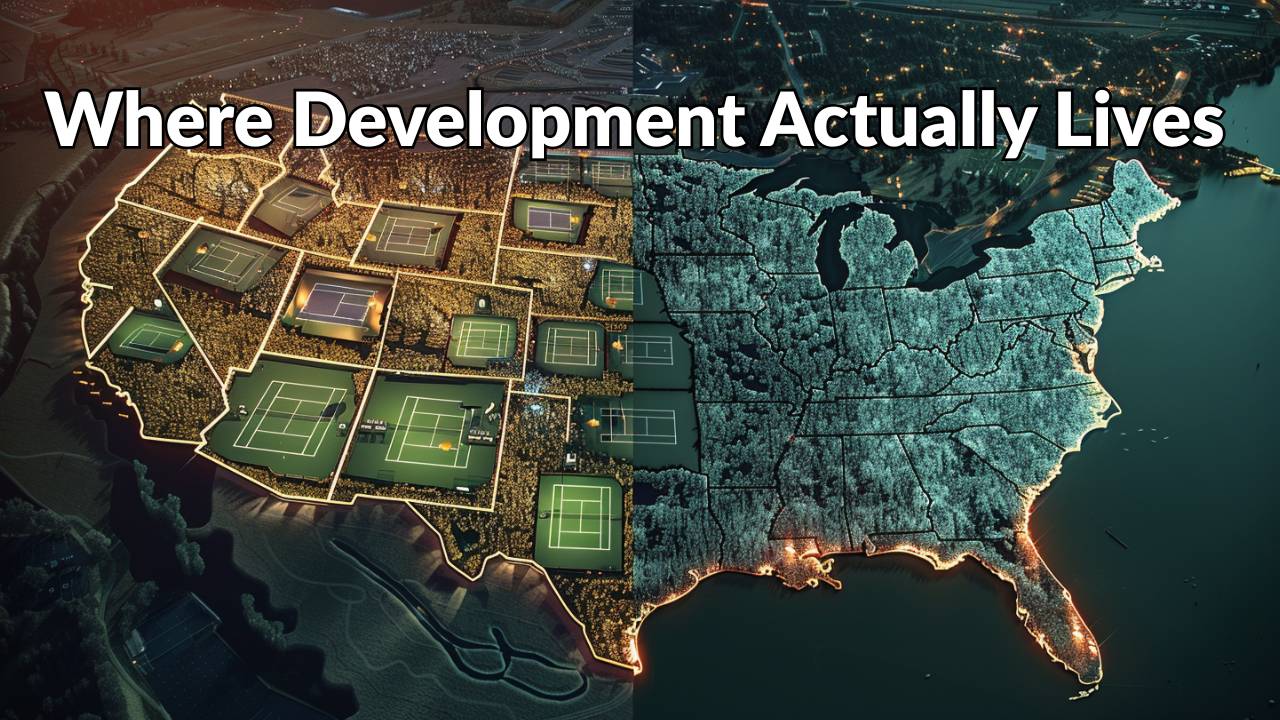
Series: We Should Have Been Building Nations Inside It
If development happens locally, then the question is not whether national systems can be improved. The question is what unit of organization is actually capable of doing the work.
The answer has been sitting in plain sight for a long time.
It is the state.
Not as a jurisdiction. As a development environment.
A state has proximity. It has the same competitive players, coaches, and families interacting repeatedly over time, inside shared junior circuits where patterns in a player's development become visible before they become permanent. It has enough scale to sustain serious competitive infrastructure and enough constraint to remain legible to the people operating inside it. Those qualities are not secondary to competitive player development. They are what it requires.
The United States is often described as a single tennis ecosystem. It is not. It is a collection of loosely connected environments that share ranking systems and tournament structures while operating independently in every way that actually shapes a player.
A player in Texas does not develop inside the same environment as a player in Massachusetts. The climate is different. The training density is different. The competitive calendar is different. The coaching culture is different. The parental expectations around what it means to be serious at twelve are different. Those differences are not noise. They are the environment. A system that flattens them into a single national model will operate at a level of abstraction that cannot fully account for any of them, and the result is uneven development that looks random from a distance and is completely predictable up close.
States already function as independent systems. They have their own training ecosystems, their own informal coaching networks, their own competitive rhythms, and their own pockets of excellence that rise and fall across generations. What they do not have is the formal structure to organize those elements deliberately. The coherence is latent. Nobody has built the container.
That is where the USTA stops and something entirely separate begins.
The USTA governs competition. It maintains rankings, standardizes tournament structures, and creates pathways that allow players to move through a defined national system. That work exists in its own lane. This is a different lane entirely. A private, independently funded system operating at state level is not reforming the USTA, not partnering with it, and not waiting for it. It is building the development infrastructure the USTA was never designed to build, with private capital, private accountability, and no structural dependency on national governance of any kind.
Development requires accountability to outcomes inside a defined population, not consistency across a dispersed one. It requires a methodology applied repeatedly across the same environment, refined over time by what actually happens rather than what is assumed. It requires decision-makers close enough to the consequences of their decisions that adjustment is instinctive, not bureaucratic.
A state-level system organized around those requirements is not a scaled-down version of the USTA. It is a different kind of entity doing work the USTA was never designed to attempt. Close enough to see individual players clearly. Stable enough to track them over years. Autonomous enough to hold a methodology without waiting for permission to enforce it. And structured in a way that allows understanding to accumulate inside the system itself rather than inside the individuals who happen to be running it at any given moment, because anything that lives only in people leaves when they do.
States already have the raw material. A competitive junior population large enough to sustain serious programming. Privately operated facilities already running, even if pointed in different directions. Enough established coaching infrastructure to build on rather than invent from scratch. Geographic boundaries that make sustained interaction among competitive players possible rather than theoretical. What they lack is not resources. It is a private organizational structure with the capital and the mandate to pull those elements into coherent, compounding development work at the level of resolution where players can actually be seen.
The assumption that competitive player development must be driven nationally has directed attention upward, toward policy and funding, when the actual leverage sits at ground level, inside the environments where competitive players are being formed. Recognition of that has been slow because the national conversation sets the terms everyone else operates inside. The people closest to the work rarely set the terms of the debate about the work.
The state is the level at which development can be seen clearly enough to be shaped deliberately. Large enough to matter. Small enough to understand. Close enough that the people inside the system are looking at each other, competing against each other, and learning from the same set of experiences over time. Alignment becomes possible there because it has a shared reference point. National alignment does not because it doesn't.
Once that is recognized, the next question becomes unavoidable.
If the state is the real federation in practice, what would it take to build one deliberately: privately funded, structurally independent, and designed from the start to hold what it learns?
Duane "Duey" Evans Founder, The Performance Architect
Never Miss a Moment
Join the mailing list to ensure you stay up to date on all things real.
I hate SPAM too. I'll never sell your information.
