The Three Conversations That Reveal Everything
Jan 07, 2026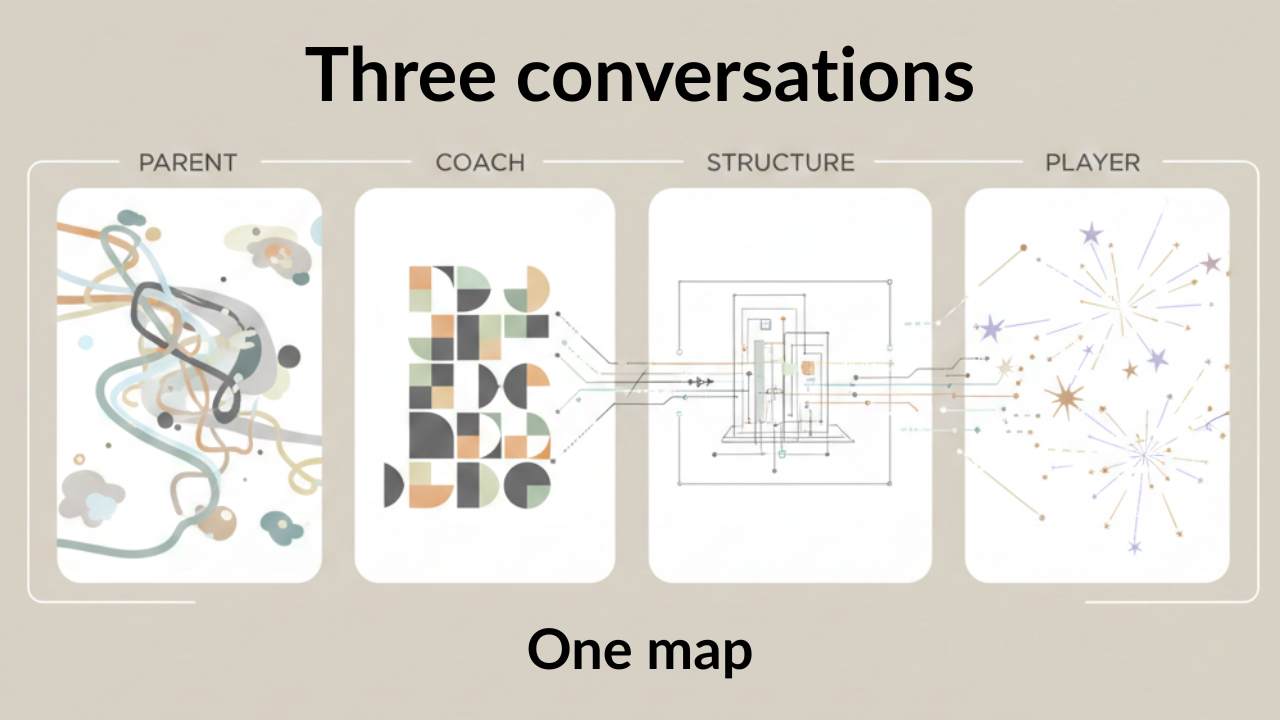
Most player development consultations happen around a table. Coach, player, parent sitting together. Everyone trying to be helpful. Everyone moderating what they say based on who's listening. Everyone performing their role instead of revealing what's actually happening.
That's why those consultations rarely produce breakthroughs. They produce agreements. Compromises. Everyone nodding while communication translation failures stay invisible.
This isn't a better version of that meeting. It's a different diagnostic instrument. The three-conversation framework removes the performance pressure. Separate conversations mean no one is defending their position, managing relationships, or protecting feelings in real time. What emerges is pattern recognition that group meetings can't access. The invisible becomes visible because nobody's managing social dynamics while they're talking.
Why Three Conversations, Not One Meeting
Group meetings create performance. Everyone knows this from experience but nobody admits it. The player won't criticize their coach while the coach is sitting there. The coach softens observations when the parent might take offense. The parent holds back concerns that might undermine the coach's confidence. Everyone's truth gets filtered through relationship protection.
This isn't dishonesty. It's normal human behavior under social pressure. But it makes diagnosis impossible.
Separate conversations remove that filter. The parent can voice anxiety without triggering defensiveness. The coach can describe what's actually frustrating without worrying the player will shut down. The player can admit confusion without looking weak in front of their coach. Nobody's managing multiple relationships simultaneously while trying to articulate complex observations.
What you learn in three separate 45-minute conversations exceeds what you'd learn in three hours of group discussion. Not because people are more honest when alone. Because they're more accurate when they're not performing.
The sequence matters. Parent first, then coach, then player. Each conversation builds context for the next.
The Parent Conversation—What Families Actually See
Most evaluations start with the coach because that feels professionally appropriate. I start with the parent because that's where pressure originates and investment decisions live.
Parents observe things coaches and players don't articulate. They see patterns over months and years that show up in ways players can't describe and coaches might not notice. They're also carrying anxiety that shapes how they communicate without realizing they're doing it.
They're also the ones making the investment decision. Understanding their perspective first isn't just diagnostic—it's acknowledging who's actually driving this process.
I ask parents what they're observing. Not what they think is wrong. What they actually see happening. The gap between those two questions reveals where their anxiety lives. "She seems frustrated after matches" is observation. "She's not mentally tough enough" is interpretation layered with anxiety. The observation is useful. The interpretation usually adds noise.
The parent conversation reveals investment context. How much they're spending. What they've already tried. Where they feel stuck. What they're hoping changes. This frames everything that follows. If they've spent two years trying mental toughness coaching without results, that's diagnostic data about what the problem isn't.
Most parents have no idea their well-meaning support is creating static. They're using language patterns that trigger anxiety in their kid's processing style without anyone recognizing the mismatch. The parent thinks they're being supportive. The player feels pressure. The communication gap stays invisible to both of them.
The parent conversation also reveals whether what they want matches what the player wants. Sometimes families are pursuing goals the player doesn't actually share. Or the player wants something the parents haven't recognized yet. That misalignment creates pressure that has nothing to do with coaching or competition.
Understanding parental anxiety and family goals first gives me context for everything I hear in the coach and player conversations. I know what the family system looks like before I examine the technical coaching or the player's experience under pressure.
The Coach Conversation—What Actually Gets Mapped
This isn't about judging coaching quality or credentials. It's observation of communication style under normal explanation conditions. How coaches naturally describe problems reveals more than what they're trying to say.
I ask coaches to walk me through their current work with the player. Explain what's going well. Describe what's not landing the way they expected. Tell me where they feel stuck. The content matters less than the structure of how they deliver it.
Now I have context from the parent conversation. I know what the family's concerned about. I can listen for whether the coach is aware of those concerns. Whether coach and parent are aligned on goals and timeline. Whether they're even talking about the same issues.
Pattern-focused coaches think in systems and relationships. "When she hits short cross-court, the angle opens up behind her opponent. The pattern we want is wrong-footing off the first ball so the court opens on ball two." They see tennis as tactical chess. Their instruction assumes the player sees patterns too.
Evidence-focused coaches think in concrete sequences. "Step into the court when the ball lands short. Move forward and right to cut off the angle. Hit behind her on the second ball." Same tactical situation. Different cognitive language. Their instruction assumes the player needs clear steps to follow.
Neither style is wrong. But mismatches between coach style and player processing create invisible barriers that look like everything except what they actually are. The evidence-focused player can't translate pattern language fast enough under pressure. The pattern-focused player gets frustrated by step-by-step instruction that feels mechanical.
The coach conversation also reveals where they feel stuck. Usually that sticking point is where the communication mismatch lives. "I keep explaining this concept but it's not clicking." That sentence tells me more than hours of technical analysis. The concept is probably sound. The translation isn't.
Sometimes the coach describes the player exactly the way the parent did. Sometimes they're seeing completely different things. Both patterns are diagnostic. Alignment means the issue is probably real and visible to multiple observers. Misalignment means something's getting lost in translation between what's happening and how different people are interpreting it.
The Player Conversation—Where Processing Style Becomes Visible
This conversation happens last because now I have context from both parent and coach. I know what the family's concerned about. I know what the coach is working on. I can listen for whether the player's experience matches what the adults are describing.
This isn't an interview. It's systematic observation of how players organize information under explanation pressure. I don't ask them to rate themselves or describe their game abstractly. I ask them to recount specific match situations. What happened. What they were thinking. What worked. What didn't.
How they describe those moments reveals their processing style. Some players talk in patterns. "I was recognizing she hits short when I go cross-court, so I was trying to anticipate the angle opening up." They're seeing relationships between shots and strategic sequences.
Other players talk in specifics. "I stepped in on a short ball and moved to my right but I didn't hit it hard enough behind her." They're processing concrete actions and physical execution. Same situation. Completely different cognitive organization.
This isn't personality typing. It's situational processing under competition stress. The pattern-focused player might use evidence-based processing in academic work. The evidence-focused player might recognize patterns in video games. What matters for tennis development is how their brain prioritizes information when time collapses and stakes rise.
The player conversation also reveals where clarity happens versus where confusion lives. "That makes sense to me" versus "I'm not sure what that means" tells me exactly where communication is working and where it's breaking down. Most players can't articulate why something creates confusion. But they know what creates confidence.
What creates panic isn't usually the pressure itself. It's receiving information your brain can't process efficiently while under pressure. That feels like choking. It looks like mental weakness. But it's actually communication translation failure compounded by stress.
By this point I can test whether the player's processing style matches the coach's communication style. Whether parent feedback language matches player processing style. Whether what the family's worried about matches what the player's actually experiencing. The player conversation becomes the synthesis point where all three perspectives converge.
The Synthesis—Where Invisible Becomes Visible
After three conversations, patterns emerge that were invisible to everyone inside them. Not opinions about who's right or wrong. Systematic identification of where communication breaks down specifically.
AI-enhanced pattern recognition cross-references specific dimensions across all three transcripts: language used to describe confusion, time orientation when discussing development, abstraction level under stress, consistency or drift across narratives. This isn't intuition. It's mechanical comparison revealing where translation is failing.
The synthesis maps three perspectives onto the same system and identifies exactly where communication breaks down. Where coach language doesn't match player processing style. Where parent language triggers anxiety instead of confidence. Where coach and parent aren't aligned on goals. Where player confusion stems from receiving information in a format their brain can't use under pressure.
This isn't averaging three opinions. It's identifying systematic mismatches with examples from the actual conversations showing where communication went off track. Not generally. Specifically.
This is what makes it diagnosis instead of consultation. Consultation adds another perspective to existing confusion. Diagnosis shows what's actually happening under the confusion. Makes invisible patterns visible. Removes guessing.
Concrete adaptation strategies emerge from that mapping. Not abstract principles about better communication. Specific language adjustments for coach, player, and parent that address the root translation failures identified in the conversations.
Any one of these conversations alone is insufficient. Any two create partial clarity. All three, sequenced and synthesized together, are the diagnostic unit. The system works because it's complete, not because any individual component is sophisticated.
For coaches: how to deliver the same instruction in the player's processing language. Not changing what you teach. Changing how you deliver it so the player's brain can actually use it under pressure.
For players: how to ask for information in the format they can process. Not blaming themselves for not understanding. Recognizing their brain works differently and knowing what language helps versus what language creates confusion.
For parents: how to provide support without creating noise. Not stopping support. Shifting the delivery so it reduces anxiety instead of triggering it.
The implementation timeline matters too. Some changes can happen immediately with minimal disruption. Some require weeks of adjustment to preserve existing relationships. Some might require larger decisions about coaching structure or training environment. Sequence matters. Some changes enable others.
What You Actually Receive
The assessment produces a detailed report. Not generic advice. Specific findings from your three conversations with concrete examples showing exactly where communication is breaking down.
Section one maps communication styles. Coach processing style. Player processing style. Parent processing style. Where alignment exists. Where mismatches exist. This isn't judgment. It's systematic identification of how each person naturally organizes and delivers information.
Section two identifies specific mismatches with examples from the conversations. Coach-player language incompatibility moments. Parent-player communication friction points. Coach-parent misalignment on player needs. Actual quotes showing where translation failed and why.
Section three provides adaptation strategies. For coach: specific language patterns that match player processing style. For player: how to request information in usable format. For parent: how to shift language to reduce anxiety. Concrete phrases. Not abstract principles.
Section four lays out implementation timeline. What changes immediately. What adjusts over four to six weeks. What might require larger structural decisions. Relationship-preserving sequence that makes changes sustainable instead of disruptive.
Section five establishes follow-up protocol. Thirty-day check-in to assess what's working. Adjustments based on implementation reality. Ongoing access for questions during the implementation window. The check-in isn't continued guidance. It's validation that the translation actually changed outcomes. This isn't one-time advice. It's architecture with accountability.
The Delivery Call—When Understanding Arrives
The delivery happens via Zoom. Sixty to ninety minutes walking through findings together. Not presenting conclusions. Showing what the data revealed. Making space for questions, clarifications, pushback.
This is the moment when pattern recognition clicks. "Oh. That's what's been happening." Not dramatic revelation. Quiet recognition that confusion finally makes sense. The blame stops because everyone sees the structural issue instead of assuming personal failure.
When done correctly, delivery creates relief rather than defensiveness. Nobody's wrong. Nobody failed. The system had invisible translation gaps that are now visible and fixable. Clear next steps emerge before the call ends. Implementation can start immediately for families ready to act.
Some families implement right away. Some need processing time. Both responses are legitimate. The clarity is there regardless of implementation speed. What changes is understanding. Once you see the pattern, you can't unsee it.
What Happens After Diagnosis
The first month reveals whether implementation is working. Not dramatic transformation. Systematic adjustment. Coach using adapted language. Player processing more efficiently under pressure. Parent reducing communication noise.
The measurable changes: confidence in practice starts translating to matches. Decision-making under pressure gets clearer. What stays hard: competition always creates stress. The difference is stress without confusion versus stress with confusion. Stress alone is manageable. Stress plus communication translation failure is what breaks players.
Thirty-day check-in catches what's working and what needs refinement. Some adaptations stick immediately. Some require adjustment. Implementation reality differs from theoretical planning.
The Difference Between Diagnosis and Opinion
Most consultations add another perspective to confusion. Someone else's theory about what's wrong. Another voice in a crowded field of competing explanations. Families collect opinions like diagnostic data but nobody's synthesizing the pattern.
This assessment removes confusion by showing what's actually happening. Three perspectives mapped onto the same system. Systematic identification of invisible mismatches. Not theory. Observation with framework that makes patterns visible.
The families who benefit most are the ones past hoping for magic solutions. Past blaming player effort or coach quality. Ready to see the structural issues everyone's been living inside without recognizing them. Ready for diagnosis that requires action rather than validation that permits continuing what isn't working.
If you're still hoping the next tournament will clarify things, this assessment will feel premature. If you're ready to understand what's been broken so you can fix it systematically, three conversations reveal what years of group meetings miss.
This isn't more coaching. It's infrastructure repair. And infrastructure repair is what makes everything else you're already investing in actually work.
If You Recognize Your Situation
Three conversations. Separate perspectives. Systematic synthesis. Two weeks from first conversation to report delivery. One month to implementation clarity. If your player showed early promise that's now stalled. If increased investment isn't producing proportional results. If you're spending $30K or more annually without clear understanding of what's actually broken.
I take eight to ten consultations per quarter. If you're past hoping and ready for recognition, if you can act on findings even when they require uncomfortable changes, if preventing another season of expensive confusion matters, schedule your three-perspective assessment now.
[Schedule Your Assessment]
If this work aligns with where your organization is heading, I’m open to serious conversations about partnership and collaboration.
Performance Architect | Founder, Communiplasticity Solutions
📧 [email protected]
📞 469.955.DUEY (3839)
🌐 theperformancearchitect.com
Never Miss a Moment
Join the mailing list to ensure you stay up to date on all things real.
I hate SPAM too. I'll never sell your information.
