The Unwatchable Gap: Tennis Data Must Move Beyond the Scoreboard
Dec 01, 2025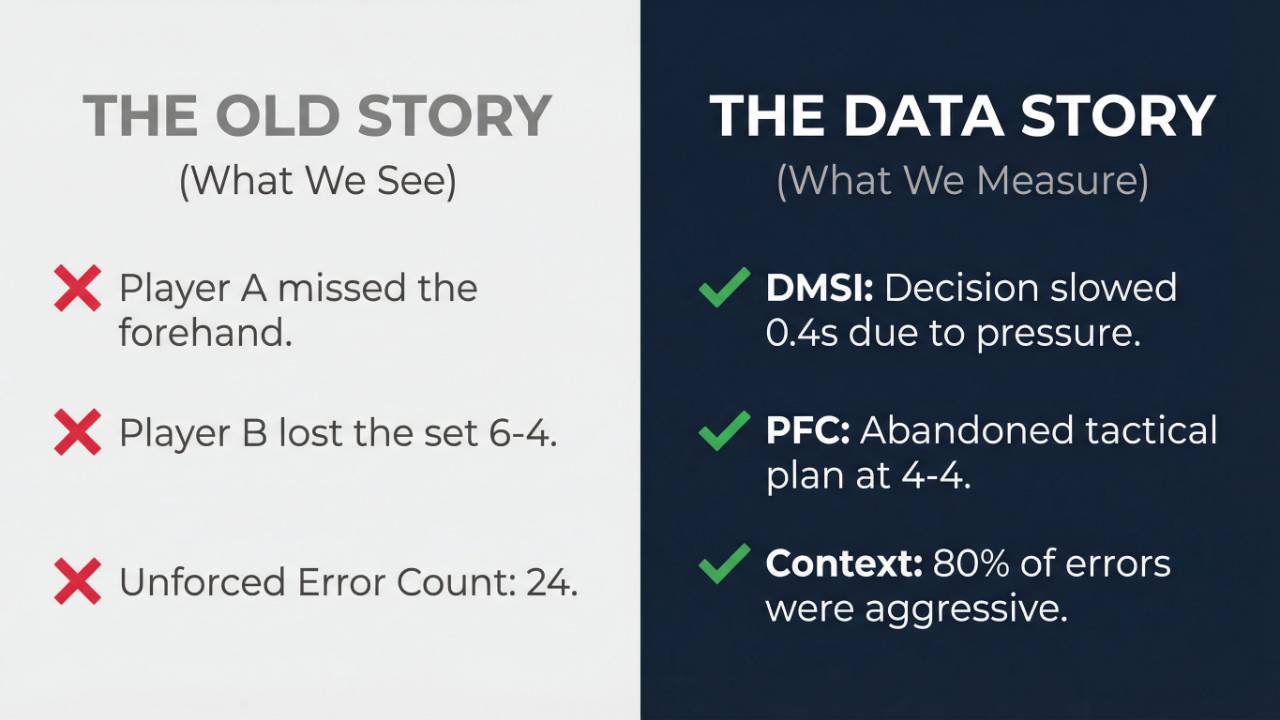
The Relatability Crisis
Tennis has a storytelling problem. At the highest level—Wimbledon finals, US Open night matches—the sport relies on the accumulated history of icons to generate drama. We watch Djokovic not just for his forehand, but for the decade of context behind it.
But strip away the icons. Go to a Futures event, a Challenger, or an elite junior L2. The tennis is physically spectacular. The ball striking is often indistinguishable from what you see on TV. Yet the casual observer feels nothing. The stands are empty. The livestreams have double-digit views.
The industry assumes this is a talent problem. They believe people don’t watch because the players "aren't good enough yet."
This is false. It is a narrative problem.
Golf figured this out years ago. A weekend golfer watches a pro hit a ball into the water and feels an immediate, visceral connection because they have felt that same failure. The shared experience creates empathy. Tennis, by contrast, alienates its audience with perfection. Watching a pro hit a flawless backhand is admirable, but it isn’t relatable.
What is relatable? Fear. Indecision. The struggle to stick to a plan when your heart rate is 170 and the crowd is silent.
The reason elite junior and entry-level pro tennis fails to capture attention is not because the forehands are weak. It’s because the broadcast tells us what happened (the score), but fails to tell us why (the struggle). We are watching a silent movie in an era of high-definition audio.
The Obsession with Purity
One of the first major innovations for television was moving from white to yellow balls. It was a brilliant, necessary change designed for visibility. The sport realized that if the audience couldn't see the projectile, they couldn't follow the game.
For fifty years since, tennis innovation has remained fixated on the ball. We have Hawk-Eye to track its path. We have radar to track its speed. We have spin rates and heat maps. We made the object perfectly visible, but we left the subject—the human being hitting the ball—in the dark.
Why did we build this architecture? Because tennis is a sport obsessed with purity of form. Purity cultures always ignore psychology because psychology feels messy. It is easier to measure top-spin than to measure hesitation. It is cleaner to critique biomechanics than to quantify fear.
So we treat the athlete’s mind as a black box. We count "Unforced Errors," a statistical dumpster fire that lumps a courageous, strategic miss on a break point into the same bucket as a lazy net ball on the first point of the game. This destroys the narrative context. It erases the difference between a failure of execution and a failure of intent.
My professional philosophy rests on the belief that "Tennis is a simple game played by complicated people." Yet our data only measures the simple game. It ignores the complicated people.
The Missing Metrics: Architecture for a New Narrative
To fix the narrative, we need new architecture. We need to map a cognitive structure onto a performance domain that is starving for it. We need to visualize the invisible battles occurring between the points using structured protocols and emerging technology.
Imagine a broadcast—or a player profile—that doesn’t just show serve percentage, but tracks Decision-Making Speed Index (DMSI). This metric measures the time between the ball crossing the net and the player committing to their stroke.
-
The Old Story: "Player A missed the forehand."
-
The Data Story: "Player A’s decision-making speed slowed by 0.4 seconds on that break point. The pressure caused hesitation. That is why they missed."
Suddenly, the error isn’t a mistake; it’s a psychological event. It’s relatable.
Consider Prioritized Focus Compliance (PFC). Before a match, a player commits to a tactical identity—say, attacking the opponent’s backhand 70% of the time.
-
The Old Story: "Player B lost the set 6-4."
-
The Data Story: "Player B abandoned their primary tactic at 4-4. Their compliance dropped to 20%. They didn't get beat; they panicked and abandoned the plan."
This is the difference between watching random movement and watching a human drama unfold. It turns a tennis match into a case study in discipline, courage, and execution.
Turning Development into Content
The current model of junior tennis funding is broken because it relies on "pay-for-play" or charity. There is no product value returned to the sponsor.
But if we change the metrics, we change the product.
Sponsors do not pay for forehands. Nike and Adidas don’t sell shoes based on top-spin rates. They sell identity. They sell narrative arcs and emotional proof. They want to align with the struggle and the overcoming of internal obstacles.
When we use technology to quantify things like Unforced Error Context (did they miss while being aggressive or passive?) or Reflective Consistency (do they understand why they lost?), we generate the exact content brands are desperate for. We provide proof of character.
A league or academy that adopts these metrics isn't just training players; it is producing a reality-based narrative engine. It allows a 16-year-old to say to a sponsor: "Invest in me, not because I won the L2, but because my data proves I am closing the gap between my training performance and my match performance 20% faster than my peers."
Conclusion
The wall between junior anonymity and professional stardom is built of silence. We haven't given the audience the tools to understand the brilliance of the developmental struggle.
We don't need faster courts or shorter sets to make tennis interesting. We need to open the black box. We need to measure the mind, visualize the pressure, and broadcast the truth of the complicated people playing this simple game.
The first academy or league that measures the mind instead of just the ball won't just develop better players. They'll own the narrative of what development means. The question isn't whether this will happen. It's who will do it first.
If this work aligns with where your organization is heading, I’m open to serious conversations about partnership and collaboration.
Performance Architect | Founder, Communiplasticity Solutions
📧 [email protected]
📞 469.955.DUEY (3839)
🌐 theperformancearchitect.com
Never Miss a Moment
Join the mailing list to ensure you stay up to date on all things real.
I hate SPAM too. I'll never sell your information.
