Three Daughters. Three Lessons. No Formula
Nov 03, 2026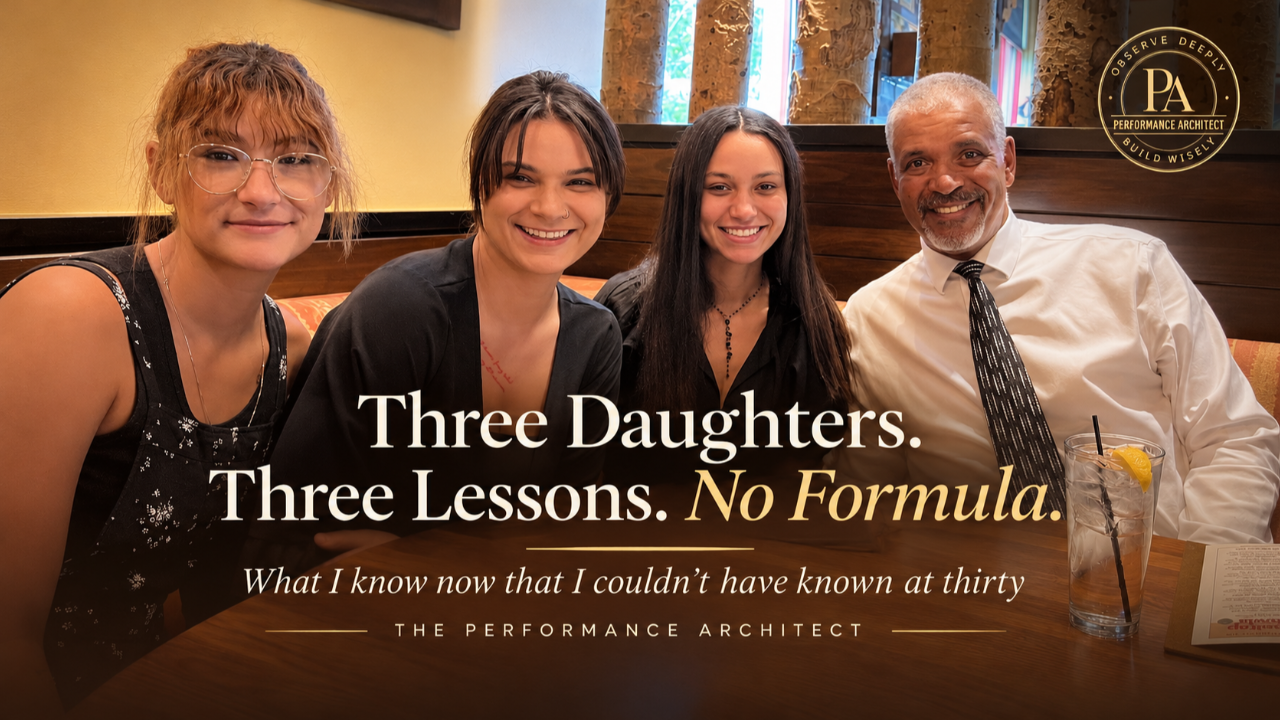
What I know now that I couldn't have known at thirty
When I was thirty, I believed I understood the development of a high-performance junior tennis player better than the parents who were raising one. I had my reasons. I did it for a living. I spent thousands of hours on court making decisions about training, competition and technique, then watching what those decisions produced. Parents mattered. They made the sacrifices, paid the bills and drove the miles. But the specialized knowledge, I thought, lived with the coach.
I didn't think parents had the easy job. I thought I knew something they didn't.
Then I had to do both jobs, and the harder one turned out to be the one I hadn't trained for. Coaching a high-performance player is difficult. Parenting one, as someone who also knows how to coach, was harder. It took three daughters to start showing me why, and what they showed me wasn't really about tennis.
## The Opportunity I Didn't Give
My oldest daughter played while I was living in North Carolina. She lived mostly with her mother in Georgia and spent weekends and other stretches with me, a lot of it around the tennis center.
At the time I was working with Thai Kwiatkowski and ReeRee Li, two players only a couple of years older than she was. They were being developed to become outstanding competitors. We trained with purpose, pushed the edges of what they could do and expected a great deal, and the work matched the expectations.
With my daughter, I chose differently. I wanted to be her father, and I didn't want our relationship to run through the demands of high-performance tennis. She was at the courts because that's where I worked. She took lessons, she played and she took part. I just didn't approach her development the way I approached Thai's or ReeRee's. In my mind, I was drawing a sensible line between my job as a coach and my job as a dad.
Shortly after we moved to Texas, she stopped playing. A couple of years later I asked her why.
"You didn't give me the chance to be as good as Thai and ReeRee."
I don't remember asking her what she meant. I wish I had.
Nearly twenty years later, what she remembers isn't a specific lesson or a particular missed opportunity. It's how the whole thing felt. She got lessons because she happened to be at the tennis center, not because anyone was making a serious investment in her becoming an exceptional competitor.
I thought I was protecting our relationship by holding back the expectations I placed on other players. To her, it looked like I hadn't offered her the same opportunity I was giving children who weren't my own. I had decided what was best for my daughter without understanding what she wanted from the experience, and by the time I found out, she'd already left the sport.
## The Correction
I carried that conversation with me. When my younger daughters started playing, I decided I wouldn't repeat the mistake. If they were going to play, they'd get the same coach everyone else got, with the standards, expectations, accountability and demands I believed serious development required. I knew how to do that job. I'd done it for years with other people's children, and I wasn't going to keep it from my own.
The logic seemed sound. I'd received information that challenged a decision, and I changed my behavior. That's what we tell coaches to do: observe, evaluate, adjust and see what happens.
What I missed was simple. I was applying a lesson learned from one daughter to a different daughter. I'd read my oldest's disappointment as evidence I'd been too reluctant to coach, so I became more willing to coach.
Then someone asked my middle daughter, Rhiannon, whether she could tell when I was being Dad and when I was being Coach.
"I absolutely understand. And I love Dad, and I hate Coach."
I don't know a more efficient way to deliver that message. Today Rhiannon coaches at Austin Tennis Academy, learning the craft alongside me. The daughter who hated Coach now answers to the title herself.
I had believed the tension between parent and coach could be managed, at least partly, by keeping the roles separate. When I coached, I coached. When I was Dad, I was Dad. Rhiannon had no trouble telling the two apart. Her trouble was with one of the people she found on the other side of the line.
So now I was holding two messages I couldn't reconcile. One daughter felt I hadn't given her enough of the coach I was capable of being. Rhiannon was telling me she didn't like that coach at all. Same father, same profession, same access to someone who knew how to develop high-performance players, and neither experience unfolded the way I'd intended.
## Knowing When to Hand It Over
By the time my youngest came along, I had a lot more experience as both coach and father. You'd think that would make the combination easier. It didn't. After a fairly short stretch of working with her, I turned her tennis development over to Lakes Tennis Academy in Frisco, Texas.
Think about that for a moment. I'd spent my professional life developing young players. Parents had trusted me with their children's ambitions, their time, their money and a good deal of their emotional investment. I'd worked with players who reached levels most juniors never get near. And for my own daughter, I decided someone else should be the coach.
I don't read that as a verdict on my coaching, and I don't read it as proof that parents shouldn't coach their children. Some parents have done both jobs very well. I came to see that being qualified for a job doesn't make you the right person for it in every circumstance, and being someone's father is a circumstance that changes things.
A coach makes decisions about training, competition and discipline inside a professional relationship. A parent makes decisions inside a much bigger one, a relationship that began before the child picked up a racket and will keep going long after the racket is put away. The two sets of responsibilities overlap, and sometimes they collide. Sometimes the very qualities that make someone an effective coach get in the way of being a parent.
Handing my youngest to another academy wasn't walking away from her development. It was recognizing that my part in it didn't have to include being the one who taught her the game. At thirty, I couldn't have imagined making that call.
## What Parenting Did and Didn't Teach Me
I hear coaches who are parents say becoming a parent made them better coaches. I understand the claim. Parenting hands you experiences no amount of professional training can copy. You watch your child struggle with something you can't fix. You make decisions whose consequences won't show up for years. You find out how hard it is to pull your own hopes apart from your child's.
But I push back on the idea that becoming a parent makes anyone a better coach. It gives you another experience to learn from. Whether you actually learn from it is a separate question, and even if you do, what you learned may not carry over to another child or another family.
I had three daughters. I didn't have three runs of the same experiment. They were different people with different needs, different personalities and different relationships with tennis. What one experienced as a missing opportunity, another experienced as an unwelcome demand.
I don't know whether I pushed too little with one and too much with another. I do know I treated what I learned from one daughter as the answer for the next.
Coaches make that same mistake with players who aren't their children. We find an approach that works, see a good outcome and grow confident in the method. Then we apply it to the next player without checking whether the circumstances actually match. Experience is supposed to make us more discerning, but it can just as easily make us more certain. Those aren't the same thing.
The methods that develop people best depend on watching one person closely and adjusting as that person changes. That kind of attention is hard to sustain, so we reach for formulas. A formula can be a reasonable place to start. The mistake is treating it as the answer after the child has started telling us otherwise.
## The Things We Don't Know Until Later
One advantage of spending this many years in junior tennis is getting to see what became of the kids. At thirty, I judged development through rankings, tournament results, technical gains and competitive progress. Those were the measures I had, and they mattered.
Now I have another view. I've watched players become adults and watched their priorities shift. I've talked with people who remember their junior years very differently from the way I remember them.
My oldest daughter's explanation for leaving the game is one of those memories. I can't rebuild twenty years of decisions or say what would have happened if I'd coached her differently. Her memory is a feeling that has lasted, and it deserves to be taken seriously. It still doesn't tell either of us what a different path would have produced.
That's the trouble with judging development. We see the path someone took, and we almost never see the one they might have taken. We also tend to be far more confident about our own contributions than the evidence supports.
A player becomes a champion. The coach takes pride in the player he developed, the parents in the opportunity they provided, the academy in another success story. Maybe all of them contributed something important. Maybe some of their decisions helped, others hurt, and the player succeeded partly because of qualities none of the adults fully understood. The outcome doesn't tell us everything about the process. Time shows us things we couldn't see before, but it doesn't always settle the question either.
## Who Gets Remembered?
I've been exploring the idea of a U.S. Junior Tennis Hall of Fame, one that would recognize exceptional junior players along with the coaches, organizations, educators and others who made extraordinary contributions to young people's development through the sport. The more I think about it, the harder that job looks.
Our sport is good at remembering results. We know who won the national championships, who earned the rankings and scholarships and who went on to succeed as a professional. We can name the coaches attached to those results.
Other contributions don't show up on a results page. How do you honor a parent who built an extraordinary opportunity without becoming the center of the child's experience? Or a coach who saw that a player needed something different from what he usually gave? An organization that developed hundreds of capable young people without ever producing a national champion has no trophy to point to. And how do you separate contributing to someone's success from simply being in the room when it happened?
I don't have complete answers. I do know the institution would have to separate two things that often travel together: producing an exceptional player and making an exceptional contribution to a young person's development. A coach can do both. So can a parent or an organization. But they aren't the same thing, and a hall of fame that can't tell them apart will end up honoring results and calling it development. Sometimes the most important contribution isn't recognized until years later. Sometimes it's the decision to step aside.
## What I Know Now
At thirty, I believed my professional experience gave me the better understanding of high-performance development. Today I understand more about coaching than I did then, and more about the limits of what coaching knowledge can tell me. Being a parent isn't the same as being a coach, and neither role automatically qualifies you to understand the other.
Looking back, I can see what connects all three. More than once, I decided how much coach a daughter would get before I understood how much coach she wanted. My expertise, my instincts as a father and the lessons I carried from one daughter to the next were answering a question that was partly the child's to answer.
The longer I do this work, the less comfortable I am assuming I know what another person's development ought to look like. At thirty, I had answers built from the players I'd coached and the results I'd helped produce. Today I have those same experiences, plus three daughters who gave me reasons to question what I thought they proved.
My oldest wanted an opportunity she didn't believe I'd given her. Rhiannon loved Dad and hated Coach. With my youngest, I finally decided Dad didn't need to be Coach at all.
Three daughters. Three different experiences. No formula.
I wish I'd understood that at thirty. I doubt I could have. It took three daughters, each telling me something different, before I understood that some of the questions I'd been answering belonged to them.
Never Miss a Moment
Join the mailing list to ensure you stay up to date on all things real.
I hate SPAM too. I'll never sell your information.
