Two States the System Has Never Distinguished
May 21, 2026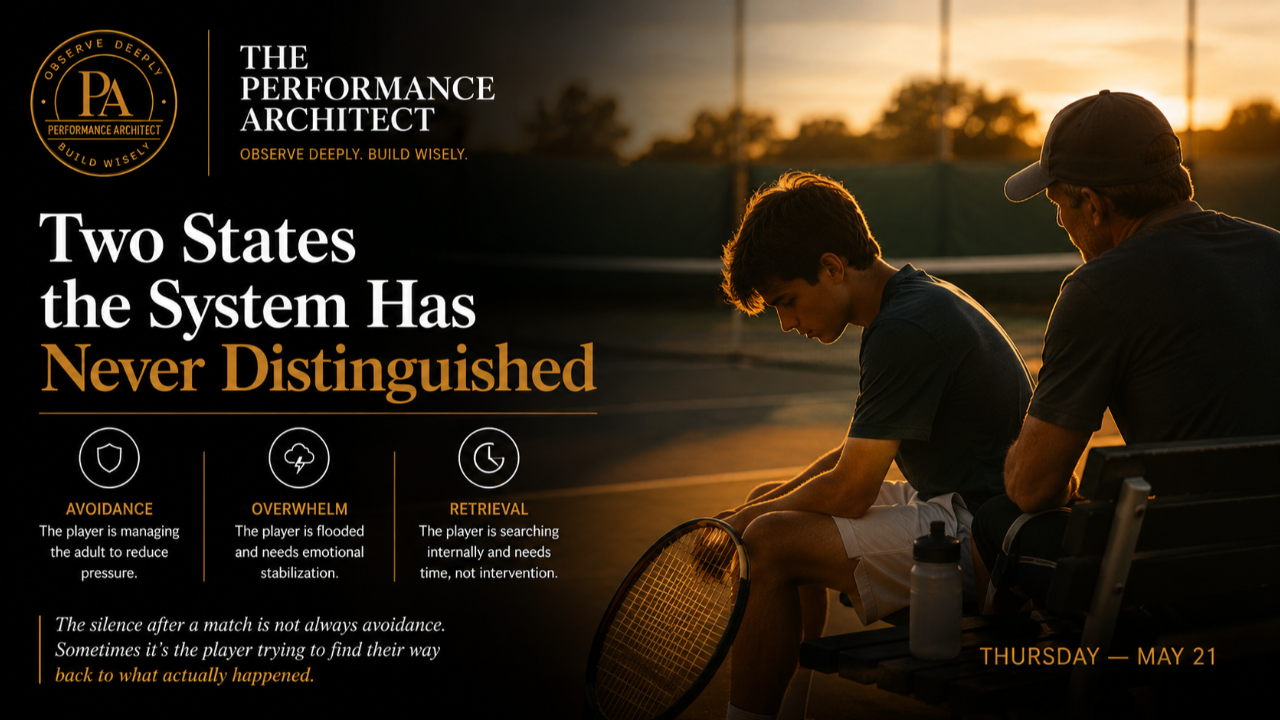
Thursday — May 21
Most experienced coaches have developed a working theory of the silence that follows a difficult match. The player goes quiet. Eye contact drops. The answer to any question becomes vague or minimal. The coach has seen this enough times to have formed an interpretation of it, and that interpretation tends to run in one of two directions: the player is avoiding accountability, or the player is emotionally overwhelmed and needs space. Both interpretations are sometimes correct. The problem is that neither accounts for a third state that looks externally identical to the other two and requires a completely different response from the adult standing in front of the player.
The third state is retrieval. The player is not refusing to think and is not too flooded to respond. They are attempting to locate themselves back inside the experience before they can describe it. The distinction matters practically because avoidance requires confrontation, overwhelm requires emotional stabilization, and retrieval requires something neither of those provides: time, without intervention, while the player attempts to reconstruct the internal sequence of the match from memory, physiology, and competitive pressure all at once.
The reason this state gets misread so consistently is that competitive environments do something to cognition that most coaches understand in theory but rarely account for in the moments immediately following competition. Inside a match, attention narrows, decision-making accelerates past the speed of language, and emotion filters experience before the verbal system can organize it. A player can feel the shape of what happened long before they can explain it. The body processes the competitive experience on a timeline that has nothing to do with how quickly the adult standing outside the fence would like the conversation to begin. By the time a match ends, the player has often experienced a sequence of events that has not yet finished resolving into anything they can describe, and the adult who watched the same match has frequently arrived at a coherent narrative before the player has had time to form one. That asymmetry is not a failure on the player's part. It is the predictable result of having experienced the match from inside it rather than from the outside.
What retrieval actually looks like in practice is a player in the minutes after competition who is still processing, who genuinely does not have language available yet for what happened, and who produces the answer most adults have come to dread: I don't know. That answer has been treated, almost universally, as the beginning of a problem. The coach rephrases the question. The parent supplies context. Someone starts helping. The conversation accelerates. The player, now receiving an external framework before their own account has stabilized, organizes their answer around what has been offered rather than around what they actually experienced. The question gets answered. The experience does not get examined.
Over time this produces a specific developmental distortion that is common enough in serious junior programs that most coaches have seen it without necessarily having a name for it. The player becomes increasingly capable of producing the right explanation in the right language at the right moment. They know the system's vocabulary. They can describe the tactical failure, name the mental error, account for the unforced mistake in terms the coach will recognize. What they cannot do is connect that vocabulary to what was actually happening in their own internal state during the match. The process that would have produced that connection, the reconstruction that begins in silence and requires time to complete, has been interrupted so consistently and so early that it never had the opportunity to develop. The practitioner who is evaluating that player is receiving compliance dressed as understanding, and the evidence the player is getting better at compliance is being read as evidence the player is getting better at the game.
The practical question for coaches and serious program builders is whether the distinction is detectable in real time, and the answer is that it is, but only if you know what you are looking for. Avoidance under pressure has a quality of management to it. The player is doing something with the silence, monitoring the adult's response, adjusting their answers toward whatever appears to reduce the pressure in the conversation. Retrieval has a different quality. The player is not managing the adult. They are genuinely elsewhere, trying to find something, and the external conversation is secondary to whatever internal process they are attempting to complete. A coach who has learned to recognize that second state learns also that the useful move is not to fill it. The useful move is to hold the space open long enough for the player to come back with something genuine, which is often not the first thing they say, and often arrives after a silence long enough to feel uncomfortable to the adult who is waiting.
The institutional dimension of this is worth naming for practitioners who sit at the program level. Systems that have never distinguished between these two states have built their post-competition protocols entirely around one of them. Structured debriefs, evaluation rubrics, standard question sets after matches all assume the player is available for verbal exchange immediately and that the coach's first responsibility is to move the conversation forward. Those tools are not wrong for what they are designed to do. They are incomplete in a way that has significant developmental consequences, because every time they are applied to a player in retrieval rather than avoidance, they interrupt the exact process that would eventually allow the player to generate their own interpretation rather than receive one. The result, at scale across a program, is a population of players who have been systematically trained out of internal reconstruction without anyone having made that choice deliberately.
The coaches who develop the capacity to hold that distinction tend to report that it changes what they are actually observing during post-match conversations, because once you know what retrieval looks like you start noticing how often you have been filling a space that was not actually empty.
Never Miss a Moment
Join the mailing list to ensure you stay up to date on all things real.
I hate SPAM too. I'll never sell your information.
